Year: 2015

  • i8tonite: Spring Arugula Pesto with Spaghetti and Crisped Prosciutto (adapted from Hugh Acheson’s “The Broad Fork”)

    i8tonite: Spring Arugula Pesto with Spaghetti and Crisped Prosciutto (adapted from Hugh Acheson’s “The Broad Fork”)


    I wish life were as easy as a recipe. Someone writes out the ingredients, measurements and methodology for creating the dish and I just follow it. I don’t think. My mind shuts off. I chop this, stir that and in the end, I have something delicious like a happy life.

    I’ve never been a follower and I don’t mean that in a complimentary way. There is something infinitely courageous about the common worker. The individual who knows that they want security, a home and safe place. None of which I knew about when I ventured out in the world. There is no recipe for living.

    That’s what I love about cooking. It makes me follow simple directions. I stop thinking and follow a direct path. I don’t drink like I used to when cooking. I found that I burned things. Besides, drinking and cooking, in my humble opinion, don’t really mix. At the table, when it’s all plated and everyone is seated, I feel that the libations are great for social lubricating; yet when cooking, I need my unbridled consciousness. I need to see the freshness. Taste the seasons. Hear the sizzling. Smell the aroma. Feel the food as it snaps. It is a sensuous experience. For me, cooking is in the moment, not on the periphery.

    It’s why I seek out simple dishes to recreate with few but quality ingredients located at my markets. For just an unfettered moment, I can take my favorite lettuce, arugula, and turn it into a lusty, verdant sauce. Its peppery essence is intoxicating when pureed with olive oil, biting garlic and salty Reggiano.  Dressed over room-temperature or leftover chilled pasta, a little more grated cheese and toasted pine nuts. It’s a perfect for meal for an outdoor supper when the heat of the day has been turned down and the fervent emotions ready to be shut off.

    I can chew my noodles with abandon, sip rosé and wish that life were as easy as a recipe (especially Acheson’s Arugula Pesto).

    Arugula Pesto, adapted from Hugh Acheson’s “The Broad Fork”. (June 2015 Cookbook)

    Spaghetti with Arugula, Pesto, Crisped Prosciutto and Parmigiano-Reggiano. Serve 4.

    Sea salt

    ¼ cup of pine nuts (or walnuts…I did say adapted)

    4 cups arugula (preferably from the farmers market or CSA. It has a lot more pepper in the bite. However if you can only get stuff in plastic…nothing wrong with it. It’s good to eat your vegetables from any source.)

    2 garlic cloves

    1 cup finely grated Parmigiano-Reggiano

    Couple turns of fresh cracked pepper

    3 ice cubes

    ¾ cup of olive oil

    1 teaspoon grated lemon zest

    1 pound spaghetti

    2 pieces of prosciutto (or salami. Acheson’s recipes calls for the salami. I didn’t have any and I wasn’t about to go out to market for the umpteenth time, so I used the ham. Shoot me.)

    1. In a large stockpot bring 4 quarts of water to a boil. Salt the water enough so you can taste it.
    2. Toast nuts in a skillet until lightly browned. Take two-thirds (eyeball it) for the pesto, the rest for garnishing. Place on the side for cooling.
    3. In a food processor or blender, combine the arugula, the two-thirds pine nuts, garlic, grated cheese, 1 teaspoon of salt, the pepper and the ice cubes. Puree on high for 30 seconds. Using the chute, with the motor running and the olive oil in a slow drizzle. Scrape everything down the sides until all the leaves are in the pesto, creating a smooth sauce. Stir in the lemon zest and put aside.
    4. Add the spaghetti to the boiling water, stir immediately and then cook to al dente. (If you made your own pasta…Good for you. Use that.) Drain into a colander and chill down with cold water. Turn into a large bowl. Drizzle with olive oil, salt and pepper. Stir. Add the pesto until coating all the pasta evenly.
    5. While the pasta cooks, add a little olive oil to a pan and crisp up the prosciutto, like bacon. Drain on a paper towel.
    6. Shave some of the cheese, chopped arugula, prosciutto and pine nuts to the top and serve-up family-style. (Or divide into 4 bowls.) (Lately, I’m really into family-style serving and letting people help themselves.)
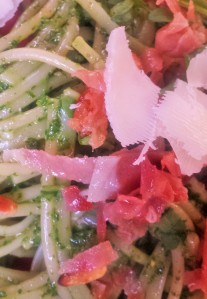

    Arugla Pesto

  • i8tonite: Braised Leeks in Cream and Tarragon (Kitchen Sense, Mitchell Davis)

    i8tonite: Braised Leeks in Cream and Tarragon (Kitchen Sense, Mitchell Davis)

    I know that as I write this that I’m not the only person who walks into a grocery store or farmers market and says, “I want to make something I’ve never made.” Recently, it was with leeks for me. I’ve cooked leeks but always as a supporting character in pot pies, vichyssoise, and fried for decoration. Thrown into stews. Chopped for soups. Roasted with meats. However, I’ve never used a leek as the main ingredient.

    In Mitchell Davis’ lovely and massive cookbook, Kitchen Sense, which we are currently cooking from for the month of May; he had a recipe for Braised Leeks in Cream and Tarragon…making the onion relative, the star of the dish. (It’s Memorial Day weekend and I’m talking about braising instead of grilling. I always did like to go against the stream. Heh.)

    Besides the leeks, the cream and the tarragon, the other major ingredients are butter and white wine. Very French. Before even making it, you can imagine the taste and subtle sweetness of the leeks with the cream’s richness. (I think a really good Loire Valley sauvignon blanc or a dry Belgian, non-fruit craft beer would be a good accompaniment; a light beverage with crispness and acidity.)

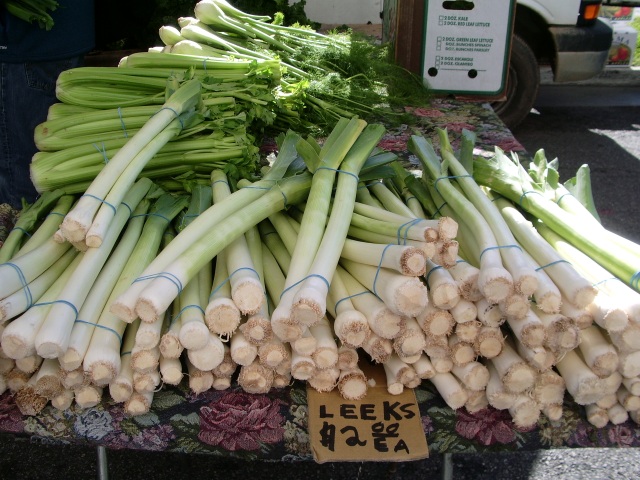
    Leeks at Santa Monica Farmer's Market

    The methodology for making this vegetable braise is very simple but it does take a lengthy time to cook. I would make this for a holiday gathering or a dinner party when I have another item roasting in the oven. The dish is also lovely to present at a table.

    Davis wants you to serve one leek per person. I feel it’s better at two leeks per person since this would be the only vegetable I’m serving; therefore, I’m doubling the recipe. If you are making the dish for two,  cut it back to four leeks. (I think you can figure that out.)

    Let’s Make This Puppy: Braised Leek with Cream & Tarragon

    6 tablespoons of unsalted butter, room temperature

    8 leeks, trimmed to white with about an inch of green

    1 cup of white wine

    ½ cup of cream

    4 sprigs of tarragon leaves; chopped

    1 bay leaf

    Salt and white pepper for seasoning.

    Preheat the oven to 350 degrees. Use some of the butter to grease a large baking dish (maybe something that goes from oven to table).

    Remove the tops of the leeks, leaving one inch of the green; thoroughly, rinse the leeks in water and then cut them in half, lengthwise. Dry them on kitchen towels. (I try not to use paper towels and conserve resources….but if you must use paper towels…do so, just remember that you can purchase really inexpensive kitchen towels at your Walmart, Target, or other large discount for pennies. You can wash them as often as you want and will last you longer than your roll of paper towels.)

    Place the leeks cut side down in the baking dish and pour the wine and cream over. The vegetables should be about three-fourths submerged. If not, just add a little more wine or cream. You choose. Add the bay leaf and scatter the tarragon. Season well with salt and pepper. Using the remaining butter, spot the top of the leeks. Cover tightly with aluminum foil baking for an hour and a quarter.

    The leeks should be tender. If you used an oven-to-table baking dish as I recommended, just remove the bay leaf and serve.

    It’s a pretty awesome dish but a little heavy with a little too much cooking time for a regular weekday meal but for a special occasion….it’s perfect!

    Braised Leeks

  • i8tonite: Chinese Roast Pork (Char Sui) (adapted from Kitchen Sense by Mitchell Davis)

    i8tonite: Chinese Roast Pork (Char Sui) (adapted from Kitchen Sense by Mitchell Davis)

    Char sui

    I inherited the love of Chinese food from my mother. One of my earliest memories was eating at a Cantonese American restaurant in Monrovia, a suburb of Los Angeles. This was 1970 and try as they might, decorating correctness hadn’t been seen in Chinese restaurants. The dining room was lacquered red, dotted with Chinese lanterns giving the space a “World of Susie Wong” crimson glow. Spread before the two of us was a hearty Asian spread in stainless steel standing bowls and piled into them were the deliciously fatty food stuff such as  roast pork egg foo young, spareribs in black bean sauce, roast pork fried rice, roast pork eggrolls and the omnipresent white rice.

    Yep, that roast pork was in everything.

    As an incredibly poor college student looking for cheap eats in Manhattan’s Chinatown I discovered “real” Chinese roast pork hanging in storefront windows. It was as if you paddled into Hong Kong but you only walked across Canal Street. The bustling was stronger, headier than other parts of the city and you could tell you entered Chinatown by the smell of hoisin, sesame, soy sauce and food dangling in windows.  Char sui drenches windows in rows upon rows, covering the glass like a maroon-colored curtain, although sometimes it’s paired elegantly with a whole tea smoked duck. Smoked duck. Roast pork. Smoked duck. Roast pork. When a customer ordered a strip, a kitchen worker’s hand pushes through, parting the meaty fabric and yanks a strip for a hungry customer. Quickly they slice it, in a rapid machine gun motion and shovel it into one of the Chinese paper containers.

    At the time, char siu was cheap, one dollar per order: I would get the roast pork, cold sesame noodles and white rice, just enough to get me through breakfast, lunch and dinner. I needed the carbs to keep me running through New York City streets. Walking from Union Square to Broadway so that I can get to Canal Street and back again. No twisting or turning….straight on through. But a long trek…a hike.

    Often it’s made with red tofu paste, red dye and MSG.  It doesn’t need it. Using a really cheap cut of lusciously marinated and richly decadent pork, this can easily be served for masses. Home roasting made my house smell of Chinatown in a good way; while eating it will reminded me of being in college, running the streets of Manhattan and discovering myself.  Who knew you could get that from a recipe?

     20150508_183311

    2 ½ pounds of boneless pork shoulder

    3 tablespoons of soy sauce

    1 ½ tablespoons Chinese oyster sauce

    1 ½ tablespoons hoisin sauce

    2 tablespoons of rice wine

    ¼ cup of brown sugar

    1 tablespoon Chinese five-spice powder

    ½ teaspoon kosher salt

    ¼ teaspoon of white pepper

    Depending on the size of your pork, cut them into 2 inches wide and approximately 1 inch thick. Place the strips into a baking dish that will hold the meat in an even layer. Combine all the ingredients in a bowl and mix well. Cover the pork with this mixture and marinate overnight.

    Heat your oven to 400 degrees and bring the pork to room temperature. Roast for about 30 to 40 minutes basting every 5 – 9 minutes. At this point, it’s done but if you want to achieve that Chinatown look apply some mascara…..kidding….to achieve that roasted, marooned charred edge, place under broiler for about 3 – 4 minutes. It will achieve that beautifully dripping-in-fat appeal…lacquered and deliciously edible. Heat up leftover marinade and serve with the pork.

    (Note: I served my roast pork as lettuce wraps with a variety of Asian condiments such as a peanut dipping sauce, alfalfa sprouts, pickled cucumbers and pickled ginger. It could have been served with rice.)

    kitchen

  • I8tonite: Food from “Kitchen Sense” by Mitchell Davis

    I8tonite: Food from “Kitchen Sense” by Mitchell Davis

    I stopped writing on “i8tonite”. It wasn’t going anywhere and truthfully, I wasn’t sure where I wanted to take it. It started because I love cooking. We know that. Truthfully, the sheer act of it (and craft) saved my life. I’m forever indebted to the stove, the fridge, farmer’s markets, and washing dishes. It will have been almost four years since I took on the name of “i8tonite” and the whole thing was a lark. Really. I just needed something to occupy my mind while I gave up a business, a partnership, a dog and the home that I had for more than decade.

    Writing out what I was cooking on social media gave me something to look forward to while I was crying about the state of my life as it became unhinged. Then came the requests for photos. Taking the images, a little food styling, along with the hazy images became an extension. My life, as a whole, began to come together again. Then, I started this blog which has had fits-and-starts. Partially, because I only wanted to cook and I wanted to show to prospective clients that I knew about the culinary world, from a sophisticated and well-traveled home cook.

    Candidly, I’m not really that interested in creating my own recipes. There are so many great chefs and home cooks out there that I just don’t feel that creative need. However, I do love reading cookbooks. I like understanding the ingredients and how they going to be appealing. I can taste the ingredients before beginning the process. It’s also important to note whether each recipe is laborious or fun. Puff pastry is laborious, making a cake or pie is fun.

    I’m also not interested in reviewing restaurants. If I did, I would want to pay for my own meals and try the experience several times over. That would be a costly endeavor and I don’t think many restaurants are worthy of going to 3 or 4 times in a year, much less in a single month. (I’ve been called by friends “extremely picky” in my restaurant choices.) No, I leave that to the food bloggers and newspapers.

    Therefore, I’m beginning this endeavor with a new verve with a fresher eye about food and cookbooks. My plan is over a calendar month to attempt at least 4 recipes from one single book. The idea is really to try cooking them. It’s not to review them so much as to just cook from them and then maybe add something with my own thoughts. I do own quite a few cookbooks and I’ve never used one recipe from about three dozen. I’ve read them…but never cooked from them. This will give me the impetus to execute something. Selfishly, I also want to expand my food repertoire and hopefully to whoever reads this blog…if anyone does.

    For the first book, I’ve chosen Mitchell Davis’ “Kitchen Sense: More Than 600 Recipes to Make You a Great Home Cook.” Davis is also the executive vice-president and director of communications for The James Beard Foundation along with being an adjunct professor of Food Studies at the venerable New York University. His pedigree about food is astounding. It’s not a new book as it was originally published in 2006 by Random House.

    It’s a vast collection around such culinary pantheons as Chinese, American, Italian and Greek and so on. Mr. Davis provides also great tips such as how to make a compound butter or “flavored butter” in a small area on various pages called “kitchen sense” or “basics”, small guidelines for executing simple home cooked gastronomic pleasures like roasted garlic or a compound butter. If you are a professional or have worked in a kitchen, you know some of these recommendations but if you haven’t, some of them are very handy to have.

    There also aren’t any photos so I have to think with my tastebuds in order to pick the recipes. I want all my senses to be used as each recipe is made. Can I smell that it might need more seasoning? How does it look? Should I have used the richer Dutch processed chocolate or no? These are the things that I hope to learn as well as a little bit about myself.

    20150505_201209

    Devil’s Food Cake with Caramel Cream Cheese Frosting (adapted from “Kitchen Sense” by Mitchell Davis, 2006, Clarkson Potter).

    Caramel Cream Cheese Frosting (NOTE: I had to double the recipe to cover the two layer cake. Although delicious and rich, the caramel flavor was very subtle. Next time, I make it I will double the caramel portion. Regardless, is was still delicious and I’m now running four miles every other day to remove it from my body.)

    ½ cup cold water

    1 ½ cups sugar

    1 cup heavy cream

    1 teaspoon kosher salt

    3 cups (24 ounces) cream cheese (room temperature)

    12 tablespoons unsalted butter (room temperature)

    Place water and sugar into a medium sauce pan. Using a medium high heat, melt sugar by stirring constantly. As the syrup develops, it will thicken into a sauce and begin to darken. This will take roughly 8 – 10 minutes. (You will notice of the water to begin to darken as the sugar stiffens.) Watch carefully as the sugar can become burnt quickly. Swirl until the color of caramel. Remove from heat.

    Slowly add the heavy cream and stir constantly. Replace saucepan on very low flame until all the cream has been incorporated. Add the salt.  Keep stirring with a spoon or wooden spatula (do not use a whisk) until a beautiful, rich caramel sauce has developed. (You can always use this for ice cream or pour over cakes.)

    In another bowl, mix the butter and cream cheese until frothy. Making sure you scrape the sides of the bowl, slowly add the caramel sauce until completely merged and, viola, you have made your frosting.

    You can chill but bring to room temperature before frosting the cake. It will make spreading so much easier. It’s still delicious even though it’s a subtle caramel flavor. I think I wanted it to be overpowering like a caramel latte from Starbucks but it’s more like a European subtle instead of an American-beat-me-until-I’m-black-and-blue.

     20150505_201332

    Devil’s Food Cake

    Honestly, this maybe the best chocolate cake I’ve ever made.  It was densely, moist with a very light crumb and an intense lovely chocolate flavor. (Will make two 9-inch layer cakes).

    Unsalted butter for greasing the pan

    Parchment paper

    1 ¾ cups unbleached all-purpose flour

    ¾ cup unsweetened cocoa powder (Use the good stuff. I like Dutch-processed as it creates a darker, fudgier cake)

    2 teaspoons baking soda

    1 teaspoon baking powder

    ¼ teaspoon kosher salt

    1 cup sugar

    1 cup light brown sugar, packed

    1 cup buttermilk

    1 cup strong coffee

    ½ cup vegetable oil

    2 large eggs

    2 teaspoons pure vanilla extract

    Heat the oven to 350 degrees. (We do this first so the oven pre-heats while we gather our wits.) Butter the pans and then line with parchment. Butter the parchment. (We do this so we keep our gathered wits about us instead of the cakes sticking to the pans. Trust me on this step….it’s a life-saver.) Once we remove the cakes from the pans, they aren’t that pretty… yet. We will do a little trimming of rough edges using a LOT of frosting to cover up the wrinkles left by the parchment indentations.

    In a large mixing bowl, we will sift all the dry ingredients together (flour, cocoa powder, baking soda, baking powder, both sugars and salt).

    In another bowl, mix all the wet ingredients together (coffee, buttermilk, oil, eggs, and vanilla). Mix with a whisk.

    Using a wooden spoon or an electric mixer on low, merge the wet with the dry.

    Pour into your buttered cake pans. Bake for 25 – 30 minutes. Remove from oven once a toothpick comes out cleanly.

    Take cakes out and cool on a wire rack. Frost. J

  • Dining Out: Pastrami, LA Style

    Dining Out: Pastrami, LA Style

    Image result for fork knife

    It’s been awhile. So much for creating a fan base for this blog. So, let’s look at this as an exercise in writing…for enjoyment’s sake. I need to generate the blog without any expectation, on my part, because clearly I can’t even keep to my own desired timetable.

    February was a very busy month with new clients, tastes and dining out opportunities. Admittedly, for a long time, going out wasn’t my favorite thing. Noisy. Congested. Expensive. Hipster women hitting the back of my head with their over-sized purses as I sit in a crowded bar is not my idea of fun. This last month, however, I did experience several great Los Angeles meals which I feel compelled to discuss beyond my circle of cohorts. It’s because of these personal experiences, I’m feeling more optimistic about dining out and spending my hard-earned cash.

    I’m not a reviewer. I’m a publicist. Granted a publicist who eats a lot and has traveled a fair amount. My resume is long in the luxury category especially for being a gay person of color who’s eaten at many Michelin-starred restaurants and placed my head on many five-starred hotel pillows. I do have a certain experience level.

    One of my food clients is Carvery Kitchen, based in Santa Monica. It’s this exceptional deli, with homespun Russian/ Uzbekistan recipes such as brisket and pastrami, “roasted and toasted” by Chef Roman Shishalovsky. It’s from this delicious vantage point that I decided to embark on a taste test of LA’s best pastrami sandwiches as decided upon by dining reviewers and Yelpers. (The latter being a term that embodies a controversial, over-generalized set of the eating out public.) It would be a taste excursion between Carvery Kitchen (the newcomer); Langer’s, the historic, award-winning stalwart of LA’s Jewish delis and Wexler’s Deli, chef-driven (Micah Wexler) and loved by most restaurant critics. Each one was different but two were stand-outs.

    Image result for Langers Pastrami

     Langer’s is a James Beard award-winner, the culinary world’s Oscar equivalent, and is considered to be a destination eating experience; one of the “must-dos” in a city that most culinary aficionados’ write off as not having great dining. Essentially, Angelenos don’t do carbs but we will if it’s written in history books.

    Image result for Langers French Dip Pastrami

     It was a packed dining room when Nick and I went to eat. We were told that the wait would be 20 minutes for a table so we opted for a pair of empty counter seats. It felt more like an East Coast deli than sitting at a booth. We ordered up the French Dip with au jus at $15.55.  Once it came, on the diner’s oval plate, we needed to wait for the au jus. The meat was blubbery and tepid with shards of fat dangling over the bun’s edge. The dipping sauce was salty and seemed to come from a jar. It was black, too dark for it to come from a roasting pan. Not my favorite but I’m glad I went. I will never criticize people who need to eat there as it’s a place of dining history.

    After sharing half of the Langer’s sandwich, we went to Wexler’s Deli at Grand Central Market. Wexler’s is that new kid, not too far from Langer’s, just a short LA drive. It’s located in another palace of eating history, LA’s Grand Central Market, recently crowned by Bon Appetit as a Top Ten “restaurant,” which it isn’t. It’s a compilation of food stalls, once occupied by a variety of vendors, mostly Latino, selling fruits, vegetables, tacos, burritos and menudo. Now, it’s becoming a food mecca with upmarket experiences such as organic butchers, noted chefs and cheese-mongers serving up designer treats to lessees of downtown LA lofts.

    Wexlers

    Wexler’s is counter only unless you grab one of the community tables situated “anywhere” in the market. Subway tiles and ‘50s wooden stools surround the small crescent shape “deli”…it’s actually more of a kiosk.  The idea behind Wexler’s is to recreate that famed experience of the Jewish American deli. Unfortunately, you can’t unless you do a little bit of revisionist history which is what Micah Wexler has gloriously accomplished at his tiny eatery. His cold pastrami, which is the only thing we had, was hand-sliced and lavishly swollen between two pieces of rye bread with coleslaw . It was better than I think history has envisioned. Fresh and smoked, with that little bit of peppery textured bite. Housemade pickles with that beautiful crispness and snap.  Definitely worth the effort of parking and eating. (I will admit I’ve always been a fan of Grand Central Market before the re-gentrification. I loved the Latin families bringing their kids and watching them pick out vegetables and fruit together. You don’t see that anymore.just Caucasian college-aged kids not appreciating what used to be there… only what is.)

    134

    Lastly, there is the Santa Monica Carvery Kitchen which opened last year and is the savory, roasted and toasted brainchild of Chef Roman Shishalovsky. His pastrami which is roasted for 24 hours is simply divine. A succulent, masterful meat-lovers dream, saturated in richness but without the oily blubber. One bite and the hand-carved meat starts to dissolve on the tongue. The bread, made off-site just like Wexler’s, is a family recipe like the pastrami. Born in Eastern Europe and a transplant to Southern California, Shishalovsky uses his own family’s Russian/ Uzbekistan techniques in making his meat which is served as a salad, a plate or a sandwich in your choice of a wrap, Panini or as a “French dip” freshly made off the just roasted meat. It’s worth the trip to eat. Carvery Kitchen is one of those low-key, dining experiences that once it’s had, you will start to crave it.

    Image result for Carvery Kitchen

    As much as I Iove old-school experiences, sometimes it’s great to move on. Nothing can change history. It’s set in stone but others can become as much a part of it, and even recreate it such as Wexler’s and Carvery Kitchen. Funny, though, how pastrami, so much a part of New York’s Lower Eastside has now become of the greatest ways to make brisket and can rival even Texas BBQ. That’s America.


  • Mâche, Lamb’s Lettuce or Corn Salad: It’s Delicious Whatever You Call It

    Lamb's Lettuce

    Have you ever eaten something that was so divinely simple and loved it? No cooking, no baking?  I mean almost completely unadorned that you thought your tastebuds were flawed because it was just two ingredients? Essentially, that’s how I discovered mâche (corn salad, lamb’s lettuce) while in Provence. (I know. How much more pretentious can I possibly get? I did eat my Southern grandmother’s biscuits with Scrapple too in South Carolina….but that’s another story.)

    We were staying at this particular luxury hotel over the holidays and dining on the New Year’s Eve menu. The property, as well as the menu, was brimming with all the French finery that one finds while eating in a Michelin-starred, French- country side restaurant. We were drinking champagne out of a Nebuchadnezzar, eating foie gras on toast, as well as a beautiful yet delicate leaf served with pickled beets.  I’ve eaten richly fat foie gras on toast, hard-boiled eggs topped with Russian caviar and steak tartare prepared tableside but this tiny and delicate lettuce, with some roots still left on, in that moment, captivated my tongue.   While the compact waiter hefted up the Nebuchadnezzar to refill my flute, which was roughly the size of him, I asked what the delicate green was and he replied in French, “Mâche, monsieur.”

    Image result for mache french lettuce

    Since then, I have eaten the nutty-tasting, tender mâche every chance I get during the late winter. It’s a hearty plant, albeit delicate to the taste, and stands up well to frost. It’s hard to believe it was thought to be a weed. Mache is a native lettuce to France, where it has been cultivated since the 17th century under the name, “doucette”. Shockingly, there are now over 200 different mâche varieties, with each noted for its character and climate agreeability.

    Mâche was presented to the United States by Todd Koons, farmer and agricultural innovator (he created the supermarket staple of bagged mixed greens). Mache became slightly popular amongst the culinary set during the late 20th century.

    Image result for mache french lettuce

    I won’t say that cooking mâche is unacceptable. I’ve just never had it cooked but it’s nature and tenderness to the palette makes me feel it wouldn’t be stellar. I would mix it with other cooked ingredients though such as beets, or small potatoes, perhaps, a form of citrus and apples. For me, the best way to eat mâche is raw, washed well, and drizzled with walnut or olive oil and a touch of salt; add a little well-aged shaved mimolette to the mix and a roasted fish or poultry. That is a meal.

  • A New Cookbook Icon: “Twelve Recipes” by Cal Peternell

    As I was reading “Twelve Recipes” by Cal Peternell, chef at Alice Waters’ famed Chez Panisse, lacking a father figure became an even more perceptible limp in my upbringing. Here was a father who was packing up kitchen gear for his son before he went away to college, useful items such as a knife, cutting board, measuring cups and spoon. When my father left me at the age of 7, he took the child-sized, baby blue golf clubs with him. I wished I had a father who took such care in my welfare but who also wanted me to cook as exceptionally as he did, using recipes he created or knew like the back of his hand, passing them down to his progeny.

    The premise of the book was to give his son the tools to create great dinners for himself and for his friends. However, as a finished product he created a well-written story on how to take care of yourself in the great big world.

    Cal Peternell: Photo by Ed Anderson

    That’s what cooking is for me, it’s the ultimate in self-care. It’s like going to the gym, getting your car washed, and seeing the dentist bi-annually. It’s a time-honored rite of passage and I really felt the love of Peternell for his children in his writing.

    Most of the recipes are fairly basic such as his recipes for “salsa verde” using olive oil, parsley, salt and garlic. Then making that into a traditional gremolata (exempting the oil) with anecdotes about how his family dry herbs: “Some kids have to wash the car; my kids have to wash the parsley, and here’s how: fill a big bowl with cold water and dip the whole bunch of parsley in, swishing it around like you mean it. Lift it, give it a preliminary shake, and then drip as little as possible on the floor as you walk quickly outside. Swing the bunch by the stems, flick it like a whip, spritz the sidewalk, the yard, the dog, the world. Bunches of basil, cilantro, or mint can be taken on the same ride. Set the bunch on a towel to dry for 5 minutes — herbs chop up nicer and fluffier and don’t clump when they are not wet.” Who doesn’t want a father who wants to spritz the sidewalk?

    But it was his cake recipes that really sold me.I’ve now made two of them, Cake-Cake and the Pan Cake. The Pan Cake is so easy it’s like why would you ever think of a mix? It’s not too sweet and best part, you can use one pan! Seriously, no bowl, everything is mixed in the cake pan you are going to bake in.  With a good dollop of crème fraiche, homemade whipped cream or ice cream (if you have the ice cream contraption), it’s so simple to make for a daily treat or to impress dinner guests at the end of a meal.  This recipe should be as standard as boiling water, scrambling eggs and buttering toast.

    Ingredients (adapted from Cal Peternell’s “Twelve Recipes”):

    1 ½ cups all-purpose flour

    1 cup sugar

    1/3 cup unsweetened cocoa (the recipe says 1/8 but I wanted it a little more bittersweet).

    ½ teaspoon salt

    1 teaspoon baking soda

    1 teaspoon finely ground coffee (optional…I also use 3 for more of a coffee/ cocoa taste)

    1 teaspoon vanilla extract

    1 tablespoon red or white vinegar

    1 cup water

    1/3 cup vegetable oil

    Let’s make this puppy:

    Preheat the oven to 350 degrees. Put the all the dry ingredients in an ungreased 8 – 9 inch round cake pan and stir with a whisk. Make a crater in the center, adding all wet ingredients together. Whisk until all the dry goods are fully incorporated. Put in the oven for about 30 minutes but check for doneness at around 20. Insert a toothpick into the center to make sure it’s fully cooked.

  • Penny’s Broiled Swordfish and Cilantro Pesto

    I was a very naïve eater before I moved to New York. (Actually, I was just naïve but that’s a different matter…and I still can be.) As I’ve said before, my mother with whom I spent most of my upbringing, just wasn’t a cook. From her, it was “here’s the Kraft Macaroni” or being handed the can-opener to expose aluminum-clad franks and beans.

    When I moved to New York City, I had the great opportunity of waiting tables and a whole new world opened up to me. It wasn’t just about food, it was about living. I wasn’t more than 21 years old, finished school and was working at a Cajun/Creole restaurant in Tribeca called How’s Bayou, (meaning “how are you”from New Orleans creole). It was an open air restaurant with sliding French doors on its two sides which allowed cool Hudson River air in the summer.

    This is the corner of Harrison & Greenwich even before Hows Bayou.

    Then, I remember thinking the blackened catfish and Cajun fried chicken, served with collard greens flecked with bacon, mashed potatoes with skins left on, a flaky buttermilk biscuit and honeyed sweet potato were the best things. And to drink, which we drank while working, we served up strong, frozen margaritas or Hurricanes topped with 151 proof rum. It was one helluva a place to work and I loved it.

    I met some a few of the most important people in my life during this time such as Penny. Penny is a loveable art historian on paper, a self-taught gourmand and to me, a national treasure. We worked together during the day shifts and sometimes, nights. She was a career waitress (when the term didn’t imply anything) and hated the food at Hows Bayou.  Hated it. She often complained that what we served was almost inedible by boasting about her annual European as proof she knew what was good. Not only did I envy her for her worldliness, but besides the cooks where I worked and my father’s family cuisine (Filipino), she was and is my greatest cooking inspiration.

    I always told Penny that she resembled the silent screen movie-star Louise Brooks with her jet black, bobbed hair and bangs. She loves to talk about food as much as she loves to cook it. When Penny finds a food delicious or she crinkles her nose and face up, exclaiming, “This is so yummy!”

    Louise Brooks

    Funny thing, even though was in her early forties, she never been to a gay bar so she proposed that she cook dinner one evening and we could go to a happy hour. Her and Tim, her husband, lived in the West Village, close to The Monster, one of New York City’s landmark watering holes, on the corner of Sheridan Square and Christopher Street. It not only had a piano …and a player…but a disco in the basement. (Talk about an identity crisis: In one corner, queens were croaking out Broadway show tunes; in another, some were slinging back gin and tonics at 2-4-1s and downstairs, vogue contests were performed.) We shouted at each other above the antics and got drunk. The two for ones really should be called 12 for 6 because that’s what we wound up drinking…each. We started at 4 o’clock and left at around 8. With four hours of drinking, Penny still had to make dinner.

    With our liquor soaked steps, we walked the two blocks to her apartment at Bleecker and Grove. Once inside her pillbox-sized studio, lined with history books instead of wallpaper, I opened the first bottle of wine. She put the swordfish steaks in the oven rubbed with olive oil, salt and pepper. We chatted.  Tim at the time wasn’t home from teaching at Queen’s College and he was to join us so we chatted and drank so more while waiting.  She made the cilantro pesto. We continued chatting and drank some more. I opened the second bottle of wine. We starting slurrying our chat.  Tim came home. Introductions were made and by this point, it was just slurring. Huge lovers of opera, we listened to a recording of La Traviata, featuring soprano Angela Gheorghiu as Violetta so that we could listen over the third bottle of vino.

    “Oh my God!” Penny exclaimed in an anguished fury. “The swordfish!!!” The wine-soaked chatting had gotten the better of us. Our dinner was ruined.

    But as luck and Penny’s cooking prowess will attest, it was not. On floral plates with lacy golden edges, beautiful browned slabs of Broiled Swordfish, smeared with Cilantro Pesto was served and a friendship was born.

    Broiled Swordfish with Cilantro Pesto:

    Ingredients:

    • 1 – 2 pounds Swordfish Steaks cut into servings of 2 to 4
    • 2 bunches cilantro
    • Jalapeno: chopped and seeded
    • Olive Oil
    • Juice of 1 limes.
    • Cotija cheese or manchego
    • Almonds

    Let’s make this puppy:

    1. Line broiler pan with foil.
    2. Arrange boiler pan about 6 inches from flame. Turn on high.
    3. Salt and pepper swordfish steaks on each side
    4. Broil one side for 5 minutes. Flip. Repeat.
    5. Remove from heat and smear cilantro pesto on fish. Serve with wedges of lime.

    To Make Pesto:

    1. Place cilantro leaves, jalapeno and lime juice into food processor. Pulse into a paste.
    2. Add cheese in small bits for flavor and coloring, such as 3 ounces (or more depending on taste.)
    3. Drizzle, through the feed tube, olive oil until emulsified or slightly creamy.
    4. Add a handful of almonds or walnuts until chopped.
    5. Smear onto any fish.

  • My Favorite Tortilla Chip (With or Without the Salsa)

    My Favorite Tortilla Chip (With or Without the Salsa)

    Recently, I was at LA’s Farmers Market at The Grove buying some vegetables from Farm Fresh Produce. It’s one of the vegetable stands that’s been in the market for more than 50 years. It’s my go-to veggie hook-up when I missed my normal Sunday farmers market or need something additional throughout the week. (It’s either there or Farm Boy Produce which is right across the hall.)

    On this particular day, I was in that wandering state. Not knowing what I wanted as I already had everything in my bag which I needed. It’s never good in any market; before I know I will have purchased four dozen cookies for $5, a new sports jacket for $500 or something equally not important and damaging to either wallet or waistline.

    Farm Fresh isn’t that a large place. The fruits, extending from citrus to rambutans (the spiny, prehistoric-looking tropical fruit), are outside still ripening in the California sunshine. The inside displays consist of seasonal vegetables, lettuces and a variety of salsas. So if you want to get into trouble spending money needlessly, it’s really hard.

    At the LA Farmer's Market

    But there they were, calling my name gently perched on a corner-shelf in sightline,…above the the kale that then I saw the chips. Bagged in plastic were this gorgeously crisped, heavily tanned tortilla chips that I looked amazing. I asked Armando Puente, owner of Farm Fresh, about the chips and asked for his opinion. He replied nodding his head, “Muy delicioso.” He said that they were made fresh daily with fresh oil and salt. That was it. With a big yellow logo crying “Nuños” and priced at $1.99, it went into the mesh shopping bag.  Along with Puente’s freshly made pico de gallo, made in the back of the store, it was a much cheaper purchase then Gucci shoes but perhaps not to my waistline, I thought.

    My Favorite Tortilla Chip (With or Without the Salsa)

    Once I got home, I opened the bag and took out a thick, honey colored triangle. It was a quarter of a homemade tortilla which meant after making their own brand of tortillas, the makers of said chip used the excess to make this snack. And one salty, crunchy bite…..I decided that this would be a blog item to espouse my new finding, calling them the “best tortilla chips” I’ve ever eaten…truly.

    Because of the thickness, the chips are extra crunchy with a light, smattering of salt. Not a lot of oil. That is it. Simple. Clean and oh so good.

    It used to be that I would seek out the cult of “Have a Corn Chip” which used to be sold in Trader Joe’s and larger grocery stores. The chip, made in The Laguna Beach, California, has a nationwide following which was vindicated in a local alternative paper. These chips have a distinctive flavor as they have cooked with hint of lime and soy sauce. Delicious but not traditional.

    My Favorite Tortilla Chip (With or Without the Salsa)

    And as I’ve written this lengthy blog item, championing these particular tortilla chips (not to be confused with corn chips such as Fritos or Doritos), I discovered that tortilla and corn chips were only recently created. Tortilla chips were made by a lone woman in the late 1940s. She wanted to lessen tortilla “waste” so she fried up the irregularly machine-produced tortillas as a snack and invented the “tortilla” chip.

    I prefer the tortilla chip which differs from the corn chip in two ways: 1) the chip from a tortilla was made to make…well, tortillas. It’s leftover from the process and 2) it’s made from the thousands of year old Mexican/ Aztec process of nixtamalization which uses lime juice and a stone to grind the corn. Corn chips on the other hand come directly from the “masa” (or ground corn) where they can go directly into the oil. A corn chip was made to be a corn chip and was created by the founder of Fritos, a vegetarian, whose company Frito-Lay seemed to have gotten waylaid in the development of wholesome, vegetarian options.

    I was in the process of doing best chips item but I decided not to, since I came upon a stories done by blog Serious Eats and Arizona Foothills. The taste test is really about grocery store brands.

    I think the upshot to the whole thing is that a chip like anything needs to be as fresh as possible. Certainly, you can make your own which to me is labor intensive or you can buy “Nuños”, simple as that. If you don’t have them available in your area, you can use the Tostitos or Santitas brand. The Santaritas for the Superbowl would be good just not the best….sort of like playing with a deflated-ball. It works, just not as crunchy.

     My Favorite Tortilla Chip (With or Without the Salsa)

  • Food, Media & Food Media: My Opinion

    If you read my posts through my social media, I love food. Not just eating it but all of it. The business of it. The cooking of it. The exploitation of it. If there is one thing that we can all agree on concerning food ….it’s not a want but a need. Yes, there are expensive food items that we might want such as foie gras or white truffles but we all need access to fresh food, produce and clean drinking water. Dining out is a luxury.

    I bring this up because of food and media. There are food writers and food reviewers just as there are a variety of culinary newspapers, food magazines, and cooking blogs. Each covering the prospective news with a different angle and format for particular audience.

    I’ve been following the Dallas Morning News brouhaha regarding the restaurant critic, Leslie Brenner. I’m throwing my two cents into this. (Not as if someone asked.) However, I feel strongly that a newspaper has the right to freedom of speech. For anyone to censor a publication because the restaurant doesn’t like it…well, is wrong. It brings up some of the most terrifying news events. If the chef and his crew are already doing $150,000 worth of business then good for them….nothing to worry about. (Most journalists, in contrast, may not even make that in 4 years of writing for a newspaper.)

    Coming from a consumer and not a marketer, I love food reviews but they don’t determine my willingness to dine at a certain restaurant even if it’s from a Michelin guide. My selection is dependent on a couple of things such as does the owner/chef have more than one restaurant? I don’t want to go to restaurant where I’m supporting an empire. (Hence, I won’t eat at Guy Fieri’s or Mario Batali’s places.) I still love the romance of a neighborhood European bistro/ brasserie/ trattoria serving up delicious regional cuisine by one chef who owns the place; not by one chef who hires a multitude of chefs to cook under his/her name.

    In today’s day and age, no one is depending upon one source of medium. We have Facebook, Instagram and Twitter explaining, photographing everything before there is a printed word. Even if the food isn’t liked by one critic, there is always another critic who will love it. It’s the nature of the beast.

    Furthermore, I rely on the food reviewers. I want them and their publications to shell out the $200 or $300 tab before I get there….and tell me their thoughts. It’s incredibly expensive to dine out and I want to know that I’m getting a really good meal. It’s not coming back up the way it went down. However, I find a reveiwer who’s tastes run towards mine. LA Times’ critic Jonathan Gold is really towards far-flung, Asian foods. San Francisco’s Michael Bauer (from the Chronicle) prefers European based fare. (This doesn’t mean that they don’t like other cuisines but we all have personal preferences.)

    When there is a chef/owner, who puts up too much of a fuss about a reviewer coming in to dine or eat, it makes me feel uncomfortable….as if my freedom of speech is being taken away. The now-defunct Red Medicine “outed” Los Angeles Times restaurant critic S. Irene Virbilia and I sort of found it heartbreaking. I personally felt she was doing her job. No one, not even a restaurant reviewer, deserves to be treated without respect. They are after all a paying customer. And she was a paying customer…regardless of who was paying for it.  Unlike the entertainment media, who get to view free movies and theater, then give a bad review; restaurant writers from major outlets publications pay for it such as “Bon Appetit”, “Food + Wine”, “Saveur” and other major newspapers. It’s paid for with journalistic integrity even if it costs an arm and a leg.

    Former New York Magazine restaurant critic, Gael Greene, and Ruth Reichl, former New York Times restaurant critic, would both dress up in costumes to review dining establishments. Maybe it needs to go back to that system so that a consumer and critic can get what they rightly pay for? Ultimately, the reason a critic gets to pay for the food is to determine if they will…or won’t…review the establishment. And it’s done anonymously so that the kitchen and staff are serving up just as if they were regular customers paying a bill.

    It’s not about taking sides. No one wants to be powerful enough to shut down an establishment that’s putting people to work. But at the end of the day, being a consumer, I want to know that the price tag for my meal will be worth the money I’m spending. It’s not cheap to eat out, nor am I saying that it’s inexpensive to own a restaurant…but there is always a better way than mean-spiritedness.

    To the media: I know so many restaurants and chefs who need to be reviewed, want to be reviewed and would love the attention…give it to them and ignore anyone who doesn’t want it. Tell me the news, don’t become it. (Listening up “The Today Show”….my opinion.)