
Year: 2015

  • i8tonite: Questionnaire with Chef Mat Schuster of San Francisco’s Canela Bistro & Bar

    i8tonite: Questionnaire with Chef Mat Schuster of San Francisco’s Canela Bistro & Bar

    Chef Mat Schuster is a master of Spanish cuisine. He is the executive chef and co-owner, along with his partner, Paco, of the four year-old Canela Bistro & Bar located in San Francisco’s Castro. With Schuster’s creative hands, diners will eat a phenomenal Croquettas con Jamon, a fried small egg shelled shaped tapa, crunchy on the outside and once bitten, oozes out a creamy béchamel interior, dotted with Iberico jam bits.  He also submits guests to his version of iconic Spanish albondigas (meatball), a thoughtful mixture of pork belly and shoulder with a hint of housemade chorizo served in an apple cider sauce. Most of San Francisco’s dining landscape is steeped in Anglo, Italian and French cooking, but the food of Spain is some of the most under represented in the culinary capital. Chef Schuster, along with his talented staff, serve up a variety of the country’s tasty bits without having to pull out your passport. In i8tonite’s Chef Questionnaire, he talks about his love of fish, his dislike of sea cucumber and love of Spain.

    Croquettes

    How long have you been cooking?  Sixteen years I suppose but some days I feel like I just started!

    What is your favorite food to cook? I love cooking fish and seafood in general.  That is my favorite.

    What do you always have in your fridge at home?  Cheese, yogurt, fruit, almond milk, something pickled, something spicy, something creamy.

    Image result for Canela Bistro What do you cook at home? When I do cook at home, its usually things that we don’t cook at the restaurant like fish tacos or barbecue.

    What marked characteristic do you love in a customer? Great question.  Adventurous, friendly, approachable.

    What marked characteristic do you find unappealing in a customer? Unadventurous, unfriendly, unapproachable. Ha ha!

    Tupperware, Rubbermaid, or Pyrex? All of them and multiples.
    Image result for rubbermaid
    Beer, wine or cocktail? Beer, beer, beer.

    Your favorite cookbook author? Its like asking a parent to choose a favorite child.

    Your favorite kitchen tool? Knife.

    Your favorite ingredient? A good olive oil.

    Your least favorite ingredient? Sea cucumber. Seriously, we actually were served this at a Michelin-star restaurant.  Yuck.

    Least favorite thing to do in a kitchen? Waste time.

    Favorite types of cuisine to cook? Spanish, of course!

    Running For Crayons

    Beef, chicken, pork or tofu? Pork, duh.

    Favorite vegetable? Onions, yum.

    Chef you most admire? Joyce Goldstein. She knows everything.

    Food you like the most to eat? I have a sweet tooth. I need a patch for it.

    Food you dislike the most? Haven’t really met one. Oh wait, sea cucumber.

    How many tattoos? And if so, how many are of food? None…at the moment.

    Bar Soriano

    Recipe from Chef Mat Schuster: Seared Mushrooms with Sherry

    Here is a recipe that Chef Mat likes to make at home. Its origin is pinxto bar in Logrono in the North of Spain called Bar Soriano. This place only makes this dish – seared mushrooms in their own juices.

    It is simple to make.  Take 3 large very white mushrooms.  Remove the stem.  Heat a pan on high and add in some olive oil, not too much.  Sear the mushrooms on one side, then flip when brown.  Be careful not to burn.  Remove the mushrooms from the pan, add in a little minced garlic and sherry.  Skewer the mushrooms on a toothpick and serve on top of a piece of bread.  Sprinkle with salt and lemon juice.  Delicious.

    –     The End. Go Eat.   –
  • Chef Questionnaire with Chef Scooter Kanfer-Cartmill, Palm Springs’ Tropicale Cafe.

    Chef Questionnaire with Chef Scooter Kanfer-Cartmill, Palm Springs’ Tropicale Cafe.

    SInce I’m still traveling here is a re-dux in case you missed it of Chef Scooter Kanfer-Cartmill. Next week, Chef Christopher Hill, Bachelor Kitchen.

  • What is Sonoran-style Mexican Food?

    SInce I’m not cooking this week but traveling in Arizona, I’ve become fascinated by the difference between Tex-Mex, Southwest, New Mexican and Sonoran as well as the state food which is the Arizona Cheese Crisp or Chimichanga. I wanted to be able to share this food experience as I learn about what is truly Arizona cuisine.

  • Chef Questionnaire with Chef Scooter Kanfer-Cartmill, Palm Springs’ Tropicale Cafe.

    Chef Questionnaire with Chef Scooter Kanfer-Cartmill, Palm Springs’ Tropicale Cafe.

    Chef Scooter Kanfer- Cartmill is pretty much a California cooking legend as much as the celebrated chefs she’s worked beside. She’s worked and trained with everyone from Fred Eric (Vida), the late Michael Roberts (Trumps), Wolfgang Puck (Spago), Thomas Keller (The French Laundry) and Mary Sue Milliken and Susan Feninger (Border Grill).  After stints at The Hollywood Hills Coffee Shop and Nic’s Beverly Hills, Kanfer opened her much-lauded restaurant the house in LA’s Larchmont. Customers could find her cooking up American comfort food at its finest such as “Animal Cookies with a Shot of Milk”, “Grandpa’s Mac-and-Cheese”, varieties of spoonbread and other comfy delights in the early aughts. (The cookies — which came in forms of dragonflies, dragons and monkeys with a shot of milk — was a favorite of mine.) Now, she is coming up with salivating and fun dishes – such as Three Little Pigs (housemade sausage, grilled pork loin and BBQ pork ribs) — in Palm Springs at Tropicale Café. Beside the cool nights and warm days, eating Kanfer’s food truly makes the desert community a destination to relish.

    “…this is one chef who delights in feeding people,” Irene S. Virbila,  Los Angeles Times.
    skheadshot2015_1)
    How long have you been cooking?
    Too long to remember, fire had just recently been invented. All the “cool” kids had to have it.

    What is your favorite food? Don’t have one. It’s like picking your favorite child.

    What do you always have in your fridge? Sriracha. Hot Sauce.  Schmaltz. Pickles. Iced green tea. Champagne. At least three different kinds of mustard. Stinky Cheese. Roast chicken.

    What do you cook at home? Roast Chicken with all the fixings (i.e.: Hungarian noodles, French green beans, or mashed potato with a garlic butter). Sunday Style Roast-Pork Prime Rib. Beef Bourgogne. Coq au vin or poached eggs with avocado on toast. Simple things that I can put on in the morning (slow-cooker) and that my wife can finish while I’m at restaurant… so we can eat together.

    What marked characteristic do you despise in your customer? Wow. Let’s go deep here. Abusive arrogance displayed to my staff — being a celebrity or hipster douchebag.

    What marked characteristic do you love in a customer? An adventurous eater with a sense of humor as well as desire for exploration and appropriate recognition of my staff.

    Tupperware, Rubbermaid, or Pyrex? Tupperware and Pyrex.

    Image result for tupperware

    Beer, wine or cocktail? Champagne, good wine, the occasional Negroni and 15-year old single malt scotch.

    Your favorite cookbook author? Too many to list (but that won’t stop me).  Julia Childs. James Beard. M.F.K. Fisher. Gabriella Hamilton. Mark Bittman. Harold McGee. Clementine Paddleford. Michael Roberts!

    Your favorite kitchen tool? Iced tea spoon and my intuition.

    Your favorite ingredient? Salt. Flavored salts. Chicken, duck and bacon schmaltz (Fat). Foie. Scooter says, “Salt and fat are where it’s at!”

    schmaltz_large

    Least favorite thing to do in a kitchen? Yell at a cook and paperwork.

    Favorite types of cuisine to cook? Pretty much anything that strikes my fancy. (By fancy, I mean American regional, re-thinking and re-imagining old classics in a modern and accessible way.)

    Chef you most admire?

    • Michael Roberts: He taught me how to grow and trust my palette.
    • Odessa Piper: She is the Alice Waters of the Mid-West.
    • Fred Eric: He taught me to not just think outside the box — but to blow the box up.
    • Mary Sue Milliken & Susan Feninger: They gave me my foundation. “Simple food is the most difficult to do. It’s either perfect and tells a story…or it just sucks”: Mary Sue Milliken and Susan Feninger.

    Food you dislike the most? Food that is pretentious, derivative or arrogant. Food that tries to be “hip” or trendy. Food that is disingenuous.

    How many tattoos? And if so, how many are of food? None. I’m going to be buried next to the Goldbergs.

    Recipe from Chef Scooter Kanfer – Cartmill. Chef, Tropicale Café (Palm Springs, CA.)

    Sunday Style Roast: Prime Rib Of Pork With Dried Fruit Sauce

    • 4-5 LB Pork Rib Roast (Have your butcher remove the chime bone so it’s 5-6 bones)
    • Drizzle Roast w/Olive Oil
    • Scooter Spice Rub: Kosher Salt, freshly crushed black pepper, crushed fennel seeds or pollen mustard seeds, garlic, celery Seeds and red pepper flakes.

    Make a bed of sliced onions, celery, fennel, and dried fruit (apricots, prunes, raisins, sour cherries) in a heavy bottom roasting pan, Dutch oven or cast iron pan. Place the roast. Add a cup or so of Marsala, little water or chicken stock. Cook in a pre-heated oven of 350 degrees. Internal temperature needs to reach 140 degrees inside thickest part of roast (push the meat thermometer until half way inside the meat). Juices should just run clear. Let roast rest for 20 minutes before carving. Serve with the dried fruit and veggies.

    – The End. Go Eat. –

  • I8tonite: Aromatic Chicken and Goodbye to Hollywood

    I8tonite: Aromatic Chicken and Goodbye to Hollywood

    Old Town Scottsdale Central Scottsdale

    I’ve feel I’ve discovered something about myself; as much as I love the idea of being a steady beacon in a sea of waves, I might be incapable of it.  I mean being that stay-in-one-spot type of person.  I think that’s what a parent is, someone that you know will be there. I see that in my friends who are parents…hell, I see it in my friends who aren’t parents. They wake up, they drink their tea and go to work, some with kids in tow.

    Me? I wake up. I drink my coffee. Manage my clients. Pitch the media. Cook. Write. Love my dogs and boyfriend. Then when it gets too quiet…in my life…I feel the need to shake it up which is what I’m going to do.  (We are going to do.) Life is supposed to be an adventure, right? Therefore, I’m up for the challenge and the adventure. No one has said that I’ve ever been held back by fear… admittedly, I’m scared shitless.

    It’s really not goodbye to Hollywood; it’s saying hello to Scottsdale and beyond.

    Billy Joel sang it well, “So many faces in and out of my life. Some will last. Some will just be now and then. Life is a series of hellos and goodbyes. I’m afraid it’s time to say goodbye again. Say goodbye to Hollywood.”

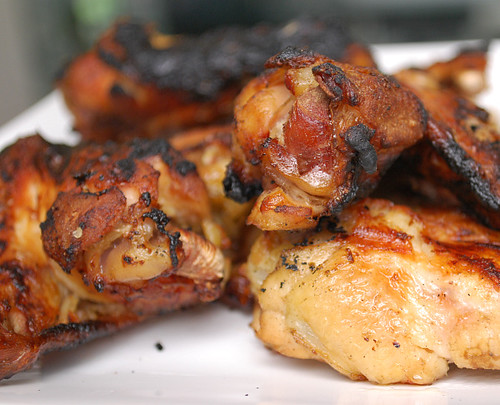
    Oh and by the way, this spice rub for chicken is delicious and easy home-cooking.  At least one thing is easy.

    Aromatic Roasted Chicken Thighs (adapted from Primal Palate)


    1 teaspoon salt

    1 teaspoon black pepper

    1 teaspoon garlic powder

    1 teaspoon onion powder

    1 teaspoon dried oregano

    1  teaspoon tumeric

    1/2 teaspoon chili powder

    1/2 teaspoon paprika

    1 teaspoon of olive oil.

    Note: I don’t even measure. I just eyeball it.

    8 bone-in, skin-on chicken thighs

    Preheat the oven to 375 degrees. Mix all the spices together in a large bowl. Rinse and dry all the chicken; then toss all of it into the bowl with  olive oil. Rub all the chicken around in the spice mixture. Let sit for about ten minutes while the oven continues to get hot. Take all the chicken and spread it out into an even layer in a large roasting pan. Cook for about 30 minutes until the juices run clear. (If you want, throw some veggies around it like cauliflower, small potatoes, wedges of zucchini.)
    The original recipe says to grill as well. That’s up to you.

  • I8tonite: A Chef’s Questionnaire with Oakland, California’s Chef Roland Robles, Handlebar and FiveTenBurger.

    I8tonite: A Chef’s Questionnaire with Oakland, California’s Chef Roland Robles, Handlebar and FiveTenBurger.

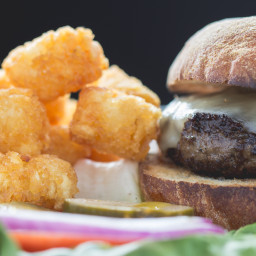
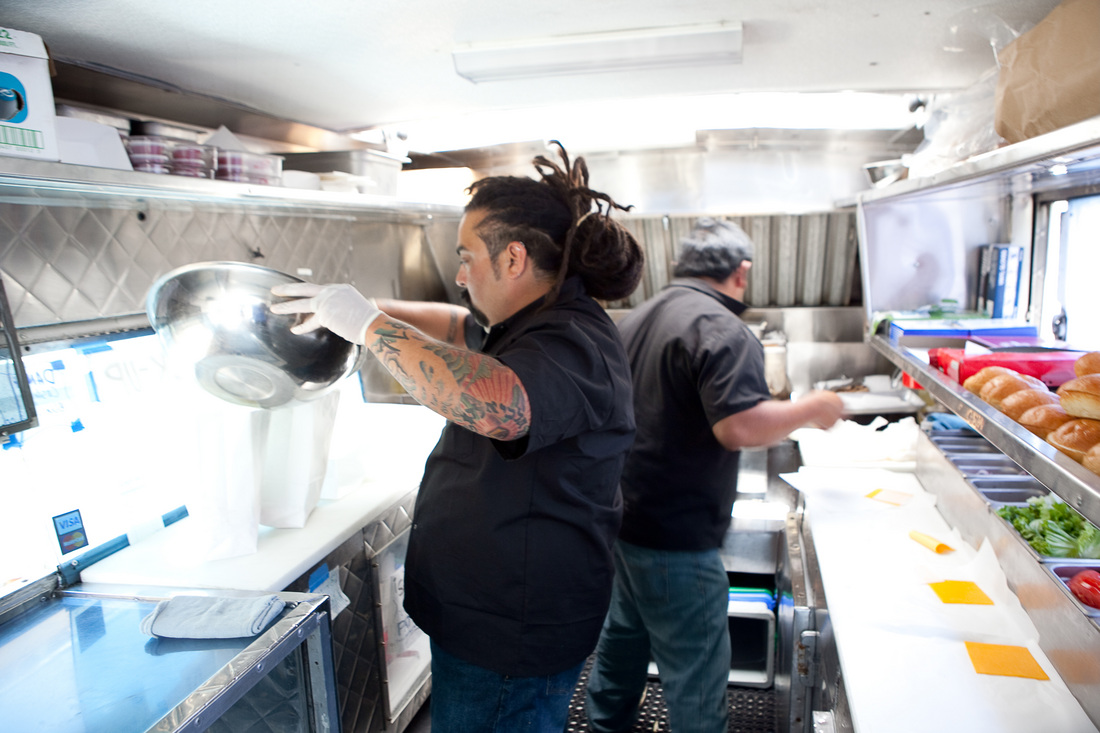
    Chef Roland Robles first came to prominence with FiveTenBurger, a food truck that cooked up delicious burgers throughout the Bay Area garnering amazing notices from such publications as Oakland Magazine and San Francisco Chronicle.  Last year, he opened Handlebar, a brick-and-mortar with partner, Jennifer Seidman who also owns the area’s Acme Bar & Company. Handlebar is a neighborhood restaurant and bar where Robles explores fare outside the bun. However, he still serves up the best burger – in my humble opinion – in the Bay Area. Hands down. Roland Robles

    • How long have you been cooking? Since I was a boy, 35-40 years.
    • What is your favorite food to eat?  I adore Chinese, especially the Americanized delivery style but any really.
    • What do you always have in your fridge at home? Herbs and eggs.
    • What do you cook at home? Extravagant ten-course dinners and tacos.
    • What marked characteristic do you find unappealing in your customer? Entitlement.
    • What marked characteristic do you love in your diners? Patience.
    • Tupperware, Rubbermaid, or Pyrex? Pyrex

    • Beer, wine or cocktail? Beer and a shot. I’m a cook.
    • Your favorite cookbook author? That’s tough… (Marcella) Hazan, (Julia) Child, my mom, (Kylie) Kwong
    • Your favorite kitchen tool? My run of the mill Japanese deba.
    Japanese deba
    • Your favorite ingredient? Salt.
    • Least favorite thing to do in a kitchen? Wash dishes.
    • Favorite types of cuisine to cook? Chinese, TexMex, Italian.
    • Chef you most admire? For television: Mario Batali, Jacques Pepin.
    • Food you dislike the most? Poorly made anything.
    • How many tattoos? A lot.
    • And if so, how many are of food? One. A sacred jalapeño.

    Roland's Jalapeno Tattoo

    A “No-Recipe” recipe from Chef Roland Robles:

    I often make these chicken tacos:

    • Diced boneless chicken breast
    • Onion, garlic, jalapeño, turmeric, salt, sugar, garlic granules, onion flake, chili flake
    • Chopped fresh cilantro

    Mix all these ingredients and a little oil. Let rest. Heat a cast iron way up, dump the mix in and sear it almost all the way through for great color and turn over to finish. Put it in a bowl, mix in chopped cilantro. Serve with raw onion, chilies and hot tortillas.

    —  Go Eat. —

  • I8tonite: 4th of July Homemade Barbecue Sauce

    I8tonite: 4th of July Homemade Barbecue Sauce

    American Flag
    American Flag

    Barbecue is a fundamental right of every American to enjoy. It is an American creation as much as our Declaration of Independence. It not just a food for celebration, it is a showcase of our cultural melting pot that helped to create our nation.

    Barbecue, the act of grilling or smoking meats with a fire may or may not come from the Spanish word barbacoa. Historians seems to be uncertain but they do know that the technique came to the United States by way of the Caribbean, via the Spanish and the reprehensible slave trade. Cooking over slow-burning coals, although brought to the shores in the 17th century, became rooted in our country’s Southern states by the late 19th century and is every bit as American as jazz and rhythm and blues.

    BBQ

    A very, very truncated version of barbeque history is that slaves had much to do with the barbeque as we know it today. Pigs were plentiful and hid in the woods so they were free. However, it was a long process to clean the animals so gatherings were created to butcher, prepare, cook — and give away — as much of the meat as possible. The sauce was adopted with a vinegar and tomato base to “mop” the meat, saturating it to assist in cutting the pig’s fat and possible gaminess of a wild hog upon eating. The slow-roasted meat, like in many cultures, was basted and then served with the same sauce.

    As we celebrate this auspicious day in our country’s history, we are cooking a time-honored tradition that was created — not by just one culture – but by many generations born in the United States and on American soil.  For me, it brings to mind why we honor July 4th – for freedom for all — and that whether you are black, white, gay, straight, hermaphrodite, transgendered, yellow, orange, gender-neutral, rainbow-colored or albino the first sentence of the second paragraph from the Declaration of Independence: “… that all men are created equal, that they are endowed by their Creator with certain unalienable Rights, that among these are Life, Liberty and the pursuit of Happiness. – Declaration of Independence, adopted by the Continental Congress, July 4, 1776

    images

    Homemade BBQ Sauce (Adapted from the kitchn) Makes 3 cups

    I tablespoon olive oil

    ½ chopped red onion

    4 – 5 garlic cloves, minced (I love garlic)

    1 (8-ounce) can of tomato paste and 1 (8-ounce) can of tomato sauce or 1 (16-ounce) can of tomato sauce.

    2 teaspoons of cumin, preferably freshly ground and toasted

    4 tablespoons of dark brown sugar

    ¾ cup of apple cider vinegar

    ¼ cup of honey (or molasses, agave syrup, maple syrup, Karo syrup). Each one will impart a different flavor so it’s up to the cook and what you have in your pantry.

    1/8 cup of Worcestershire sauce

    ¼ cup of yellow, brown or Dijon mustard (never grainy)

    1 teaspoon Kosher salt

    2 teaspoons liquid smoke

    Several dashes of hot sauce to taste (if you want it with some kick.) I used sriracha as it had the heat. I wanted to temper the sweetness with some high temperature on the finish.

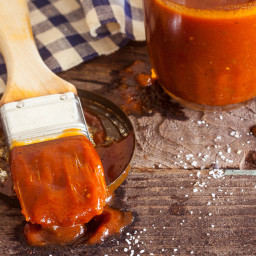
    barbecue-sauce-7

    Let’s make this puppy:

    Using a medium size sauce pan, drizzle in the olive oil and get it hot. Throw in the onions and cook until soft. Add the garlic. Stir until fragrant.

    Add the cumin and tomato sauce/puree. (Add 8 ounce of water if using the puree). Stir.

    Now add all the remaining ingredients and stir until thickened. Add more water, if you would like a thinner sauce. Also, at this point, see if you want to add more sweetener or make it zestier.

    Use it as a baste for meats or non-meats. Serve extra on the side.

    NOTE: This is a homemade barbeque sauce. It’s delicious but you can definitely play around with the ingredients. There should not be a hard and fast rule. Just deliciousness.

  • I8tonite: A Simple Roasted Chicken

    I8tonite: A Simple Roasted Chicken

    As I was making my roasted chicken on Friday night, I thought to myself how gloriously easy it is. The only thing I added was the leftover jalapeno and lime compound butter from the grilled London Broil the night before; otherwise it was a simple roasted chicken.

    Preheat the oven to about 380 – 390. While the oven does its thing, take a small bird of about 3 – 5 pounds and stuff if with some, salt, pepper, wedges of lemon and onion, garlic and herbs. Put some butter under the skin (optional); drizzle the skin with olive oil. Cover for the first 30 minutes. Uncover to brown. In about an hour, at 12 to 15 minutes per pound. Chicken is done when the juices run clear. (If not done, tent again for another 15 minutes.) In roughly an hour to an hour and a quarter, a herbaceous, citrusy and succulent dinner is on the table (or coffee table in front of the TV or computer) for a party of 2 to 4; possible, leftovers for lunch.

    Ostensibly, any home-cook can take this variation and change it. Using only thighs or legs. Breasts. Half-chicken. Quartered chicken. Spatchcocked. Make a bed of all the ingredients and put into the roasting pan. Instead of wedges, cut everything into slices so the chicken lays evenly and place chicken on top. Salt and pepper.  Drizzle olive oil and cover for half of cooking time; uncover for duration. Again, same period of time 12 – 15 per pound. You don’t even have to cover the chicken. I only do it speed up the roasting time with a little steaming before the browning.

    IMG_20150113_181652

    I’m preaching to the choir, me thinks. ….

    And here, with the recipe first, dear reader, you will not have to listen to my diatribe about cooking at home. It is such a wonderful thing to cook for yourself (meaning by yourself as a party of one) or your family. Before Nick came along, I was cooking by myself all the time. Experimenting. Changing things up. I love cooking. It gets me out of my head. Stirring. Blending. Roasting. Chopping. I don’t need the audience. I really love to do it.

    Recently, on my favorite social media site, someone queried, “If you could leave one thing behind, what would it be?” I answered, “Nothing. Absolutely nothing.”

    After writing this, the one thing I would really love to instill is a love of cooking. It separates us from the rest of the species on our planet and yet, it binds us to the world as well.  Our choices in how we eat, what we eat and how it gets to that table is the binding. It’s cyclical.  Cooking encompasses all of our essential human needs in one act. Sharing, loving and caring.

    IMG_20150625_181437

  • Cuban Mojo (pronounced “mo-ho”, not Austin Powers “mojo”) Chicken

    Cuban Mojo (pronounced “mo-ho”, not Austin Powers “mojo”) Chicken

    Image result for cuban style mojo chicken

    Nick is cooking tonight…and he’s making Cuban Mojo Chicken which is a marinade or sauce of only 5 ingredients: bitter orange, freshly ground cumin seeds, garlic, fresh oregano and olive oil. Having lived in Miami for most of his adult life, Nick loves Cuban food. According to LAist, there are quite a few Cuban restaurants in Echo Park, which we will need to check out.

    Mojo originally appeared in The Canary Islands which are not far from Spain. As the frisky Spaniards started conquering The New World, we know they brought much of their language and food with them. This marinade which is fairly international, as the travelers dropped anchor at every island, can be made with any combination of acid/ oil such as red peppers (roasted and ground), green peppers (roasted and ground), cilantro, onions, and on and on.

    In Cuban cooking, mojo typically applies to any sauce that is made with garlic, olive oil, and a citrus, in this case, bitter orange. Home cooks will notice in Cuban recipes that mojo is frequently used to flavor the yucca and is also used to marinate roast pork.  Cubans supposedly refer to the sauce as ‘mojito’ – not to be confused with the mint, rum and cachaça drink — and used for dipping fried plantain chips and yucca.  (I don’t know that for sure because the closest Cuban I have to is Nick. And he’s half Ecuadorean, not from Cuba but only lived in Miami where there is massive Cuban community. HA!)

    If finding bitter (Seville) oranges is difficult – but not impossible — you might find it easier to add a couple of tablespoons of freshly squeezed lime and lemon to the fresh orange juice which is what Nick does.

    (Incidentally, consumers can find this bottled and made with cornstarch. Don’t buy it. Make it. It’s so much better.)

    1 to 1 ½ heads of garlic

    1 cup fresh bitter orange juice (or if you can’t find  that substitute ½ cup of fresh orange juice, 1/8 cup of fresh lime juice (or approximate) , 3/4 cup of fresh lemon juice

    ½ cup olive oil

    1 teaspoon fresh oregano (or 1 ½ teaspoons of dried)

    1 full teaspoon toasted and freshly ground cumin seeds (Easy to find in your local market and will make a HUGE difference in the outcome with a wonderful smoky flavor.)

    (With salt and freshly ground black pepper to taste)

    Mash the garlic in a mortar and pestle or smash it into a paste which the flat side of a knife. Toast the cumin seeds in a skillet until fragrant. Grind.

    Place everything into a bowl and stir well. Marinate any meat (chicken, pork or beef) for in the fridge for 12 to 24 hours. Grill, roast or broil according to your taste. It’s a taste of the islands…and drink lots of mojitos.


  • i8tonite: A Spring Fava Bean Salad

    i8tonite: A Spring Fava Bean Salad

    Image result for Fava beans

    The first time I had ever heard of fava beans was by Anthony Hopkins playing Hannibal Lecter in “Silence of the Lambs” (1991). Lecter, as serial killers go, was immensely smart and sophisticated. (To Clarice Starling: “A census taker once tried to test me. I ate his liver with some fava beans and a nice Chianti”.) I was 25 years old when the movie came out. By this time, working in New York City restaurants, I had already had Chianti, an Italian wine varietal, many times over. I hate liver…especially after this movie but fava beans. Wow! They sounded cultured and classy especially spoken by Mr. Hopkins though it was supposed to be in that cinematic moment, a flash of Lecter’s murderous pedigree, cannibalism and insanity.

    Simply put, in that singular utterance, fava beans, became one of the most sought after edibles; although they are not easy to get around to eating. Before getting to the cooking of the bean itself, there are two coatings, a pod and then a shell around the bean which needs to be removed. Honestly, fava beans are a lot of work; shelling and then popping them out of the second casing? No, thanks.  Having once tried to cook them, I decided that I’m going to only eat them in a restaurant or when I can find them frozen. Needless to say, on the West Coast, they are not easily found in restaurants, the farmer’s markets or the frozen food section. Therefore, I don’t eat them often unless on the East Coast or in Europe.

    Image result for Fava beans

    However, on one of my many shopping excursions, I recently discovered that Melissa’s , the Southern California produce company, has done the hard part. They are packing fava beans that have been cleaned, peeled and steamed the beans in one easy to use package.  Melissa’s also produces ready-to-eat beets, carrots and other

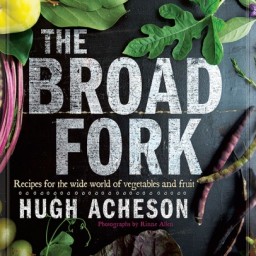
    That raises the question: What do fava beans taste like? Once cooked they have a slightly buttery and earthy flavor to them. By earthy, meaning like a vegetable, slightly bitter but with a palatable smoothness not unlike a giant white bean. You can puree favas into a dip much like hummus, using tahini, garlic, and lemon. Or, add the puree to a homemade aioli and it gives the spread a deeper flavor. In Hugh Acheson’s “The Broad Fork” (Clarkson Potter), he takes the fava bean mixing it with mint, arugula, salami and parmesan. Steeped in a profile of Mediterranean flavors, the fava beans combined with the other ingredients, crafts a sublime salad full of spring textures and saltiness. If you can find Melissa’s Fava Beans in the local vegetable section of your grocery, I highly recommend making this salad for an al fresco meal or BBQ….just don’t forget the Chianti.

    Fava Bean Salad

    Fava Bean Salad with Mint, Garlic, Arugula and Salami

    Sea Salt

    1 Pound of fava beans in their pods (Or buy Melissa’s)

    I head of fresh spring garlic, broken into cloves and peeled

    1 pound of arugula

    ½ cup of mint, leaves shredded by hand.

    2 tablespoons of olive oil

    1 teaspoon grated lemon zest

    1 teaspoon freshly sqeezed lemon juice.

    ¼ pound of salami, chopped and diced

    ½ cup shaved Parmigiano- Reggiano

    1. Create an ice water bath. (Ice cubes, water in a bowl.) On the stove, get a large pot of water to boiling and seasoned well with salt.
    2. Remove the fava beans from their large pods. Add the fava beans to the boiling water and blanch for 1 minute. Drain the favas and put them into the ice water bath. Discard the outer skins. (Or Melissa’s Fava Beans).
    3. In a small saucepan, cover the garlic cloves with water and bring it to a boil. Season the water with ½ teaspoon of salt, turn and heat down and simmer for about 10 minutes. (GREAT TIP: This process removes the heat of the garlic, leaving the clove gently sweet.)
    4. To serve the salad, in a large bowl add olive oil, lemon zest and lemon. Mix well. Add the favas, garlic, arugula and mint. Season with salt and arrange on a plate. Sprinkle with chopped and diced salami and shaved Parmigiano- Reggiano