Nicole Gulotta is a writer, editor, and tea enthusiast. She’s the author of Eat This Poem: A Literary Feast of Recipes Inspired by Poetry (Roost Books, 2017), and pens a blog by the same name. I first discovered Nicole’s website years ago, when looking for travel guides that encompassed both bookstores and great food. What gems Eat This Poem’s literary city guides are – written by those in the know, so it’s a local’s guide to goodness, when you travel. Nicole’s website is fill of musings on cooking – and life, and is one that I turn to again and again.
Imagine my elation when I saw Nicole’s new book being created, published, and released (next week!). I caught up with Nicole in sunny California, while snowbound in Michigan, and asked her about writing a combination of food and poetry. She noted that while she had been writing the blog for several years, and had felt rooted in the combination of food and poetry, she was approached by an editor about starting the book – and it felt like the right project at the right time. And while the gestation process for Eat This Poem: A Literary Feast of Recipes Inspired by Poetry was long, she had been writing of these topics for years, had found her footing with it, and was excited to do something more substantial with it – for which I am grateful.
When I delved into her history, I learned that while poetry arrived early in her life, food came much later – and so it wasn’t a natural fit to pair the two. But Nicole noted that when you can step away from your life experiences and look at them, it enables those insightful moments to happen.
The Eat This Poem cookbook features more than 75 new recipes paired alongside verse from 25 of America’s most beloved poets. Forage mushrooms with Mary Oliver, then wander into your kitchen to stir creamy truffle risotto. Study the skin of a pear with Billy Collins while you bake a warm vanilla-pear crumble. And honor the devoted work of farmers with Wendell Berry while snacking on popcorn dusted with rosemary and drizzled with brown butter.
You know me – when I asked what she hoped readers take away from the book, Nicole said, “The idea of being still in a kitchen, and having food and poetry be an opportunity to do something that takes care of yourself and the people around you as well. Our lives are so rushed and busy and we have all these things to do…and I want people to feel like they can indulge in poetry and food and ENJOY that, even if only for a brief moment.”
And, when I asked about poetry, Nicole (a life-long poetry lover) remarked, “Poetry is so great because it really keeps you rooted in the moment/present, and if you read a poem it might take a short time (or longer), but it is a special, be-present time. You can do this and inspire your day!”
Indeed – food and poetry are the perfect combination for stillness, thoughtfulness, and a good life.
Food People Questionnaire (with a nod to Proust):
What is your favorite food to cook?
Something Italian, like bolognese that simmers for hours
What do you always have in your fridge at home?
Homemade almond milk, Dijon mustard, a wedge of Parmesan, and eggs from the farmers’ market
What do you cook at home?
I keep things simple, especially Monday through Friday, like quick bean tacos, lentil curry, and pasta with whatever fresh vegetables are in season.
What marked characteristic do you love in a person with whom you are sharing a meal?
A good appetite
What marked characteristic do you find unappealing in a person with whom you are sharing a meal?
Chewing with your mouth open
Tupperware, Rubbermaid, or Pyrex?
Pyrex
Beer, wine, or cocktail?
Wine
Your favorite cookbook author?
Nigel Slater’s writing is so welcoming and poetic
Your favorite kitchen tool?
My Japanese chef’s knife
Your favorite ingredient?
Garlic. It’s the beginning of everything.
Your least favorite ingredient?
Dried fennel
Least favorite thing to do in a kitchen?
Empty the dishwasher
Favorite types of cuisine to cook?
Italian, Indian, and Mexican. But these days, anything I can get on the table in under 30 minutes.
Beef, chicken, pork, or tofu?
Beef, medium rare, with a touch of flaky salt on top
Favorite vegetable?
I know they’re technically a fruit, but tomatoes have my heart every summer. I also love roasted cauliflower.
Chef you most admire?
Suzanne Goin
Food you like the most to eat?
Always pasta, preferably spaghetti with a slice of garlic bread alongside
Food you dislike the most?
A poorly dressed salad
What is your favorite non-food thing to do?
Spend time with my son
Who do you most admire in food?
Anyone who helps support local farmers, treats animals and the environment with respect, and values seasonal cooking
Where is your favorite place to eat?
My kitchen table, or Bestia, in downtown Los Angeles
How many tattoos? And if so, how many are of food?
Zero.
Recipe: Energizing Orange Smoothie
In a high speed blender, add 2 cups freshly squeezed orange juice, 1 chopped carrot, 1 banana, 1 cup frozen mango, 1 small piece of peeled ginger (1-inch), ½ teaspoon ground turmeric, and 1 cup ice.
Process until smooth, and garnish with chia seeds, if desired.
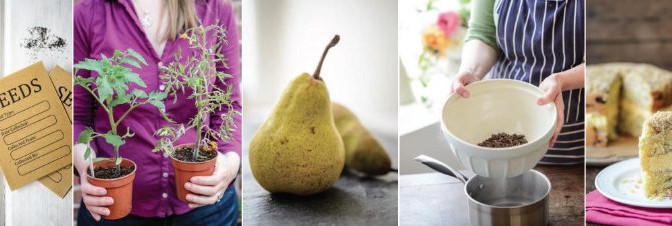
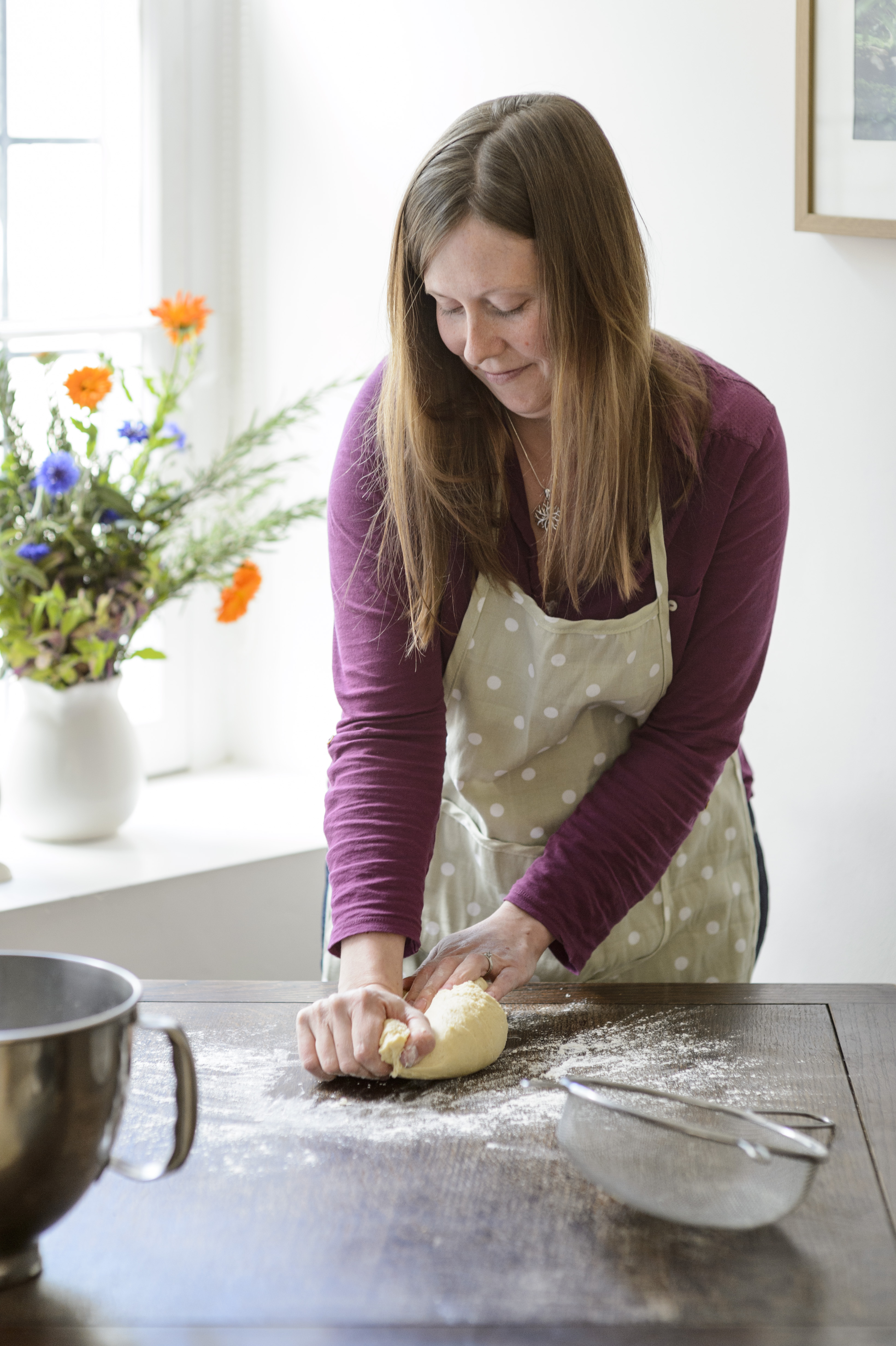
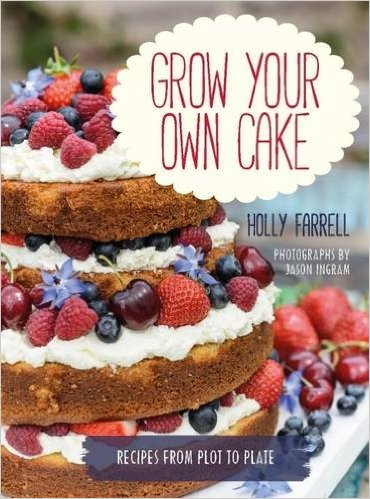
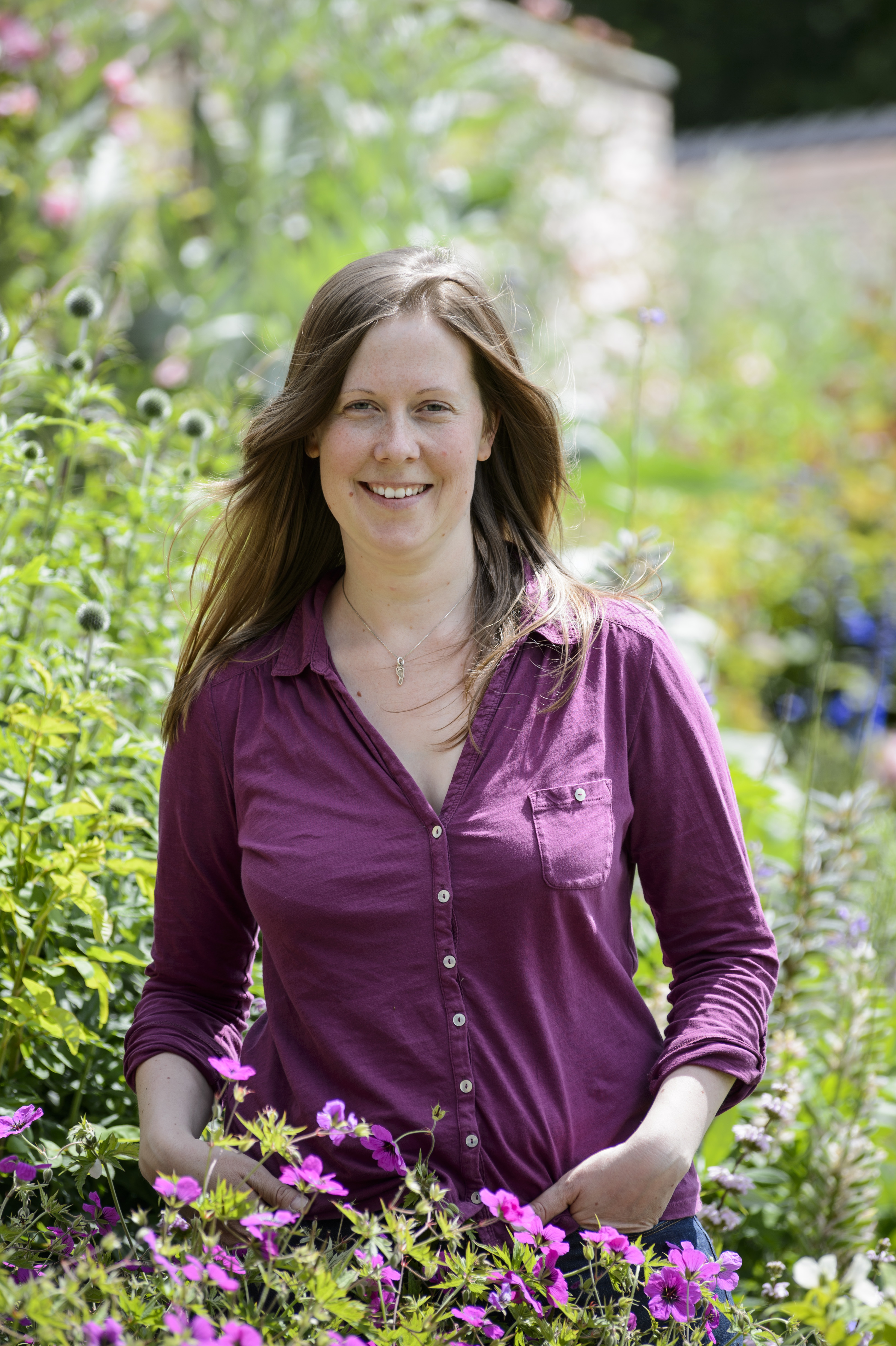
“Who doesn’t love cake?” Thus my introduction to Holly Farrell began, when I called her at her gardener’s cottage on an estate in the UK, near the Shropshire/Herefordshire border. Farrell is a serious gardener, mom of a toddler, and the author of Grow Your Own Cake: Recipes from Pot to Plate, a genius book that is both a backyard gardening guide and cookbook. The beautiful, inspiring photos are by Jason Ingram.
Farrell has a delicious twist to her cake recipes, though – she has a vegetable garden devoted to all things cake.How did this come about?
In college, Farrell majored in history. Which led, curiously, to gardening. What? Yes, well, love entered the picture, too, as you’ll find out in a moment. She got the growing bug working at a chili pepper farm, after which she trained at RHS Gardens Wisley, where she gained the Wisley Diploma in Practical Horticulture and the RHS Certificate and Diploma, both with Commendation – and met her husband! They now live on the country estate where he is the Head Gardener.
Soon, she started writing garden books – and freelancing on kitchen gardens for private clients. Now one thing that’s a bit unusual, you’d think, for gardeners – sometimes the accommodations where they lived didn’t have big gardens, because the estate had such extensive gardens! So, she has been growing her own fruit and vegetables for many years, in a variety of settings, from allotments to container gardens. I think for Farrell, gardening is like breathing – something you do no matter where you are. It was amazing to hear her clear passion for gardening – and her love of teaching how to grow things – from across the pond.
Farrell has always cooked, and always liked cake. This book is a glorious combination of the two, where ingredients you never thought would be in a cake are the stars – or the firmament.
lavender shortbread cookies
She hopes to inspire people to expand their gardens – and palates. This book will appeal to gardeners who are already growing, and bakers who have never gardened, too. Using freshly grown ingredients (including herbs and flowers) – especially from your own hand and land – makes such a difference. Can’t grow much? Start with herbs in pots on your windowsill, and get the rest from local farmers at your farmer’s market.
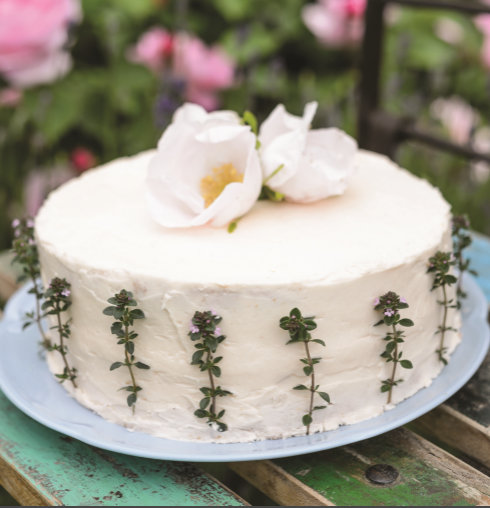
Rose cake
I love this book, for it teaches much in both the garden and the kitchen. If you know one, skip ahead to the other. But the recipes (50 of them!) shine, I will be honest. Her chapters include spring and summer cakes, autumn and winter cakes, afternoon tea, pudding, and savory bakes. When I asked what readers might be surprised about her book, Farrell mentions that she while she loves gardening, she doesn’t grow her own wheat, or raises cows and chickens – and the recipe that raises the most eyebrows is the savory cheesecake (you know I flipped right to that page after our afternoon chat, and indeed, I was both intrigued and impressed. Making soon!).
As a mom, I asked Farrell for tips were to get kids started baking (and gardening) early. She said to start early by baking sweet stuff! And while plenty of people are great at hiding vegetables in a cake, that’s not what she’s about. She prefers getting kids to appreciate growing things, picking, and then cooking them. Their time and efforts are rewarded and they’ll want to try it again (and again).
I was impressed with Farrell’s philosophy on gardening, eating, and life. She noted that, “so much goes into the experience of eating – where you are, who you’re with, if the sun is shining, etc. The cakes in the book will taste good, but hopefully you’ll be in a good place, a garden, and the satisfaction of having grown it yourself will make it better.”
To that end, she’s shared two recipes to inspire you.
Questionnaire, with a nod to Proust:
What is your favorite food to cook at home?
Cake! Or anything involving cheese.
What do you always have in your fridge at home?
Butter and eggs, and parmesan cheese (see above).
What marked characteristic do you love in a person with whom you are sharing a meal?
I’m terrible at deciding between dishes in restaurants, so it’s always nice when they order the other choice so I can try both!
What marked characteristic do you find unappealing in a person with whom you are sharing a meal?
Poor table manners.
Beer, wine, or cocktail?
Cocktail.
Your favorite cookbook author?
Too many to choose, but for the writing, Nigel Slater and recently Ruby Tandoh.
Your favorite kitchen tool?
My silicone spatula.
Favorite types of cuisine to cook?
Anything sweet – pudding, dessert, cake…
Beef, chicken, pork, or tofu?
Chicken, but I couldn’t live without pancetta for ragu.
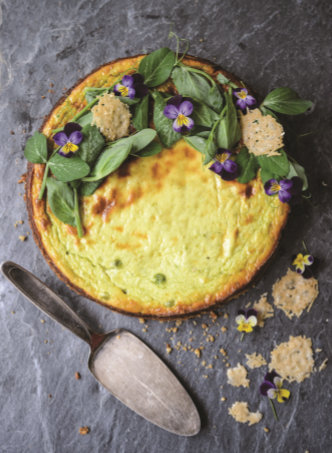
Pea Cheesecake (told you. Make one!)
Favorite vegetable?
Broccoli – it’s what I crave when I’m under the weather, but for baking with, carrots.
Chef you most admire?
Jamie Oliver and Hugh Fearnley-Whittingstall do great work with their campaigns for better food.
Food you like the most to eat?
I couldn’t live without chocolate.
Food you dislike the most?
Visible fat on meat – I just can’t stomach chewing it. Or semolina and rice puddings, a school-dinner legacy.
What is your favorite non-food thing to do?
Gardening.
Who do you most admire in food?
Michael Pollan writes so well, and his Food Rules is brilliant.
Where is your favorite place to eat?
At the kitchen table with my husband and daughter.
What is your favorite restaurant?
The best meals I’ve ever had out were at Raymond Blanc’s Le Manoir, and at a little place called Da Enzo in Rome.
Do you have any tattoos? And if so, how many are of food?
Hah! No, sorry, I’m not nearly rock and roll (or brave) enough for tattoos.
Growing Carrots & Carrot Cake Recipe
Grow your own carrots…
G R O W CARROTS
When I first started growing my own vegetables, I had a friend who thought carrots is carrots is carrots. I presented him with my home-grown roots for dinner, pulled from the soil that afternoon. ‘Oh’, he said, ‘so that’s what carrots are supposed to taste like.’
BEST VARIETIES
For recipes that call for blended or grated carrot, sweet, juicy, long, blunt-ended varieties are best, such as ‘Sugarsnax 54’, ‘St Valery’,
any of the ‘Nantes’ type or the shorter ‘Amsterdam Forcing’ for growing in pots. When using whole carrots, as in Root veg
tarte Tatin, baby carrot varieties such as ‘Paris Market’ are a good choice, and also suitable for growing in pots.
PLANTING
Sow carrots in a sunny spot in spring, and again at intervals until late summer. Scatter the seed thinly in a drill in well-prepared soil free from large stones. Small carrots can be grown in pots, and this is actually preferable to growing them in heavy clay soils.
MAINTENANCE
Carrot flies are attracted by the scent of the foliage so avoid brushing it while tending the plants. To protect the crop from such pests, cover with horticultural fleece or fine mesh. Clear plastic tunnels can also be used if aired daily. Check the edges and folds regularly for slugs and snails. Thin the seedlings once the roots have grown to a usable size, leaving one plant every 10cm/4cm or so.
HARVEST
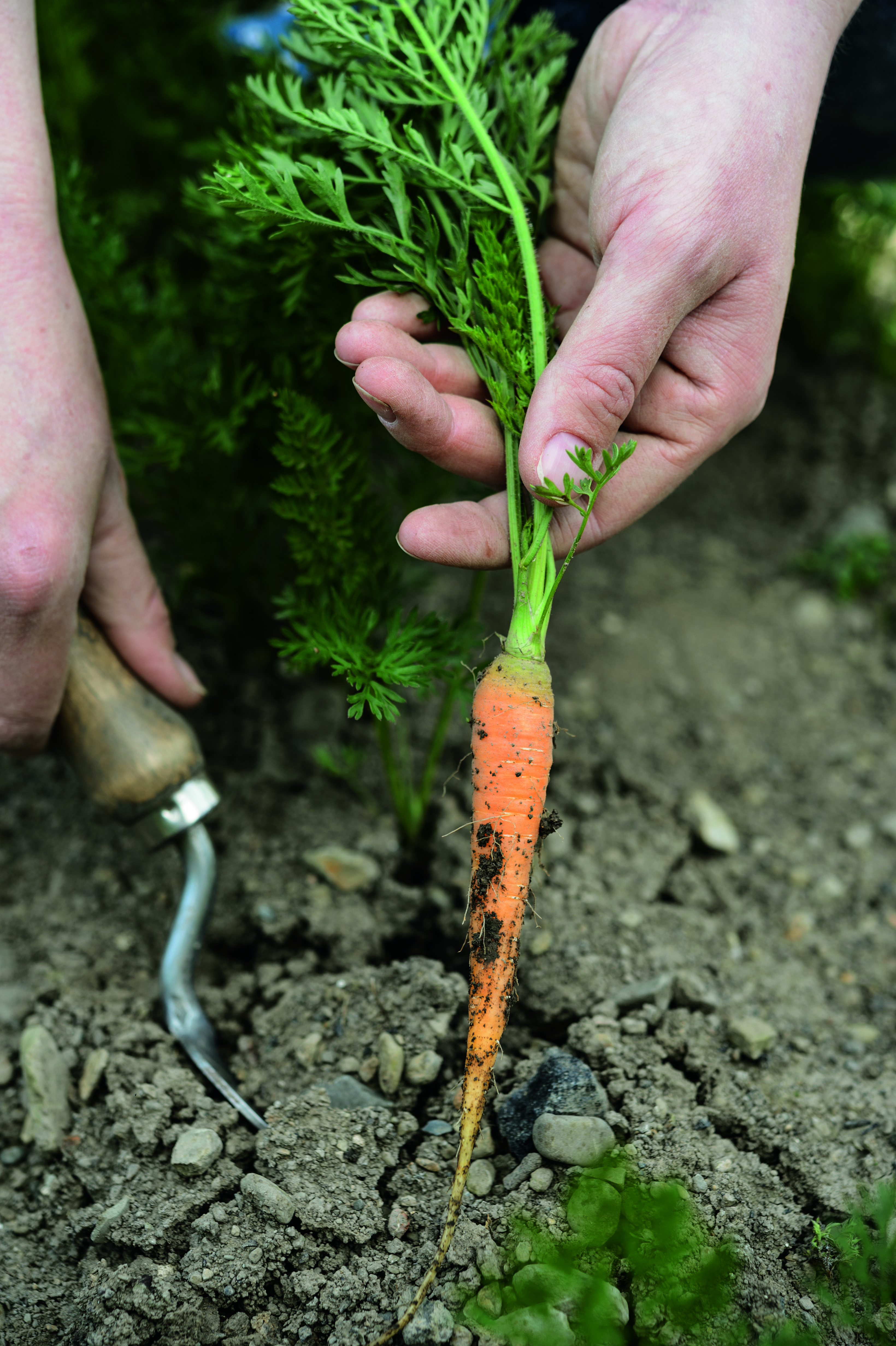
Satisfying as it is to just pull up carrots using the foliage, this should be avoided so the root does not break; instead use a fork to lever them out of the ground. Carrot thinnings provide the first harvest, while the main crop will be ready around four months after sowing.
Recipe: CARROT CAKE
for this amazing carrot cake!
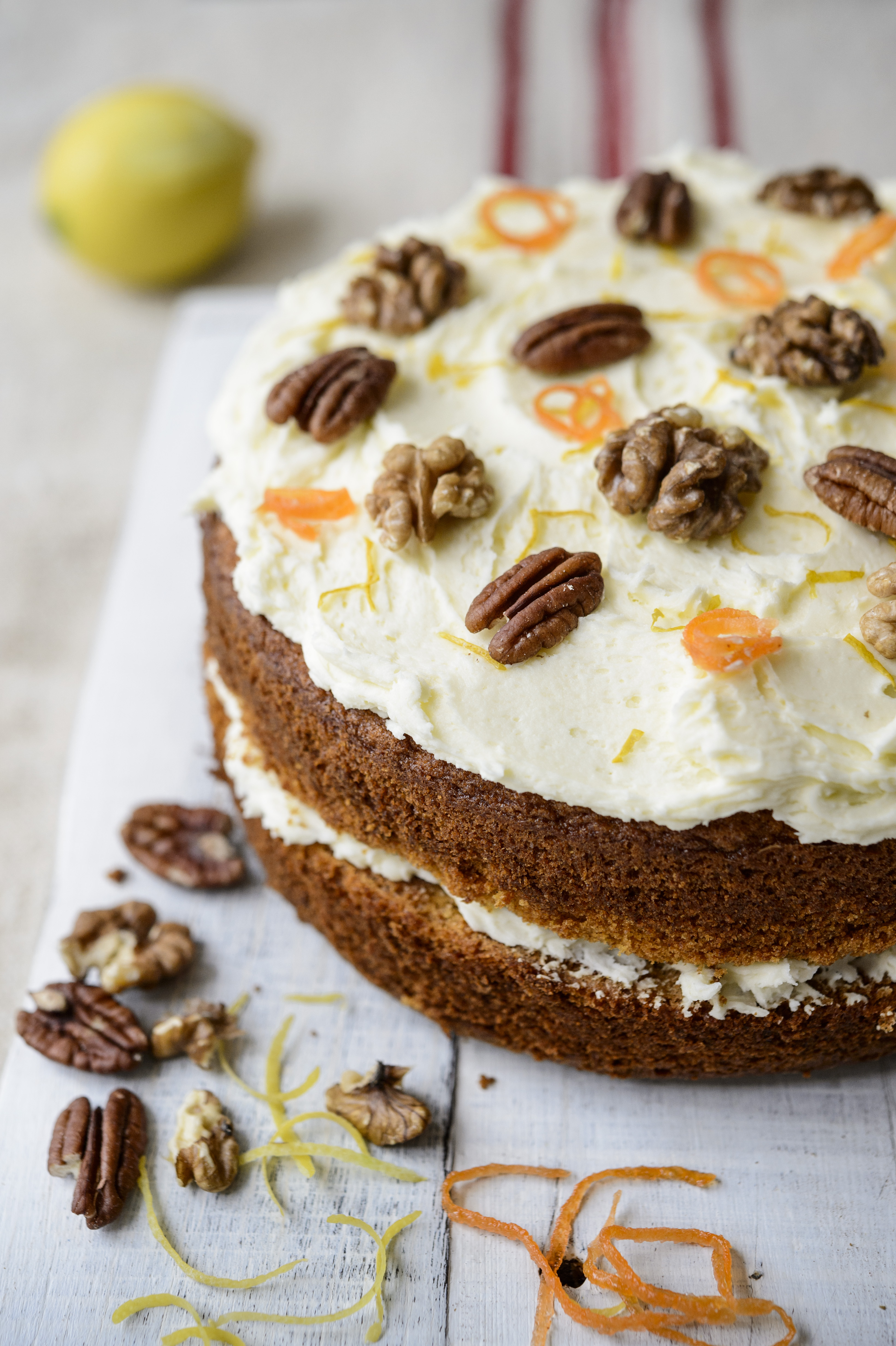
Perhaps the most well-known of all the vegetable cakes, and with good reason, carrot cake comes in many guises. This sponge version is lightly spiced, moist and includes a zesty buttercream. It is light enough for baking with fresh, sweet carrots in summer.
MAKES A TWO-LAYER CAKE
YOU WILL NEED
2 x deep, round cake tins, 20cm/8in diameter, greased and base-lined
METHOD
• For the cake, preheat the oven to 170°C/325°F/gas mark 3. Grate the carrots, then blitz in a food processor or blender with the yogurt and orange juice to form a rough purée. Set aside. Sift the flour, sugar, spices and baking powder into a large bowl, then beat in the butter until it has coated the dry ingredients and the mix looks like breadcrumbs. Beat in the eggs until just incorporated, and then the carrot purée for 2–3 minutes. Divide between the two tins. Bake for 30 minutes, or until a skewer comes out clean. Then remove from the oven and turn out the cakes to cool on a wire rack.
• For the candied carrot, using a zester or small knife, pare long, thin strips of carrot into a small saucepan. Then add the sugar and water. Bring to a simmer over a medium heat and cook for about 5 minutes, until a thin syrup has formed. Hook out the carrot strips and leave to cool on a wire rack.
• For the buttercream, sift the icing sugar and beat with the butter to combine, then add lemon juice to taste. Beat for 5–10 minutes until light and fluffy.
TO ASSEMBLE
Use half the buttercream to sandwich the two layers of cake together, and the other half to cover the top. Grate over the lemon zest and finish by sprinkling over the toasted nuts and candied carrot.
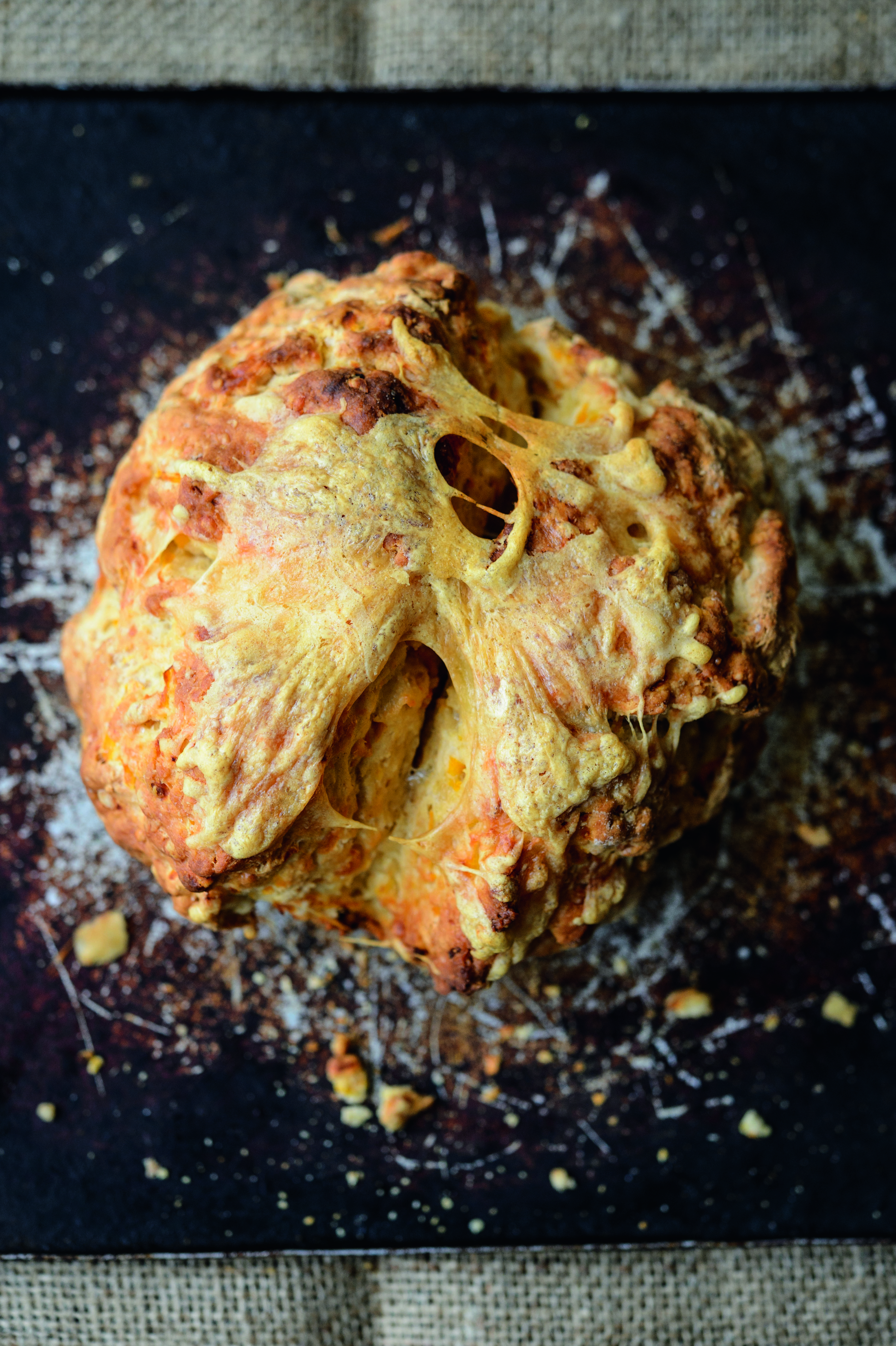
Recipe: PUMPKIN SODA BREAD
Soda bread, which is created using baking powder rather than yeast, requires no kneading and no proving. It is best served warm, making it an ideal choice for a quick weekend lunch. Tradition has it that the cross sliced into the top of the bread is to ward off the devil, but whatever the origin it makes each loaf easy to tear apart into
chunks to share.
MAKES 2 LOAVES
YOU WILL NEED
1 × baking sheet, dusted with flour
INGREDIENTS
500g/1lb 2oz plain flour, plus extra for dusting
1 tsp salt
pinch of freshly ground pepper
4 tsp baking powder
150g/5oz grated pumpkin
100g/3½oz grated
gruyere cheese
300ml/½ pint buttermilk
METHOD
• Preheat the oven to 200°C/400°F/gas mark 6. Mix the flour, salt, pepper, baking powder, pumpkin and three-quarters of the cheese quickly and thoroughly in a large bowl. Then make a well in the centre.
• Pour in the buttermilk and stir until it comes together as one ball of dough. Work as quickly as possible until the ingredients are all incorporated, but do not mix for longer than necessary to do this.
• Divide the dough into two equal pieces, and shape each into a ball. Put on to the baking sheet and flatten slightly. Cut a deep (almost to the base) cross in each ball, sprinkle with the remaining cheese and dust with a little flour.
• Bake for 25–30 minutes, until the bread sounds hollow when tapped on the base. Remove from the oven and cool on a wire rack.
TO SERVE
Serve warm or cold. The loaves will last 2 days at most, and are best eaten as soon as possible after baking.
Inspiration, indeed. Spring is here – what are you planting, with a mind to bake and eat?
I have written many times that my mother wasn’t really a cook. She was a working, single mother and it wasn’t really in her repertoire to cook. Occasionally, she would make a meatloaf or the requisite holiday dinner but normally it was a sandwich, doughnuts, Kraft Mac & Cheese, possibly a can of Campbell’s Pork and Beans (very Sandra Lee).
It wasn’t until I moved to New York City that my taste buds began to experience real food and cooking. One of my teachers in my gastronomic learning was my roommate, Teresa. Born in Massachusetts, outside of Boston, from a family of 9, she quickly became someone I thought of as a family member; plus, she loved to cook. She made simple American dishes like “baking soda biscuits”, roasted chicken and made delicious “Apple Brown Betty” which is what she called it. Really it was just a “crumble” also known as a “crisp”.
Brought over by English settlers, a crumble or crisp, is baked fruit topped with a crust of sugar, butter and flour. And one of the most amazing things in the American cooking world. It’s a simple concoction that conjures up Norman Rockwell scenes: kids frolicking in freshwater lakes, post an afternoon of strawberry picking or climbing apple trees, yanking down bushels of apples. (None of which I experienced growing up in Baltimore. Besides, I had never seen a berry plant much less an apple tree in the urban Seventies landscape.)
It was Teresa’s Irish family cooking which opened me to this bit of Americana. I can still smell the baking aromatics of cinnamon and nutmeg with the sweetness of the apples. She would pull it from the oven still bubbling hot and top it with some cheap ice cream bought at one of the local bodegas.
It sort of came back to me when I was moving. I was triggered to make a crisp for me and Nick. It’s funny how doing something can make you want to do something else. A move is stressful and I wanted to eat something nostalgic, when I thought life was simpler like living in New York City and being a club kid. (LOL)
You will need:
2 pounds of hulled and sliced fresh strawberries
2 or 3 cups of fresh blueberries
3 tbs. of cornstarch
1 cup of brown sugar
¾ cups flour
¾ cups quick-cooking oatmeal
1 tsp cinnamon
1/2 tsp nutmeg (optional)
½ cups Butter
To Make:
Preheat oven to 350 F. Put the berries into a large bowl. Toss berries with cornstarch. Butter a 10″ glass pie plate or loaf pan and place the berries inside.
In a medium sized bowl, mix together the brown sugar, flour, rolled oats and cinnamon. Cut butter into the dry mix until resembling “crumbles”. Place over top of the berries.
Bake for 45-55 minutes with a rimmed baking sheet just in case it bubbles over.(Hate having to clean an oven!)
Serve warm with your choice of ice cream…vanilla is probably my choice because it’s tasty and doesn’t conflict with the berries. You can top with some homemade whip cream. (Add a touch of bourbon to the cream….whoo- hoo!)
Manage Consent
To provide the best experiences, we use technologies like cookies to store and/or access device information. Consenting to these technologies will allow us to process data such as browsing behavior or unique IDs on this site. Not consenting or withdrawing consent, may adversely affect certain features and functions.
Functional
Always active
The technical storage or access is strictly necessary for the legitimate purpose of enabling the use of a specific service explicitly requested by the subscriber or user, or for the sole purpose of carrying out the transmission of a communication over an electronic communications network.
Preferences
The technical storage or access is necessary for the legitimate purpose of storing preferences that are not requested by the subscriber or user.
Statistics
The technical storage or access that is used exclusively for statistical purposes.The technical storage or access that is used exclusively for anonymous statistical purposes. Without a subpoena, voluntary compliance on the part of your Internet Service Provider, or additional records from a third party, information stored or retrieved for this purpose alone cannot usually be used to identify you.
Marketing
The technical storage or access is required to create user profiles to send advertising, or to track the user on a website or across several websites for similar marketing purposes.

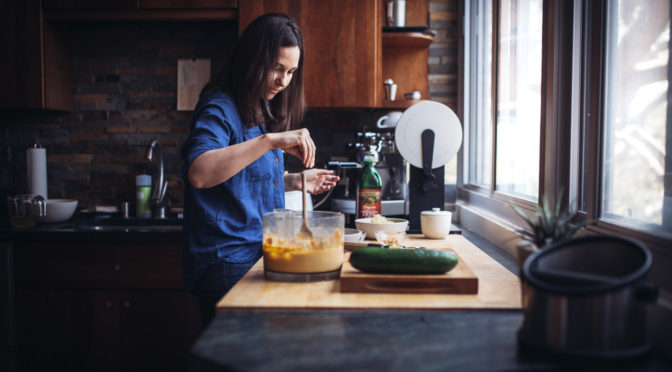
 Nicole Gulotta is a writer, editor, and tea enthusiast. She’s the author of Eat This Poem: A Literary Feast of Recipes Inspired by Poetry (Roost Books, 2017), and pens a blog by the same name. I first discovered Nicole’s website years ago, when looking for travel guides that encompassed both bookstores and great food. What gems Eat This Poem’s literary city guides are – written by those in the know, so it’s a local’s guide to goodness, when you travel. Nicole’s website is fill of musings on cooking – and life, and is one that I turn to again and again.
 Imagine my elation when I saw Nicole’s new book being created, published, and released (next week!). I caught up with Nicole in sunny California, while snowbound in Michigan, and asked her about writing a combination of food and poetry. She noted that while she had been writing the blog for several years, and had felt rooted in the combination of food and poetry, she was approached by an editor about starting the book – and it felt like the right project at the right time. And while the gestation process for Eat This Poem: A Literary Feast of Recipes Inspired by Poetry was long, she had been writing of these topics for years, had found her footing with it, and was excited to do something more substantial with it – for which I am grateful.
 Your favorite kitchen tool?