Category: Arizona

  • Milk-Braised Carnitas: Born in the Sonoran Desert

    Milk-Braised Carnitas: Born in the Sonoran Desert

    I’ve made carnitas in every city I’ve called home, always riffing on a San Francisco Chronicle recipe: pork, aromatics — cloves, cinnamon — some citrus, a little heat, and slow-cooked until it falls apart. Most people crisp the meat in oil or bake it after shredding, but I usually just leave it in the braising liquid and pull it apart. Moving to Southern Arizona changed that for me. I started to see how many versions of carnitas belong to the Borderlands, each one telling a different story of history and its place in it.

    Along this 378-mile stretch of border, from California to New Mexico, ingredients document memories of their location, from climate to use to migration. Even a dish as familiar as carnitas raises more questions once you pay attention to its components.

    I came across a version of carnitas braised in milk. It’s a technique I’d always thought of as French. So how did milk-braising find its way into Mexican cooking? And who gets to say whether it’s authentic or not?

    Even as I seek out meaningful conversations about food, that question remained with me. One of those talks turned out to be a lesson I wasn’t planning to learn. Or, maybe I knew I would. I’ve seen it before.

    Authenticity, Permission, and a Closed Door

    After the holidays, I decided to reframe a cookbook I was working on around immigrants. And since I moved to the Sonoran Desert, I wanted to focus on this historic region. I was recommended to speak with someone — a Midwest academic — known for their knowledge of Indigenous cooking and farming. More scholastic and less homey. More explanation than trying to expand the actual use of ingredients and how to use them in a pie or noodle dish. In less than a full five-minute conversation, this educated man of many letters, who claims the region as his adopted home, slammed the door. His words: “I don’t want to dumb it down.”

    It wasn’t so much a conversation as a “see what I’ve done” and “I should be recognized for bringing this to the world.” He mentioned his cookbooks and how long he has been bringing this knowledge to others. He stated that he grows some of the ingredients and sells them as part of his business. I realized it wasn’t about food at all, but that he had an arrogance in wanting to give me permission: In other words, I was supposed to listen to his answers to the questions I wanted to ask, and I was to stay in a lane that he controlled.

    It wasn’t so much a conversation as a “see what I’ve done” and “I should be recognized for bringing this to the world.” He mentioned his cookbooks and how long he has been bringing this knowledge to others. He stated that he grows some of the ingredients and sells them as part of his business. I realized it wasn’t about food at all, but that he had an arrogance in wanting to give me permission: In other words, I was supposed to listen to his answers to the questions I wanted to ask, and I was to stay in a lane that he controlled.

    It was as if these foodways and history, built on centuries of survival — long before he wrote a book and became the self-appointed guardian — were meant only for the privileged few who used ingredients such as mesquite or chiltepin according to his God-like instructions. It made me think about how power works. Even with the best intentions, these keepers protect the culture and believe they own the traditions.

    I don’t think you need credentials to cook. You can certainly have them, and even get degrees in culinary programs, such as a PhD in gastronomy or food & beverage management. But I don’t think caring and storytelling need permission. Tradition only survives because people keep cooking at home with family and loved ones. Adaptation comes over time. Recipes continue to stay alive because they’re savored and eaten, not because they’re locked away or put on display for approval. And chefs, cooks and writers can be creative with whatever they want.

    For me, making pork braised in milk was not about proving authenticity. It’s a recipe born in a region where these ingredients resided, and someone said, “Let’s use this before it goes bad,”-a type of humility food earned by being well-made with quality ingredients accessible to all, not by being defended.

    Why Milk-Braised Carnitas Belong Here, and How I Make Them

    Milk-braised pork isn’t pulled from nowhere. Dairy appears differently in northern Mexican cooking than farther south, shaped by ranching, the climate and, of course, history. Milk isn’t foreign to the Sonoran region, but it’s not native either. It’s existed for centuries, and now, it’s become part of the cuisine. When pork simmers gently in milk, the meat softens deeply, the liquid reduces and caramelizes, and the dish moves naturally from braise to fry.

    For this version, I keep things simple on purpose

    Sonoran Milk-Braised Carnitas Recipe

    INGREDIENTS

    • 3 pounds pork shoulder or butt, cut into large chunks
    • 1 tablespoon kosher salt
    • 2 tablespoons lard or neutral oil
    • 1 orange, peeled and pith removed
    • 1 teaspoon freshly ground black pepper
    • 1 teaspoon crushed Mexican oregano
    • 2 bay leaves
    • 3-4 garlic cloves, smashed
    • 1 medium onion quartered
    • 1/4 teaspoon crushed chiletepin pepper or red pepper flakes
    • 2 cups whole milk or more.

    Cook this up:
    Season the pork generously with salt, pepper, and oregano.

    Heat up the lard or oil in a wide, heavy-bottomed pot or Dutch oven. Gently place seasoned meat and lightly brown, no more than a minute or two. We aren’t browning, we are preparing it for the braising. Once done, add the bay leaves, garlic, and onion. Stir for a minute or so.

    Pour in the milk. It should reach halfway up the meat. Add in the orange peel. Bring the pot to a gentle simmer over medium heat.

    Turn the heat to low and cook uncovered, stirring occasionally, for about 2 to 2½ hours. As the liquid reduces, the milk will begin to caramelize and separate, as expected. Watch carefully. (I like to set a timer on repeat in 15-minute intervals. It sounds far more labor-intensive than it actually is. You are making sure the liquid doesn’t evaporate too quickly.) The meat will brown and continue cooking until the liquid has fully reduced — you might need to add a little more milk depending on how the heat — and the pork begins to fry gently in its own rendered fat.

    Stir and turn the pieces carefully, allowing them to brown evenly. Cook until the pork is deeply tender with crisped edges, about 20–30 minutes more. Taste and adjust seasoning. Serve as desired — I like it as tacos with crema, pickled red onions, cilantro, thinly sliced radish and crumbled queso fresco.

    Eat well.

  • Mesquite Shortbread Cookies with Pecans, Baked in Tucson

    Mesquite Shortbread Cookies with Pecans, Baked in Tucson

    Mesquite shortbread cookies with toasted pecans and dark chocolate dip on a baking sheet
    Mesquite shortbread cookies with pecans, partially dipped in dark chocolate.

    I’ve been baking and cooking with mesquite lately. It’s an ingredient you don’t see on many menus or listed in recipes except as wood used for burning meat. As a wood, it imbues an aroma and smoky flavor you’d associate with a campfire or a grill. That savory, romantic smell of open flame alone is part of the reason many pitmasters pair it with apple and cherry woods.

    But mesquite has a much longer history as an edible food. Across the Sonoran Desert, Indigenous communities have harvested not only the wood from the trees but also the pods, drying them and grinding them into flour for thousands of years. That flour was mixed with water or fat and baked into tortillas, bread, or porridge. Mesquite flour isn’t meant to be used as a substitute for wheat. Because it’s derived from a tree pod, it’s grainy in a way that feels closer to rough-hewn corn or barley than sugar. It works best when blended with another flour, such as almond.

    I decided to try my hand at gluten-free shortbread made with mesquite. I paired it with almond flour, folded in pecans, and dipped it in melted dark chocolate. Pecans feel like a natural choice. They’re the only nut native to North America and appear across Indigenous, Mexican, and American kitchens. Cacao, indigenous to Mexico and the Amazon, adds another layer,  chocolate, to the cookie. Shortbread made sense because it’s traditional and feels like a holiday, and it doesn’t need frosting or messy sprinkles to contend with. This cookie relies on butter and balance, creating a sturdy texture that holds up to being dipped in chocolate.

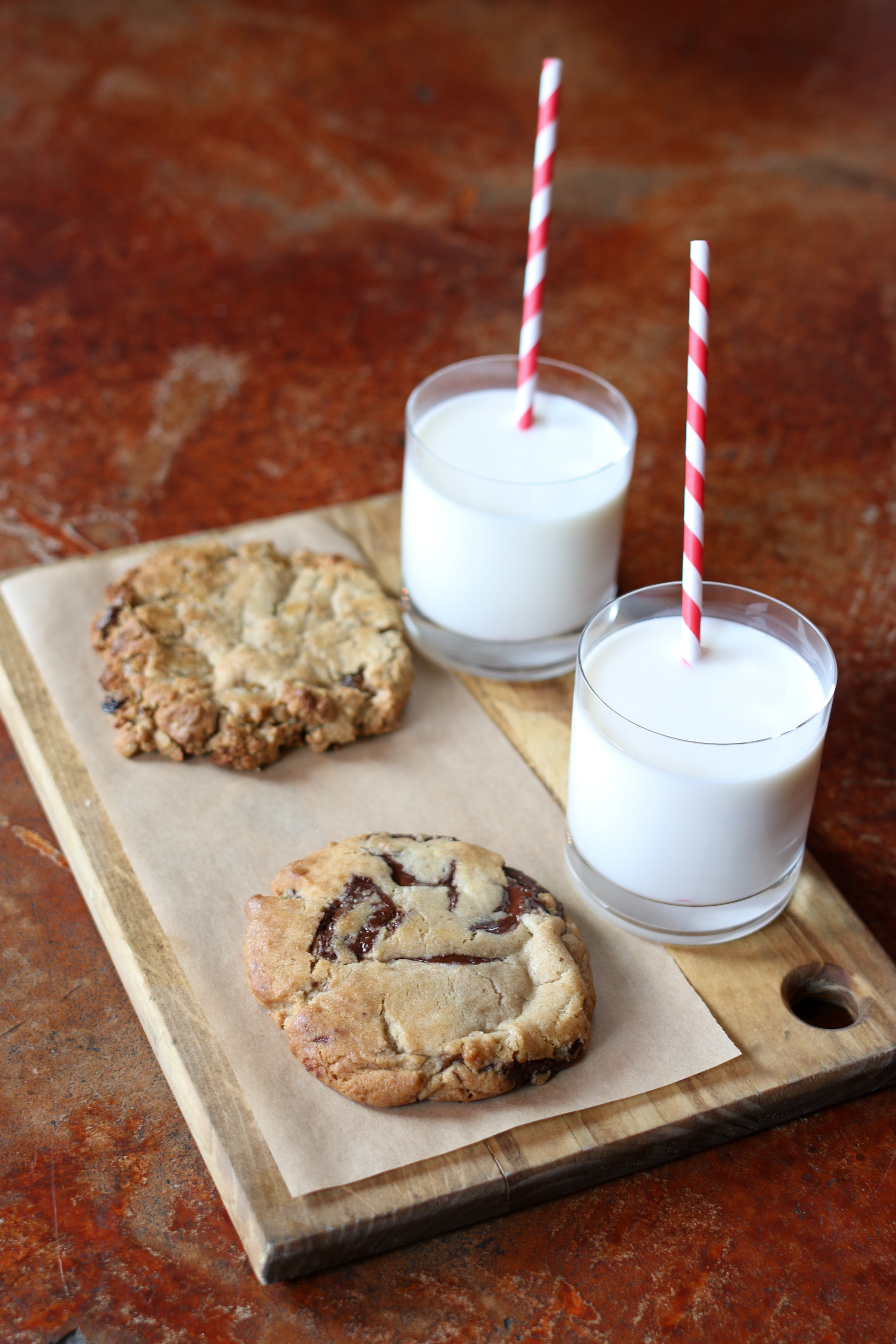
    When they are finished, they make a good Santa treat. How could the jolly man, after squeezing himself down a Tucson chimney, covered in Sonoran dirt, not find joy with these and a glass of milk?

    I like mesquite – I’m using it in sauces too –  because it connects Indigenous foodways, Mexican culture, and the American Borderlands kitchen that absorbed both, often without being acknowledged.

    Did I say these were gluten-free?

    Mesquite shortbread cookies with pecans, dipped in chocolate.
    (Gluten-free) Makes about 24 cookies

    Ingredients

    1 cup almond flour
    1/3 cup mesquite flour
    1/4 cup powdered sugar
    1/4 teaspoon fine salt
    1/2 cup cold unsalted butter, cut into small cubes
    1 teaspoon vanilla extract
    1/2 cup finely chopped pecans
    4 ounces dark chocolate, chopped

    Instructions

    1. Heat the oven to 325°F. Line a baking sheet with parchment paper.
    2. In a bowl, whisk together the almond flour, mesquite flour, powdered sugar, and salt.
    3. Add the butter and work it in with your fingers or a pastry cutter until the mixture looks like coarse sand and holds together when pressed.
    4. Stir in the vanilla, then fold in the pecans. If the dough feels dry, add 1–2 teaspoons of cold water.
    5. Roll out the dough so it’s about a quarter inch thick, then cut it into. Cut into rectangles for a classic shortbread shape, then place them on the baking sheet. Repeat the process with the remaining dough.
    6. Bake for 14–16 minutes, until set and just lightly golden at the edges. Let cool completely.
    7. Melt the chocolate gently. Dip half of each cookie into the chocolate, then return it to the parchment to set. You can even paint the chocolate onto the cookie with the back of a spoon – which is what I did. I tried dipping a couple of times, but found the cookie broke under the weight. I didn’t wait for the cookie to cool completely.

    Aside: Because mesquite flour is naturally sweet, it doesn’t need additional sugar. These keep well for several days and freeze well, both as a dough and as a finished product.

    Leftovers

    Local: Tucson Foodie reported that brothers Erick and Jose Quintero have opened Kintoki Sushi House & Bar in the former El Berraco space on North First Avenue, bringing a modern sushi concept with subtle Latin influences to a longtime neighborhood location. The restaurant, which opened Dec. 5, retains the building’s recognizable exterior while introducing a new menu of sushi, small plates and cocktails, keeping the cultural focus of the brothers’ Tucson ties.

    Regional: According to KJZZ, winter vegetable growers in southwestern Arizona are preparing for another uncertain season as water constraints and rising input costs continue to pressure food production in the Sonoran Desert. The Yuma region, which supplies a majority of the nation’s leafy greens during the winter months, remains heavily dependent on Colorado River allocations, even as short-term conservation agreements provide some stability. Growers say labor costs, transportation expenses and long-term water security remain key concerns heading into 2026.

    National: Labor shortages across U.S. agriculture are continuing to strain the food supply chain, with growers warning that limited access to workers could reduce output and contribute to higher food prices, according to national trade publication, FreshPlaza.

    The end. Go eat.

  • i8tonite: The Case for Mesquite Coffee with Food Person Monika Woolsey (Or When the Apocalypse Happens)

    i8tonite: The Case for Mesquite Coffee with Food Person Monika Woolsey (Or When the Apocalypse Happens)

    i8tonite: The Case for Mesquite Coffee with Food Person Monika Woolsey (Or When the Apocalypse Happens)“I want people to realize that when they walk out their front door,” says Phoenix-based nutritionist Monika Woolsey, “that they have a whole world to choose from not just the same six foods that we always eat.” This statement starts the conversation about how do you define Woolsey, named in 2016 by Phoenix New Times as one of city’s 100 Tastemakers. Unsurprisingly, she was the only registered dietitian on the alt-weekly’s restaurant heavy industry list. By i8tonite’s definition, she is a quintessential food person, making a mark in her community through her work. According to her website, she is the team nutritionist with the Milwaukee Brewers Baseball Organization, maintaining the needs of 150 athletes from a dozen countries, keeping their energy so they can reach home plate;  and the Caesar Chavez Leadership Academy Garden Project focusing on hunger relief and blogging on community gardens.

    She can be thought of as keeper of “indigenous plants” and foods to eat maintaining healthy diet for all. Woolsey states, “We eat the same foods, but it’s important to eat what you know. Recently, I was working with a young Mexican athlete, who’s food consists of corn. We needed to implement that food into her diet, making it easier for her to sustain a balance.”

    i8tonite: The Case for Mesquite Coffee with Food Person Monika Woolsey (Or When the Apocalypse Happens)Woolsey has a degree from the University of Boulder, Colorado in kinesiology,but began nutrition when approached by the Chicago Cubs, who needed someone who knew food and was a fluent Spanish speaker to talk to the team. (Woolsey does both and has traveled throughout Latin America.)

    Winding down the conversation, Woolsey says, “I’m making mesquite tea.”

    With surprise, I quip, “I’ve never known you could drink mesquite as a tea.”

    “Oh yeah. During the Civil War, Texan soldiers didn’t have any coffee so they would drink this (brew). They called it ‘apocalypse’ coffee.”

    I know who I’m hanging out with when the last day comes.

    Food People Questionnaire (with a nod to Proust):

    What is your favorite food to cook at home?
    Slow cooker meals that get better as they sit: chili, ropa vieja, minestrone soup, sauerbraten.

    What do you always have in your fridge at home?
    At least 8 different seasonal vegetables. Ricotta cheese, milk, and eggs. Sofrito, salsa, Dijon mustard, sriracha, and curry sauce.

    What marked characteristic do you love in a person with whom you are sharing a meal?
    Someone who can simply enjoy the meal, and the meal environment, without taking a picture of it, commenting on its nutritional value, or lack thereof.

    i8tonite: The Case for Mesquite Coffee with Food Person Monika Woolsey (Or When the Apocalypse Happens)

    What marked characteristic do you find unappealing in a person with whom you are sharing a meal?
    Excessive special requests for the host that remove the love and thoughtfulness that went into its creation.

    Beer, wine, or cocktail?
    I’m German. It’s going to be beer! Nothing better on a hot Phoenix day than a Weissbier with a spritz of lemon!

    Your favorite cookbook author?
    Gran Cocina Latina by Marcicel Presilla. The author is a chef with a PhD in Mediieval Spanish History, and her book approaches the entire Latin continent from a historical perspective. I read it cover to cover last summer, and plan to do so again this summer. This book completely launched my confidence in creating healthy recipes for the Latin athletes I work with.

    Your favorite kitchen tool?
    My garlic press! I am constantly pulling it out of the dishes, washing it, and using it for the next project!

    i8tonite: The Case for Mesquite Coffee with Food Person Monika Woolsey (Or When the Apocalypse Happens)Favorite types of cuisine to cook?
    Most of my audience is people new to cooking. I enjoy creating simple renditions of complicated recipes that leave anyone feeling like they can succeed in the kitchen. Recently I’ve been focusing on Latin American cuisine. Not just Mexican, but Caribbean, Venezuelan, Central American, each one is different and each has introduced me to delicious ingredients I take back to my other recipes.

    Beef, chicken, pork, or tofu?
    Anything, anything, but tofu!

    Favorite vegetable?
    With a business named “Hip Veggies,” it’s hard to play favorites. But I suppose it would be homegrown tomatoes. Mine are ripening right now, and they rarely make it inside to the salad. I love snacking on them as I pick them. But then there’s corn. Who doesn’t love a fresh roasted elote? Oh my, I had best move on to the next question before you get a dissertation.

    i8tonite: The Case for Mesquite Coffee with Food Person Monika Woolsey (Or When the Apocalypse Happens)

    Chef you most admire?
    Tamara Stanger, of Helio Basin Brewing Company, here in Phoenix. She’s blazing her own trail, daring to use native desert ingredients I have not seen other local chefs know how to use. And every time she steps up, she wins awards. Tammy is very quickly raising the bar for the definition of “local food” in Arizona.

    Food you like the most to eat?
    I like what’s grown locally, in season. Food that was pulled out of the ground the day I get it. My CSA box has sharpened my awareness of what tastes best at different times of year. And I have learned that when you eat with the seasons, there’s always something coming up, just around the corner, that I haven’t had in awhile. It keeps my kitchen interesting.

    Food you dislike the most?
    Anything with ingredients piled together in some way that suggests they’re only there because they are trendy. I love kale, quinoa, sweet potatoes, avocado, blueberries, and salmon. But please, don’t pile them together in a Superfood Bowl. Been there, seen it on Instagram a million times.

    What is your favorite non-food thing to do?
    Anything related to nature. Hiking, photography, biking, visiting a zoo or botanical garden.

    Whom do you most admire in food?
    The farmers who put it on our table. They work so hard for so little credit. If it were not for their love of the land and willingness to be out there 7 days a week, often in brutal conditions, we wouldn’t even be having this discussion. We take them for granted. They deserve better.

    Where is your favorite place to eat?
    Anywhere that is likely to create a memory. On a log while hiking a beautiful trail, with family on a holiday, any environment that encourages savoring the experience as well as the food.

    What is your favorite restaurant?
    My family has been eating at Casa Molina in Tucson, Arizona for over 40 years. The menu hasn’t changed, the décor is the same. Good things stick around for a reason. Try a carne seca tostada with a margarita on their patio, and you’ll understand.

    Do you have any tattoos? And if so, how many are of food?
    I have never intentionally tattoed myself. However, food has had a way of tattooing me! I have a nice scar on my left forefinger, a souvenir from a bout with a cantankerous bagel. A few marks from splattering grease, touching hot baking sheets I thought were cool. I wear each one with pride.

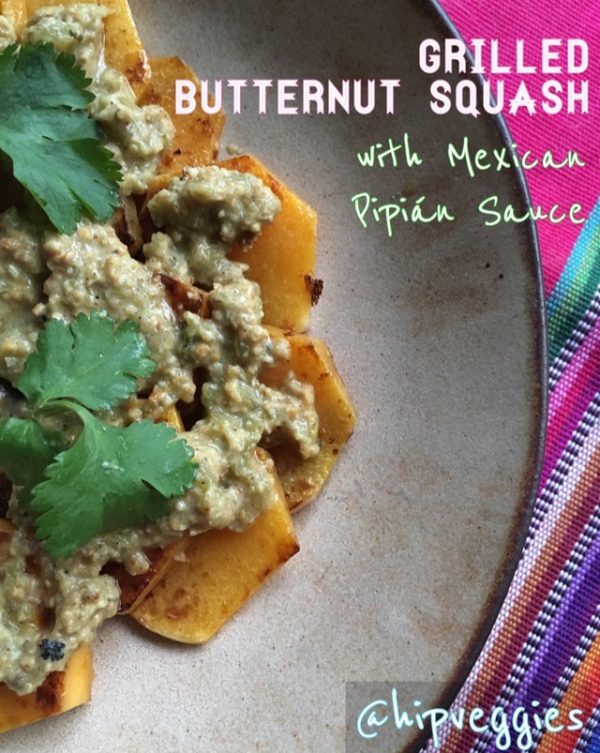
    Recipe: Grilled Butternut Squash with Mexican Pipián Sauce

    i8tonite: The Case for Mesquite Coffee with Food Person Monika Woolsey (Or When the Apocalypse Happens)

    Serves 2

    1 butternut squash
    1 tablespoon peanut oil
    Salt
    1/2 cup 505 Southwestern Green Chile, Tomatillo, Cilantro, and Lime Salsa
    ¼ cup raw, unsalted peanuts
    ¼ cup pumpkin seeds

    Clean the squash

    Peel butternut squash and cut into thin slices; set slices in a small mixing bowl. Set aside the seeds you recover while cleaning and preparing the squash.

    Make the pipián sauce

    Place reserved squash seeds in a ¼ cup measuring cup. If you do not have ¼ cup of seeds, add enough pumpkin seeds to measure as ¼ cup. Add these seeds and the peanuts to the skillet, and toast them over medium heat. Stir frequently.

    When the seeds and peanuts start to pop, turn off the heat and let them continue to cook in the heat remaining in the skillet.

    Place seed/peanut mixture in a spice grinder, a coffee grinder, or a food processor and grind thoroughly.

    Remove mixture from grinder and set aside.

    Cook the squash

    Add peanut oil to the squash; toss to evenly coat slices with oil.

    Salt lightly.

    Place squash slices on a grill (or in a cast iron skillet over medium heat) and cook until both sides are nicely browned. It should take just a few minutes on each side. Remove from heat and set aside in dish.

    Assemble the dish

    Arrange the squash pieces attractively on a serving plate.

    Spoon pipián sauce over the squash slices.

    Garnish with cilantro.

    Enjoy!

  • My Favorite Dishes of 2016

    My Favorite Dishes of 2016

    As 2016 began, it was planned that Nick, me and the kids — Holly, the 11-year-old pitbull and our 7-year-old Frenchie, JJ — were moving to Denver from Phoenix. Our intention after twelve months in the Sonoran Desert was to relocate to the Mile High City for his work. Our last stop was the Rocky Mountains. However, after all that, we have found ourselves back in Southern California, where we had originally started. Not in Los Angeles – coming full circle — but in Newport Beach, behind the Orange Curtain. Still for Nick’s work, but with a fluffier job description.

    It’s a good location for us. Far from the histrionics of the world’s entertainment capital. Yet, we discuss missing Camelback Mountain rising out of the valley, the vast blue skies and, of course, the food. Phoenix taught me that good eating can be found anywhere if you are looking for it. It doesn’t have to be in one of the anointed culinary islands such as New York, Chicago, San Francisco or Los Angeles.

    While living in Phoenix, I discovered deep blended roots of Mexican and Native American food. Indeed, it’s common for local hunters born of Mexican descent to shoot game such as moose or elk during the holiday season. The braised meat is then turned into Christmas tamales and frozen to eat throughout the year. It’s a practice that goes well beyond the area’s 114 years as a state. Originally, Mexican settlers joined with the natives crafting unique food and then in turn, became Americans when the 48th state entered the Union.

    I bring this up because I read a well-known restaurant writer’s suggestions of “best food trends”. In her lengthy piece, she proffered gastronomic extravagances in Copenhagen, Paris, and of course, the Big Apple which is where she is based. I can always choose what is great elsewhere, from Singapore to Argentina, France to Greece. However, I think it’s our duty to describe what is “great” in America. Our culinary prowess is the myriad of cultures creating our nation – borrowing from here and there, making our own indigenous taste profiles such as fried chicken, pot roast or apple pie. Derived from other places, but made here crafting American comfort. We need to recognize that we are great, looking only to our dinner tables.

    Unlike the writer, who travels often, I didn’t get on a plane this year except a roundtrip to Vegas and Phoenix. After almost two dozen countries and nearly 250 cities, I’m not big about getting on planes anymore; plus, I love the dining scene in smaller cities such as Phoenix, Portland and even in Orange County, California. They aren’t massive but what’s cooking is robust and lively.

    As go into the new year, as a nation, we have dreamed up all types of unique food – Mexican-Korean tacos, Japanese sushi with Brazilian flavors, Thai with Texas BBQ– turning it into one melting pot of goodness. The ingredients simmering on the American stove is where we have always been welcoming, tasting little bits of this and adding some of that. Authentic American flavor is made from our fusion of cultures right here at home and it’s always been great.

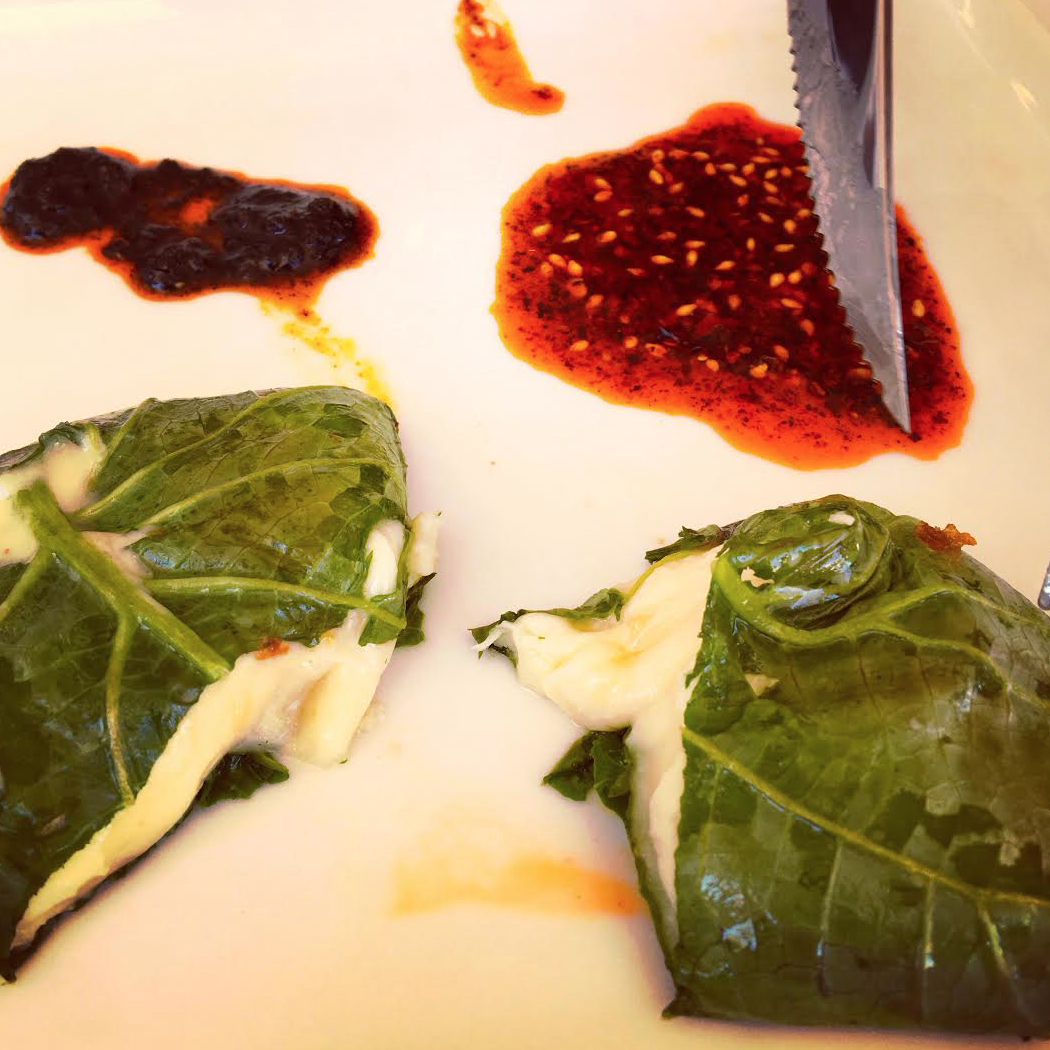
    Hoja Sante stuffed with Mennonite Cheese, Gran Reserva Barrio Café : Chef Silvana Salcido Esparza (Phoenix, Arizona).

    Chef Silvana Salcido Esparza should be a nationally recognized chef and it’s a shame she’s not. She is a proud Mexican American born in the United States and is un-WASP-like most Food Network stars such as Giada, Rachel or even Paula Deen.  At her five restaurant mini-empire based in Phoenix, her cooking is Mexican but with European techniques. At Gran Reserva Barrio Café, her new restaurant which opened in spring 2016, Esparza’s creativity is evidenced in the simplicity of a melty hunk Mexican Mennonite cheese, wrapped burrito-like in a large hoya sante leaf and served with two smoky chili pastes. Simple. Traditional and yet still other worldly.

    Image result for Hoja Santa Gran Reserva Arizona Latinos

    The indigenous plant is not commonly found north of the border, and when it is, it’s usually used in stews and braises. Esparza uses it whole, instead of strips, allowing the anise flavor to compliment the queso’s milky texture. The venomous bite of the peppers is nulled by the dairy and leaving only smokiness. Texturally, the crunch of the leaf, emission of creaminess and a nullified heat is eye-opening. As I sat eating the dish, along with interviewing the Phoenix-based chef for Arizona Latinos, she imparted the history of the Mexican Mennonites and how they are still important to the agriculture of the country.

    This gooey delicious dish is modest, and that’s what makes it brilliant.

    Chicken Liver Pasta, Sotto:  Chef Steve Samson (Los Angeles, CA)

    On a media tasting invite, I went through a selection of items chosen by Chef Steve Samson at his almost six-year-old restaurant Sotto. The cozy space is inviting with blue walls, wooden tables and chairs as is Mr. Samson, who is one of the kinder cooks in the culinary world.

    Going through his menu, which is all yummy the standout, became the housemade Rigatoni tossed with Chicken Livers, Parmigiana Reggiano and Porcini. It’s a daring dish for Angelenos to embrace. First, there are the carbohydrates but second the livers aren’t normally found on regular menus much less Italian. Having traveled often to Italy, I didn’t recall pasta and innards used in this way and asked Samson where it was based. It was his unique twist on the typical Bolognese ragu. Instead of throwing away something tasty, he invented this earthy and rustic dish. I’m not fond of chicken livers – and I don’t know many people who are – but this I would eat every day for the rest of my life.


    Jardineros (Garden) Tacos, Taco Maria: Chef Carlos Salgado (Costa Mesa, CA)

    Taco Maria is a high-end eating experience much like the Rick Bayless’ chain Red O or even Phoenix’s independent Barrio Café (see above). White tablecloths, waiters with crumbers and sparkling water served in wine glasses, my type of my place, where a diner feels special. Located inside a mall within a mall, it is an indoor-outdoor space which is a good showcase for the unique tastes presented by Chef Carlos Salgado.

    Much has been written about Salgado and for good reason, his fusion of California agricultural and Mexican cooking produce, arguably the country’s best tacos. Ordering a la carte during lunch, there are a five varieties of the national south of the border food: chicken, beef, pork,  fish and vegetarian. Exceptional eats every single one, wrapped with the housemade delectable blue corn tortillas found only at Taco Maria. (B.S. Taqueria gets their masa from here too.) The standout is clearly the vegetarian (jardineros) made with shitake mushroom chorizo, a crispy potato and queso fundido. Separately, each one would make a great filling but together, they create something truly different. The minced fungi spiced with traditional south of the border flavorings texturally give the chorizo a meat-like consistency. However, it’s the flavor which is a standout.

    Pasta dishes, Tratto: Chef Chris Bianco (Phoenix, AZ)

    Legendary chef Chris Bianco is  renowned for Pizza Bianco. Matter of fact, his pizzas have been called the best in the world by former “Vogue” food writer Jeffrey Steingarten. Therefore, when someone invites you to Tratto, his new restaurant which opened in early summer 2016 in the same mall as his world-renowned pizzeria, you go – but not for his pizzas. At his new space, he has opened his creativity to showcase other goodness derived from Arizona farmers; mostly notably, the wheat growers.

    Bianco does everything else but pizzas. Old-fashioned, Italian food but a real display of southwestern growers. I don’t mean peppers, tomatoes and cheese but bold pairings such as beets and gorgonzola roasted in a fig leaf. All ingredients are sourced from the 48th state, crafting Italian food. Don’t question it but eat his handmade pastas which are carefully crafted by Bianco. Get off the carb diet and have a bit of heaven.

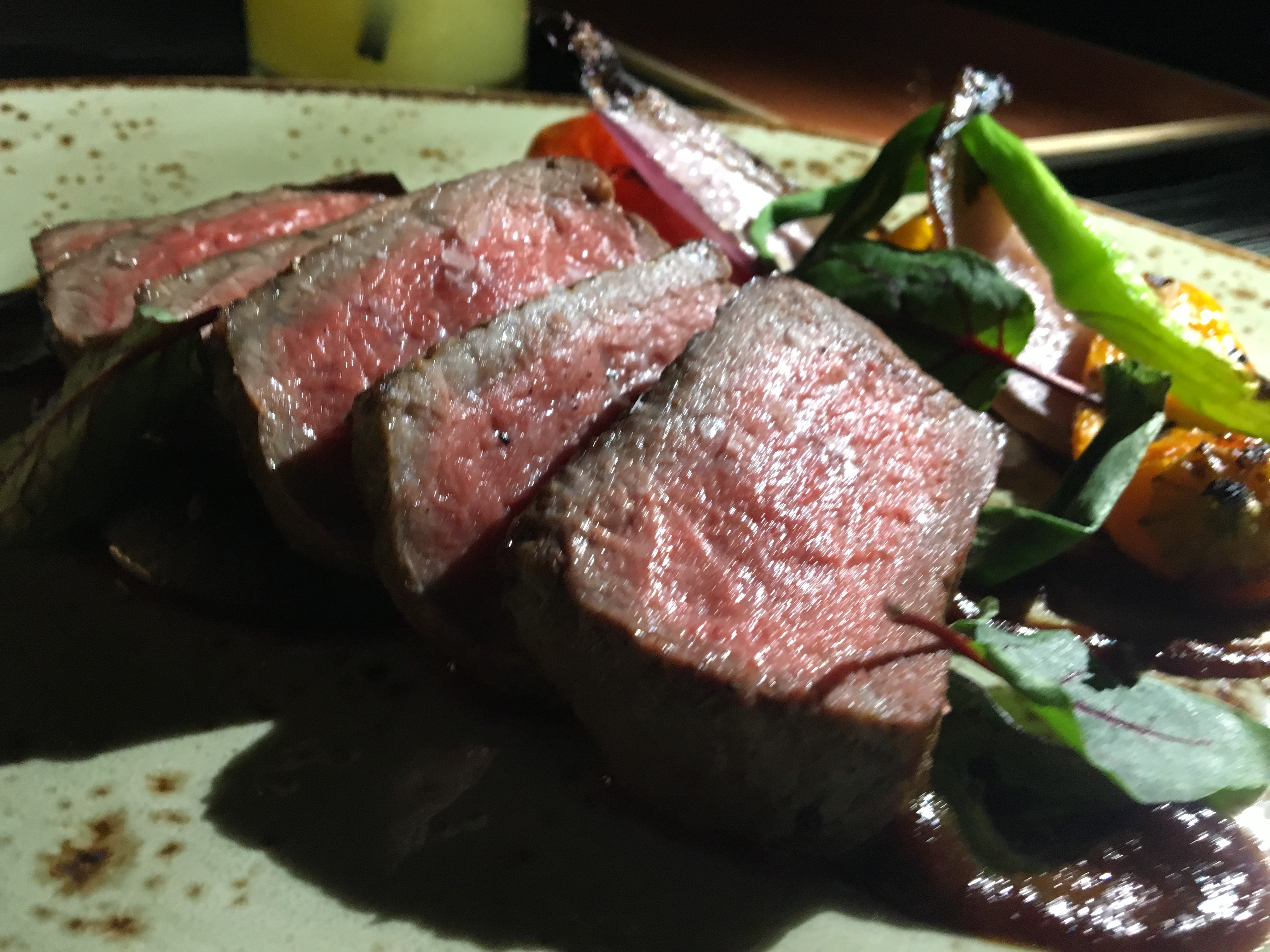
    Beef Tenderloin with Mole Negro, Talavera at Four Seasons Scottsdale: Chef Mel Mecinas (Phoenix, Arizona)

    To reiterate, I’ve listed the dishes I’ve eaten over the course of the year which I remember fondly. Eating them, at the restaurant, the conversations around them and how good they are. Nothing comes as close to Chef Mel Mecinas and his mole negro and beef tenderloin.

    Mole is probably one of the world’s most difficult sauces to make. Consisting of more than two dozen ingredients ground and simmered into a liquid, resulting in something edible which is complex, luscious and fortifying. Fish is too delicate for the earthiness but lean cuts of meat provide a great experience to taste the Mexico pottage which is what diners get at Talavera under the capable hands of Chef Mecinas.

    Unfortunately, he no longer works at the restaurant where he was the Executive Chef for more than a decade. Greener pastures beckoned. However, one day I hope the world gets to eat his extraordinary mole.


  • i8tonite with Phoenix’s TEXAZ Grill Chef Steve Freidkin & Chicken Fideo Recipe

    i8tonite with Phoenix’s TEXAZ Grill Chef Steve Freidkin & Chicken Fideo Recipe

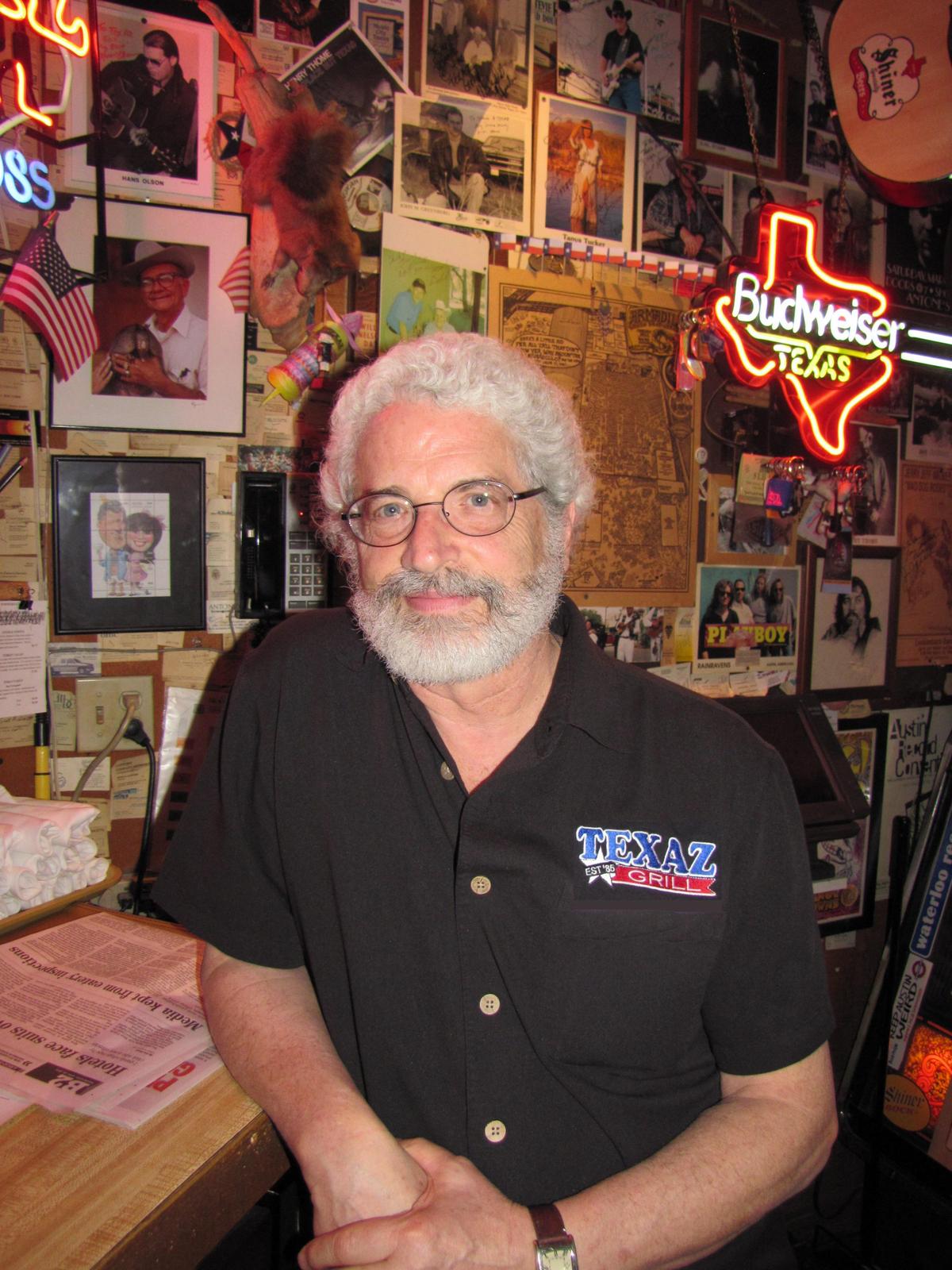
    i8tonite with Phoenix's TEXAZ Grill Chef Steve Freidkin & Chicken Fideo RecipeChef and owner of TEXAZ Grill Steven Freidkin is that rarity in restaurants nowadays. Long before the Food Network and celebrity cooks ruled our dinner tables, Freidkin had always been a good, respectable chef, and learning the trade not in fancy culinary schools, but employed in the eateries were he worked. As a pre-teen, he began his kitchen career working at his family’s kosher deli in Shreveport, Louisiana cutting up corned beef in the front and then hanging with his friends. Reminiscing about his youth, Freidkin said, “We would be hiding behind the pickle barrels.  We were the only store that cured our own pickles.”

    His first job away from his parents’ store was as a dishwasher. Then while attending college in the Dallas, he cooked in many kitchens, learning that this could be his way of making a living instead of getting a social work degree. Ultimately, this led him to turn specifically failing restaurants into moneymakers. For a bit of time, he worked for well-known Victoria Station, a popular chain of railroad themed steakhouses that proliferated throughout the 1970s and 80s.

    Arriving in Phoenix in 1976 on a proposition to a restaurant called Pointe of View located by Squaw Peak, he’s been in the Valley of the Sun ever since.

    Before TEXAZ Grill, there were a couple of other stints in restaurants and a catering company, but in 1985, he, along with a former partner, opened the Phoenician steakhouse landmark. TEXAZ Grill isn’t one of the high-end places where people drop their credit cards to pay for the hefty price-tag on a wine and ribeye. No. Freidkin has established an important Valley of the Sun staple – as important as a saguaro cactus on a dusky evening — among the steak and chops set, leading the southwestern pack in crafting down home eats.

    i8tonite with Phoenix's TEXAZ Grill Chef Steve Freidkin & Chicken Fideo Recipe

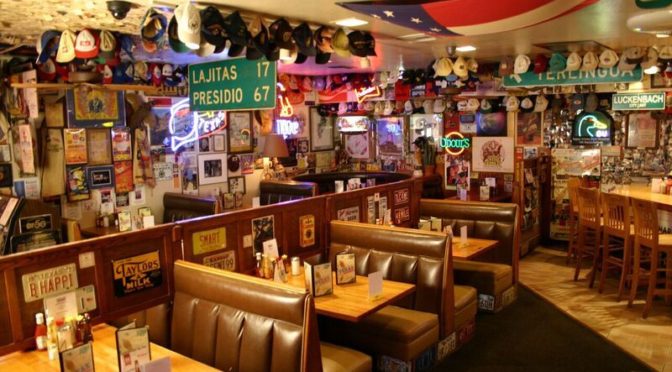
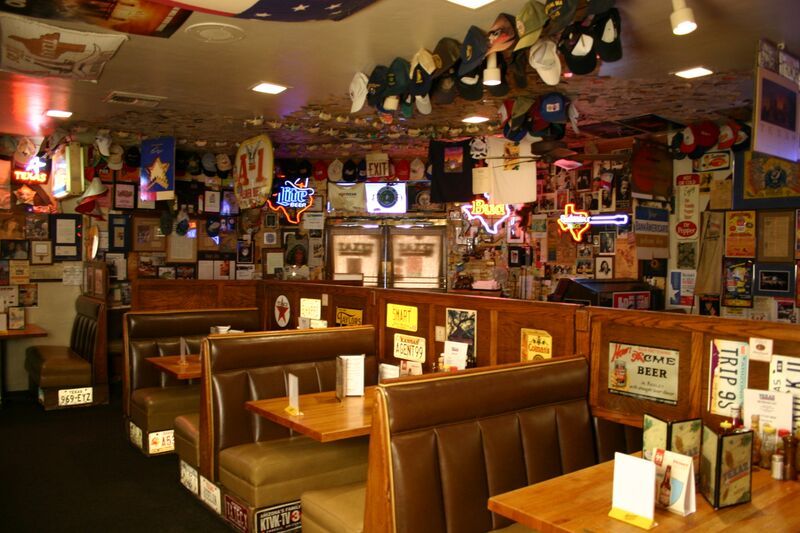
    Regulars come to sit in the eclectically decorated space. Walls filled with hundreds of baseball hats, deer heads, pen and ink drawings found in thrift stores, black and white photos, and beer labels lavishly cover the space. It’s an homage to roadhouses long gone, or it’s an actual roadhouse, depending on your personal age and reference.

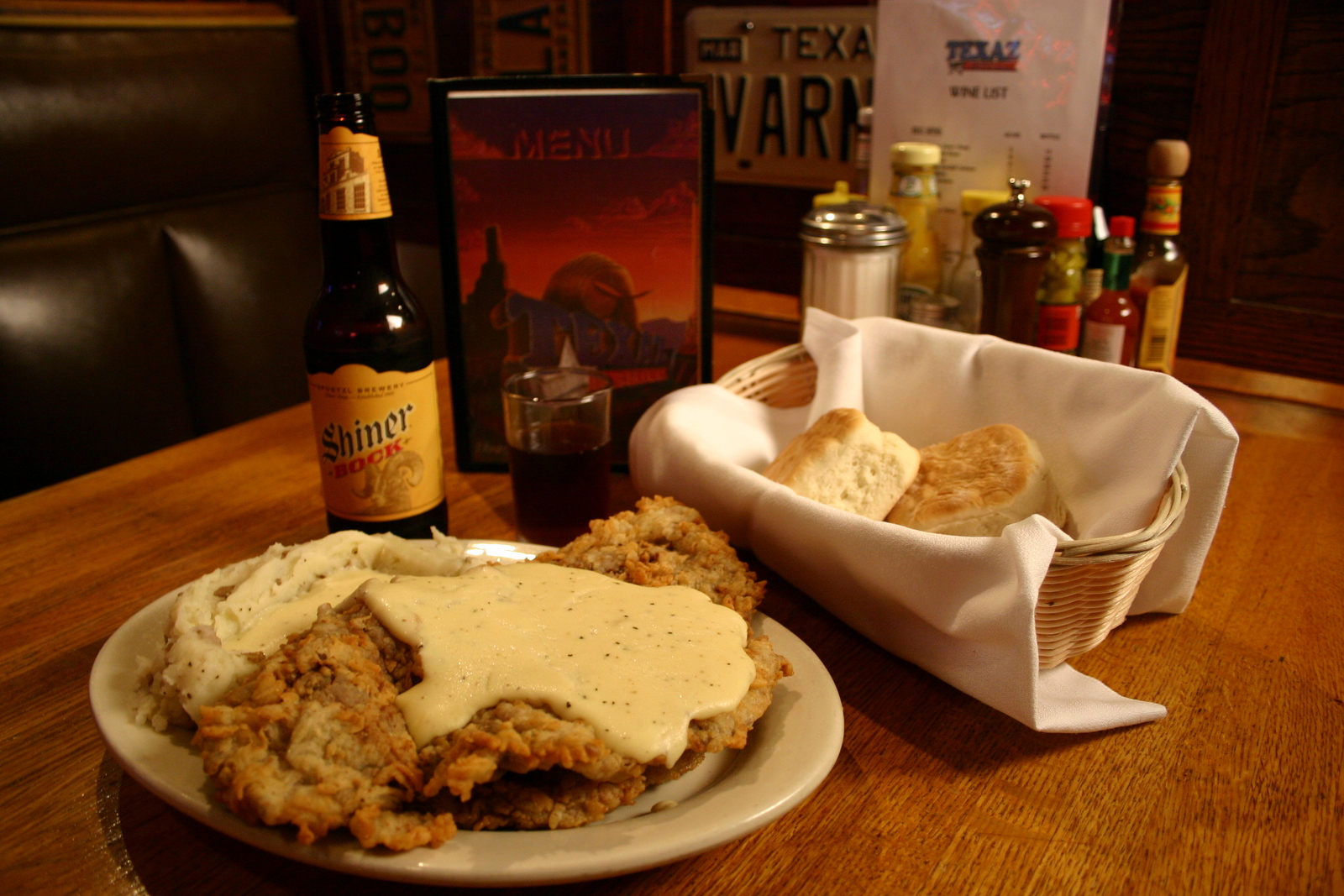
    Among the ribeye and the New York Strip, listed above the delicious stalwart of fried chicken, is the house specialty – the chicken fried steak. Friedkin recalls, “When we first opened, we had a lot of requests for it. We put it on the menu for a special, and then gradually it stayed.” Two big breaded cubed steaks are dredged in flour, deep-fried, and served with white gravy. “We have served more than 900,000 of these since we opened,” Freidkin comments. Here’s to 900,000 more.

    i8tonite with Phoenix's TEXAZ Grill Chef Steve Freidkin & Chicken Fideo Recipe


    Chef Questionnaire (with a nod to Proust):

    How long have you been cooking?
    I started cooking in our family delicatessen in Louisiana when I was 10, so I have been cooking 50 years.

    What is your favorite food to cook?
    My favorite dish to cook is noodles, Cajun and Creole.

    What do you always have in your fridge at home?
    I always have pickled okra in my fridge.

    What do you cook at home?
    I cook everything- Mexican, Asian, Southern, Italian, Greek, Middle Eastern…and I fridge raid (clearing out the fridge and making a full meal).

    What marked characteristic do you love in a customer?
    Friendliness.

    What marked characteristic do you find unappealing in a customer?
    Unfriendliness.

    Tupperware, Rubbermaid, or Pyrex?
    Pyrex.

    Beer, wine, or cocktail?
    All of the above. My favorites range from a Shiner Bock, Old Vine Zin, and Tito’s on the rocks with a pickled Okra.

    Your favorite cookbook author?
    Robb Walsh.

    Your favorite kitchen tool?
    Japanese Cleaver.

    Your favorite ingredient?
    My favorite ingredient is black pepper.

    Your least favorite ingredient?
    My least favorite ingredient is CILANTRO!

    Least favorite thing to do in a kitchen?
    Clean up!

    i8tonite with Phoenix's TEXAZ Grill Chef Steve Freidkin & Chicken Fideo Recipe

    Favorite types of cuisine to cook?
    Southern, Italian, Mexican, and Asian.

    Beef, chicken, pork, or tofu?
    Beef.

    Favorite vegetable?
    Eggplant.

    Chef you most admire?
    The chef I admire most locally is Robert McGrath.

    Food you like the most to eat?
    Noodles, Creole and Cajun are my favorite foods to eat. My absolute favorite is Texas BBQ.

    Food you dislike the most?
    Liver.

    How many tattoos? And if so, how many are of food?
    N/A.

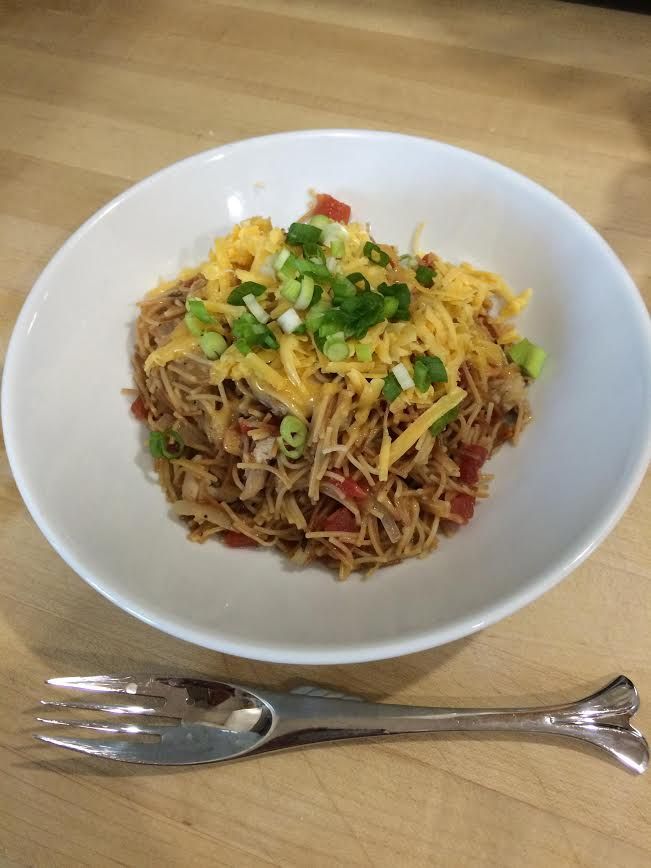
    Recipe: Chicken Fideo

    i8tonite with Phoenix's TEXAZ Grill Chef Steve Freidkin & Chicken Fideo Recipe

    Serving Size: 5
    Prep Time: 0:21

    Ingredients:
    7 oz vermicelli — fideo
    1 oz butter
    3 cups cubed chicken thigh meat
    1 c julienned onion
    2 t minced garlic
    1 can Ro-tel tomatoes
    3 cups water
    2 t chicken bouillion paste
    1 t oregano
    2 t whole cumin
    2 oz canned jalapeno peppers – juice

    Directions:
    Brown fideo in butter until golden.
    Add onion and garlic and saute briefly.
    Add chicken and cook for 3 minutes.
    Add the rest of the ingredients and cook over moderate heat, until done – about 30 minutes.
    Serve topped with sliced green onion and grated cheddar.
    – The End. Go Eat. –

  • i8tonite with Phoenix’s Crudo Chef Cullen Campbell & Recipe for Semolina Gnocci with Trotter Ragu & Cacio e Pepe

    i8tonite with Phoenix’s Crudo Chef Cullen Campbell & Recipe for Semolina Gnocci with Trotter Ragu & Cacio e Pepe

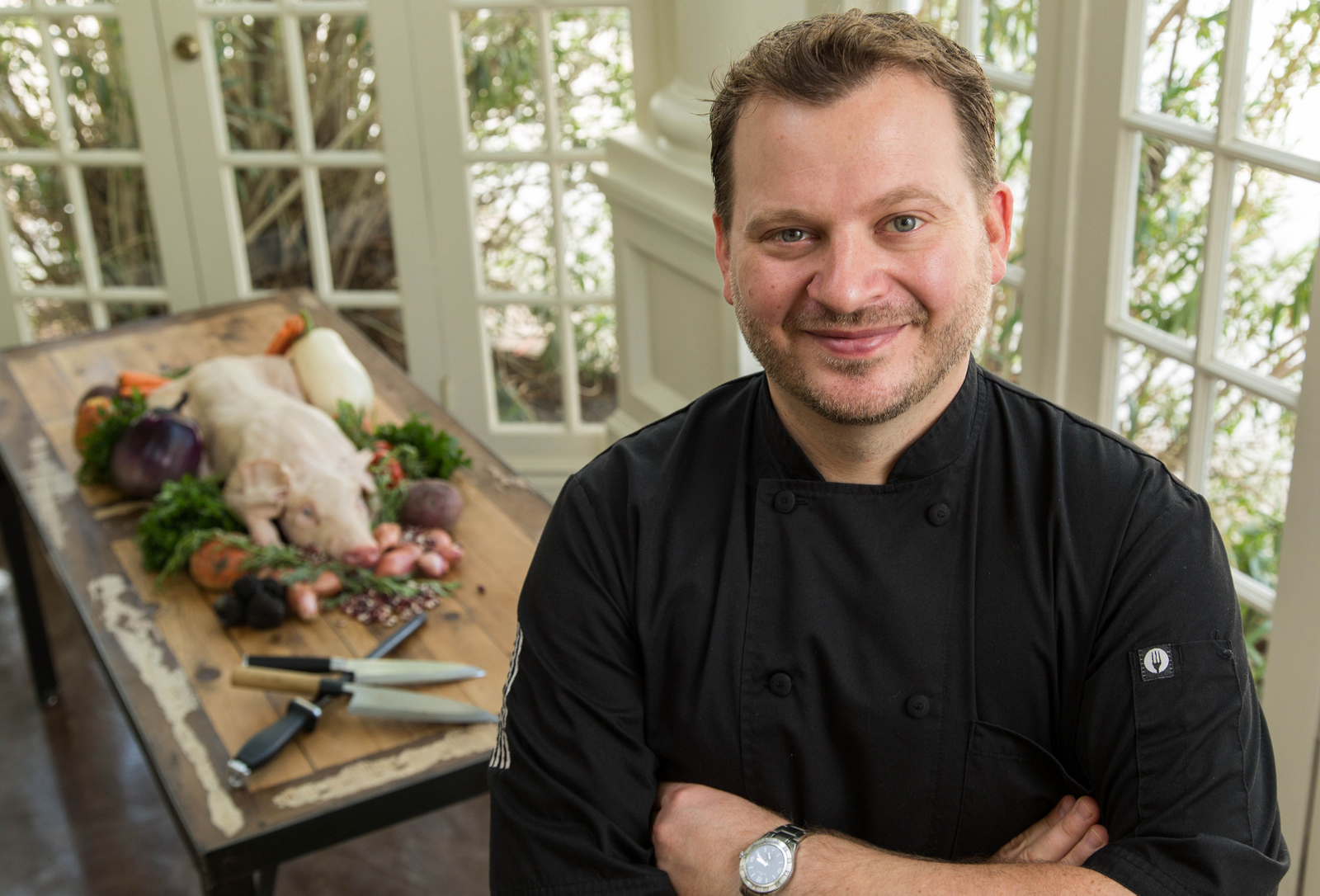
    i8tonite with Phoenix's Crudo Chef Cullen Campbell & Recipe for Semolina Gnocci with Trotter Ragu & Cacio e Pepe“After college, I thought I was going to go to California, but I got delayed,” says noted Chef Cullen Campbell, chef owner of the nationally known Phoenix-based Crudo, which he opened in 2012 with mixologist Micah Olson. Last year, the duo, along with Campbell’s wife Maureen McGrath, unlocked Okra, a Southern-themed restaurant with touches of Italy, harkening back to growing up in Arkansas. Although born in the 48th state, Campbell spent time on the Arkansas family farm and attended university in Memphis, where he picked up some of the deep Southern touches that craft the excellent flavors of his sophomore effort. Clearly, he wanted to bring some of that country to Arizona.

    i8tonite with Phoenix's Crudo Chef Cullen Campbell & Recipe for Semolina Gnocci with Trotter Ragu & Cacio e Pepe

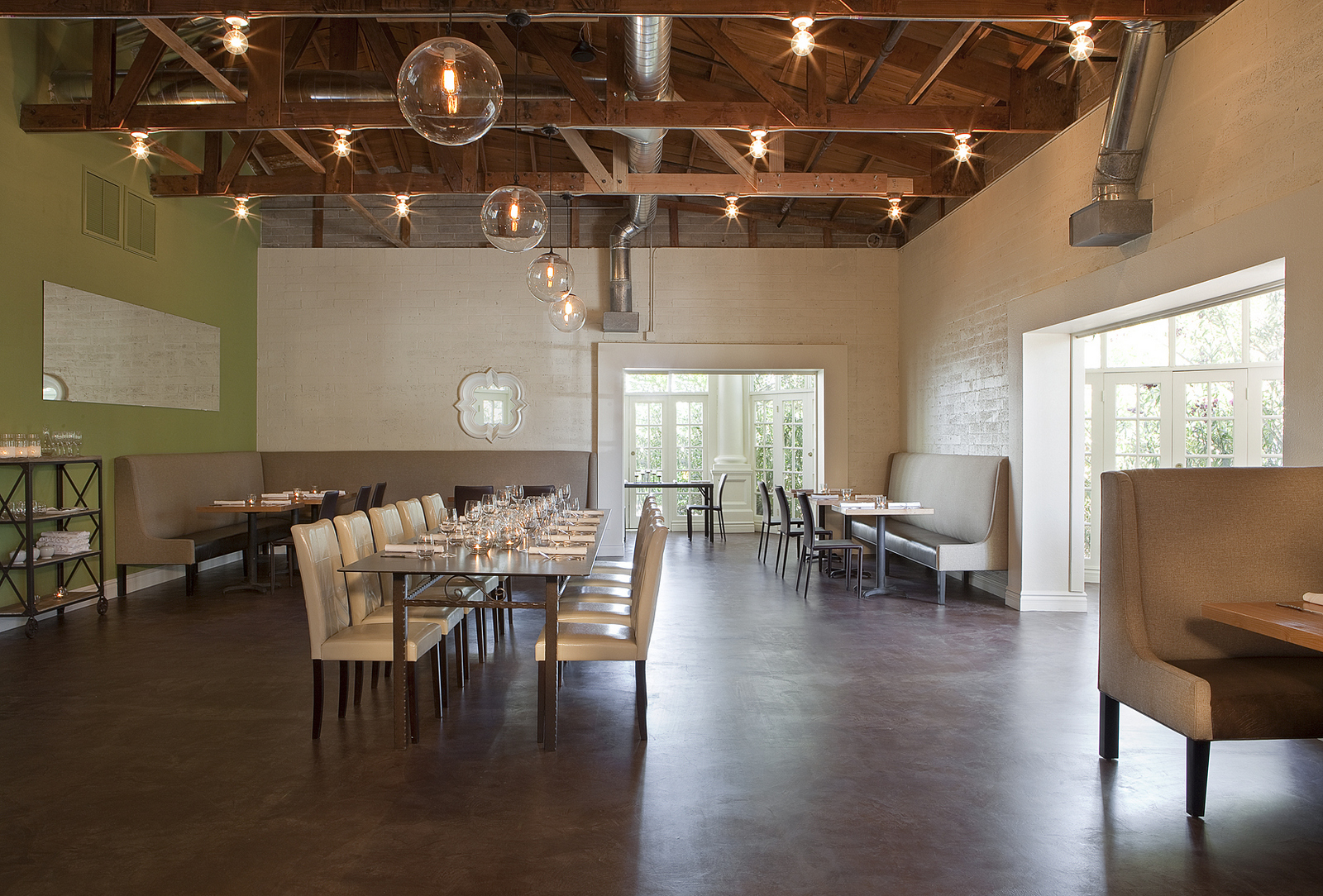
    Like the Sonoran Desert, the interiors of both places are wide and vast. There aren’t any nooks or cubby holes  for clandestine dinners to hide in. The restaurants are boisterous, raucous affairs, letting the diner know they are in for a delicious meal. Crudo is the higher end of the two, with a collage of shutters as artwork at the entrance, but it’s the casual wood-tones of Okra which come across warmly. Both restaurants, though, are a showcase of Campbell’s kitchen talent. Arizona Republic’s restaurant critic Howard Sefetel said in his 2012 review of Crudo, “What makes Campbell’s fare stand out? Certainly, the ingredients are primo. But what Campbell does with them is often highly original and always skillfully executed.”

    i8tonite with Phoenix's Crudo Chef Cullen Campbell & Recipe for Semolina Gnocci with Trotter Ragu & Cacio e Pepe

    Since then, the kitchen star has been on the rise, putting Valley of the Sun’s dining and drinking culture on the national culinary map, with noted stories in Sunset Magazine, USA Today, and Los Angeles Times.

    What’s next on the horizon for the Arizona cooking wunderkind? “I have a bunch of different concepts I want to try out. Something small and higher end with no more than a dozen tables. Then I have a hot dog concept I want to do with Micah. Cocktails. Beer and wine list all paired for the dogs.”

    Whatever Campbell does, we know it will be delicious.

    Chef’s Questionnaire (with a nod to Proust):

    How long have you been cooking?
    I have been cooking for 20 years.

    What is your favorite food to cook?
    My least favorite food is Shellfish.

    What do you always have in your fridge at home?
    I have wine, water, & leftovers.

    i8tonite with Phoenix's Crudo Chef Cullen Campbell & Recipe for Semolina Gnocci with Trotter Ragu & Cacio e Pepe
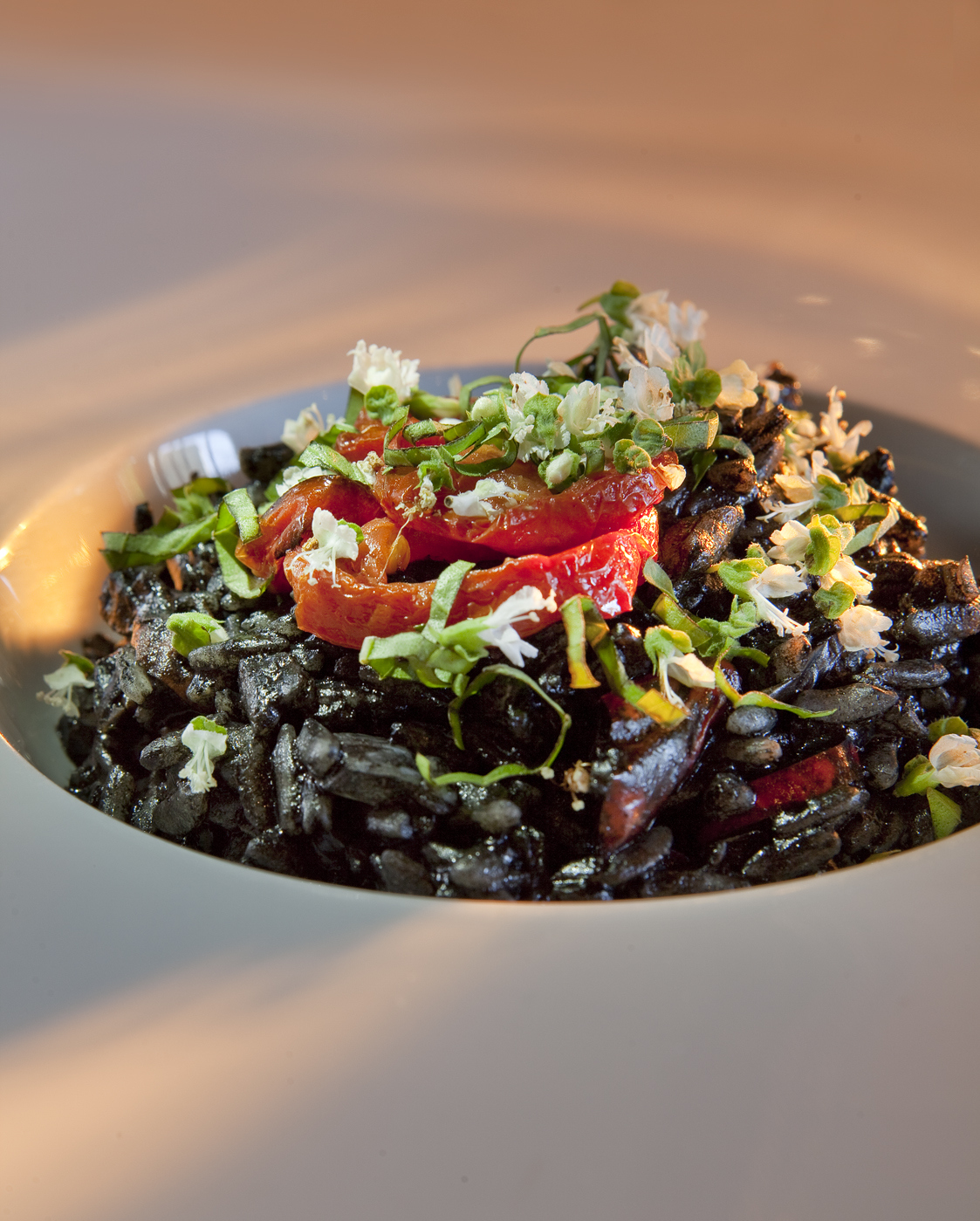
    Squid Ink Risotto

    What do you cook at home?
    Not much but sometimes, I r&d at my house. I just made some pici, which is like a thick hand rolled spaghetti. I love hand rolling pasta!

    What marked characteristic do you love in a customer?
    The person wanting to try everything.

    What marked characteristic do you find unappealing in a customer?
    The person that is scared to try new things.

    Tupperware, Rubbermaid, or Pyrex?
    Rubbermaid.

    Beer, wine, or cocktail?
    Wine all the way, especially really great white wine.

    i8tonite with Phoenix's Crudo Chef Cullen Campbell & Recipe for Semolina Gnocci with Trotter Ragu & Cacio e Pepe
    Burrata

    Your favorite cookbook author?
    David Joachim. Not only has he written his own books, he has also collaborated on some of my favorite books.

    Your favorite kitchen tool?
    Spoons.

    Your favorite ingredient?
    Olive Oil.

    Your least favorite ingredient?
    Anything processed.

    Least favorite thing to do in a kitchen?
    Clean. I make a mess haha!

    Favorite types of cuisine to cook?
    I go through spurts. Of course Italian & southern. But I have started playing around with Polynesian.

    i8tonite with Phoenix's Crudo Chef Cullen Campbell & Recipe for Semolina Gnocci with Trotter Ragu & Cacio e PepeBeef, chicken, pork, or tofu?
    Pork.

    Favorite vegetable?
    Rapini.

    Chef you most admire?
    I have two: Jean Georges Vongerichten & Marc Vetri. One is very refined & the other is more rustic, but they both work with the best ingredients & don’t overcomplicate dishes.

    Food you like the most to eat?
    Cheeseburger & fries!

    Food you dislike the most?
    I eat everything!

    i8tonite with Phoenix's Crudo Chef Cullen Campbell & Recipe for Semolina Gnocci with Trotter Ragu & Cacio e PepeHow many tattoos? And if so, how many are of food?
    I only have two at the moment. One of them is an alcohol in Japanese. But I want to get a fork & spoon on me. Also, one that celebrates my restaurants – Crudo & Okra.

    Recipe: Semolina Gnocci with Trotter Ragu & Cacio e Pepe

    i8tonite with Phoenix's Crudo Chef Cullen Campbell & Recipe for Semolina Gnocci with Trotter Ragu & Cacio e Pepe
    Semolina Gnocchi

    Semolina Gnocchi
    3 cups milk
    1/2 cup butter
    11/2tsp salt
    4 egg yolks
    1 cup parmesan
    1 cup semolina

    Put milk, butter, & salt into a medium pot (bring to a boil).
    Add semolina & whisk vigorously for 4 minutes.
    Add 1 egg yolk at a time while stirring.
    Then add the parmesan and whisk until the cheese melts, about 3 minutes.
    Spread mixture on a sheet tray & let cool for 45 minutes.
    When cooled, cut out circles with a ring mold.
    Sear the gnocchi in a pan on medium heat until golden brown.

    Cacio e Pepe
    1 cup heavy cream
    1/2 cup grated parmesan
    1/2 cup grated pecorino remano
    1tbs roux
    2tbs fresh ground black pepper
    Salt to taste

    Heat heavy cream & both cheeses together until melted.
    Add roux to thicken & then add the pepper.

    Trotter Ragu
    5lbs pig trotters
    1 yellow onion chopped
    1 head of garlic chopped
    1/4 cup olive oil
    3oz thyme picked & chopped
    6 cups da napoli crushed tomatoes
    6 cups meat stock
    2tbs salt
    1tbs fresh ground pepper

    Preheat oven to 375 degrees
    In a roasting pan, brown the trotters in the olive oil.
    Add onion, garlic, and thyme & stir until fragrant.
    Season with the salt & pepper.
    Add crushed tomatoes and meat stock & cover the pan tightly with foil or lid.
    Lower the oven to 300 degrees & cook for 3.5 hours.
    After pulled from the oven, let the trotters cool down for about an hour.
    After cooled, shred the trotters off the bones & mix back into the sauce.

    To Plate
    Put the ragu in the bottom of the bowl, arrange gnocchi, & top with a generous amount of cacio e pepe

    – The End. Go Eat. –

  • i8tonite with Scottsdale’s J&G Steakhouse Chef Jacques Qualin & Recipe for Roasted Whole Snapper with Yuzu Sauce

    i8tonite with Scottsdale’s J&G Steakhouse Chef Jacques Qualin & Recipe for Roasted Whole Snapper with Yuzu Sauce

    i8tonite with Scottsdale’s J&G Steakhouse Chef Jacques Qualin & Recipe for Roasted Whole Snapper with Yuzu Sauce

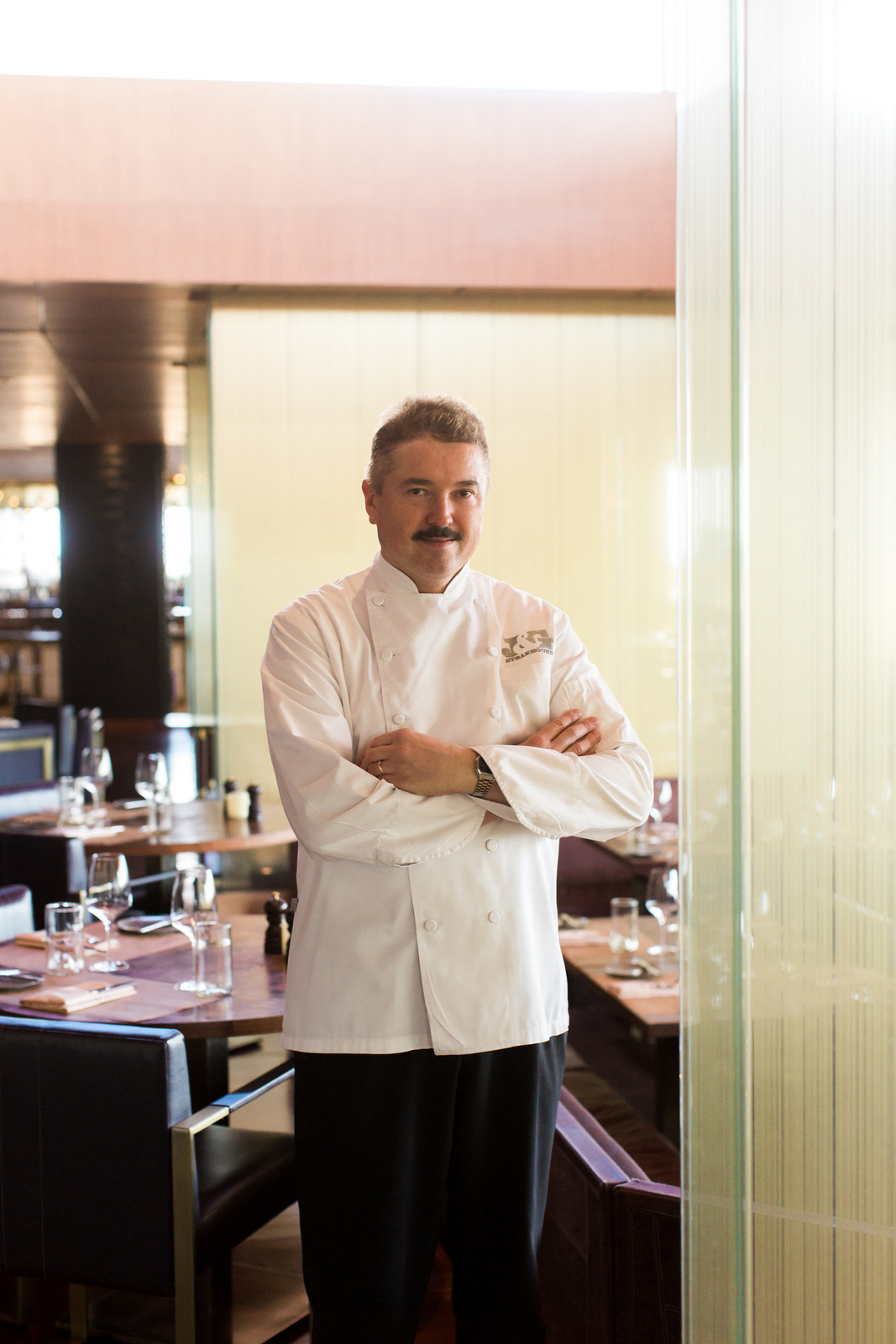
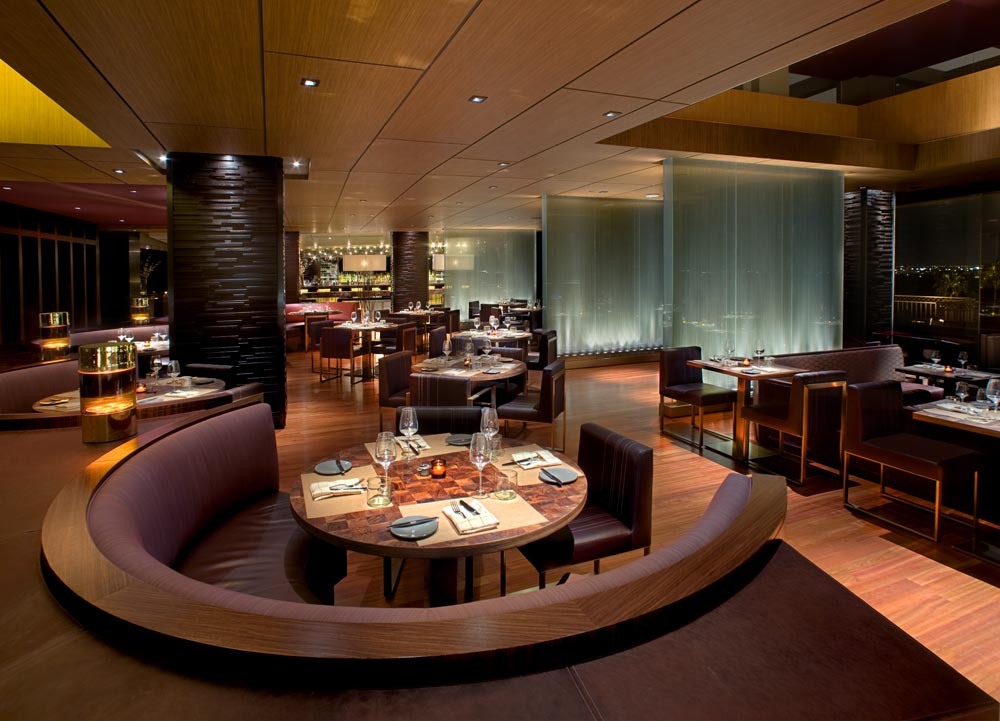
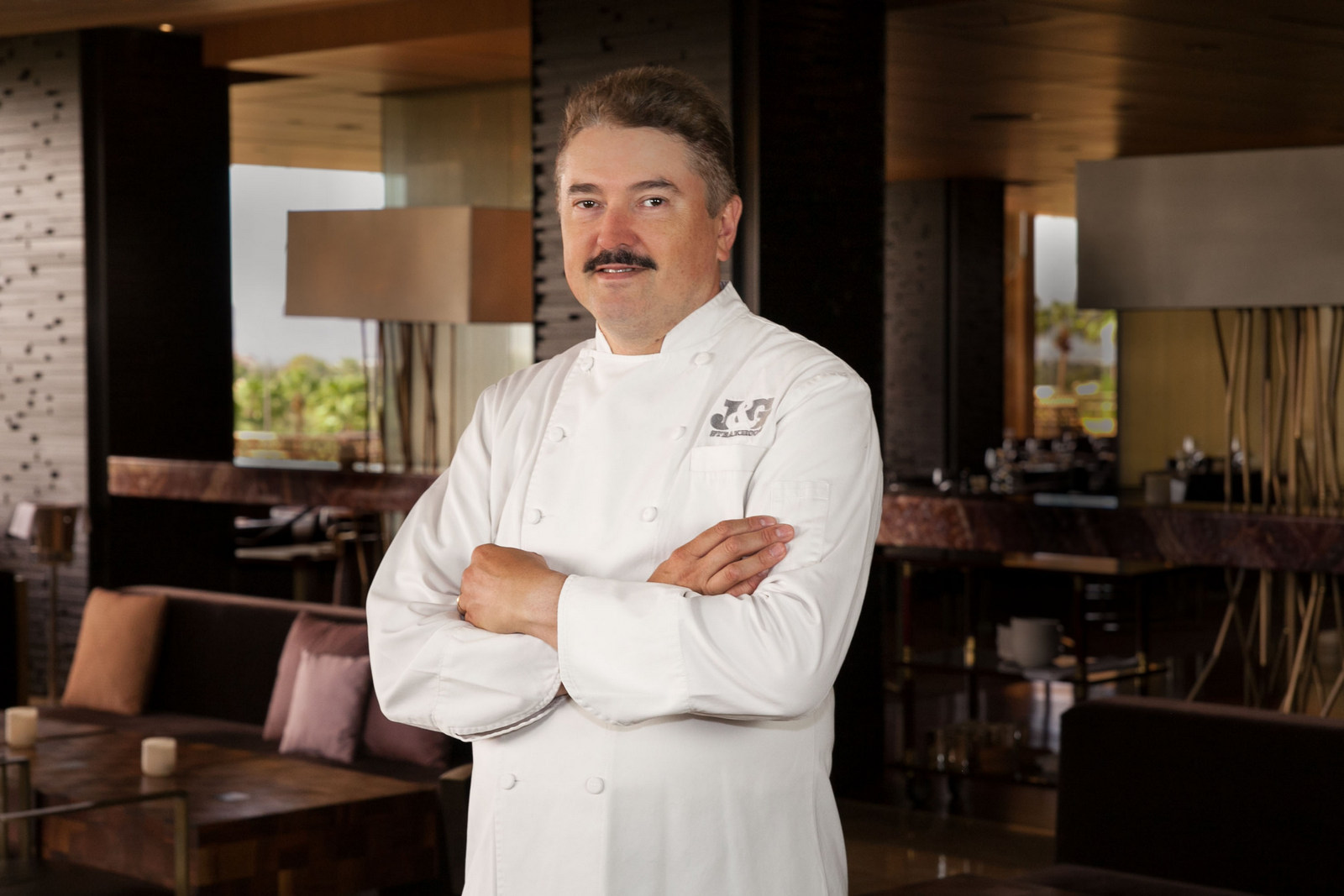
    The world is full of great food and chefs – we only need to open our tastebuds to them. For instance, at Scottsdale’s J&G Steakhouse, at The Phoenician, a Starwood property, French-born Executive Chef Jacques Qualin may be the area’s only stove helmer to have worked at four Michelin restaurants – two in France and two in New York – a very rare distinction. If you are a sports fan, it’s like saying you played soccer with Manchester United and Real Madrid; then moved to the United States, and played baseball with the Yankees and Mets.

    Qualin, like many chefs, started cooking with his mother, tying his apron strings and sticking close to her, learning about food from the region of his birthplace, Franche-Comté, home to Comte and Emmenthaler cheeses. As a young cook, he traveled to Paris, where he studied under Michelin-rated chef Michel de Matteis, working at his three-star Restaurant Taillevent, defined by The New York Times as “the best in Paris, if not all of France.” Several other kitchens later, including working for Daniel Boulud in New York at the world famous Le Cirque, Qualin worked again in Paris as at the cosmopolitan Restaurant La Marée, before working with his friend Jean-Georges Vongerichten at Jojo’s on East 58th Street as the culinary great’s first sous chef.

    After closing his seventy seat restaurant in upstate New York, The French Corner, The New York Times reviewer said, “(Qualin) created a unique and wonderful restaurant…delightfully rustic and complex all at once.” Vongerichten asked him about working together again, this time in Phoenix. He says, “I had been in France and New York City for fourteen years and I was looking for opportunities to come to the West Coast.”

    i8tonite with Scottsdale’s J&G Steakhouse Chef Jacques Qualin & Recipe for Roasted Whole Snapper with Yuzu SauceWorking in the Valley of the Sun, Qualin now defines himself as a “Frenchman who cooks with an Asian flair,” speaking to Vongerichten’s penchant for European and Asian cuisine. He says about working at J& G Steakhouse, a long distance from European Michelin restaurants, “I like good food and I like the brasserie-style we have at J&G. It’s a different restaurant than before, but it’s a steakhouse. I like that.”

    Chef’s Questionnaire (with a nod to Proust):

    i8tonite with Scottsdale’s J&G Steakhouse Chef Jacques Qualin & Recipe for Roasted Whole Snapper with Yuzu Sauce

    How long have you been cooking?
    I have been cooking as far back as I can remember, I have loved cooking my whole life.

    What is your favorite food to cook?
    I get very excited when I see or find a product that looks pristine in quality and freshness, and that’s the way the flavors will come out the best. French cooking is my soul, Italian my guilty pleasure, and I like all Asian types of cooking.

    What do you always have in your fridge at home?
    I love hot sauce, so I always have good selections from wacky hot to mild. French mustard is a must too and fresh herbs.

    What do you cook at home?
    Everything from a six course tasting for my friends, to a simply grilled fresh fish. I do like to do some classical French dishes that remind me my childhood or some Asian dishes, like a Pad Thai.

    What marked characteristic do you love in a customer?
    To be open to try new things and flavors.

    i8tonite with Scottsdale’s J&G Steakhouse Chef Jacques Qualin & Recipe for Roasted Whole Snapper with Yuzu Sauce

    What marked characteristic do you find unappealing in a customer?
    Ignorance.

    Tupperware, Rubbermaid, or Pyrex?
    I used all of them, but I tend to go back to Pyrex as it’s PBA free and can take extreme heat or cold, such as liquid nitrogen.

    Beer, wine, or cocktail?
    All of them! Depending on the mood and the occasion or the food. I love to start with a ginger margarita or a crafted beer and wine (red or white), with a preference to the old world.

    Your favorite cookbook author?
    Many of them! I do have quite a extensive collection, from old traditional French cookbooks to the latest trends in cooking.

    Your favorite kitchen tool?
    Cake tasters are very helpful for checking the food.

    Your favorite ingredient?
    Hard to say; there are too many I like, from yuzu to ginger or mint.

    Your least favorite ingredient?
    Fish sauce.

    Least favorite thing to do in a kitchen?
    Not doing anything in the kitchen.

    Favorite types of cuisine to cook?
    French/Asian.

    i8tonite with Scottsdale’s J&G Steakhouse Chef Jacques Qualin & Recipe for Roasted Whole Snapper with Yuzu SauceBeef, chicken, pork, or tofu?
    All, I like a nice Prime beef grilled to perfection, Milk feed Chicken roasted whole, Smoked and Braise Pulled pork sandwich with Habanero sauce, or seared tofu with a cilantro pesto.

    Favorite vegetable?
    Beets.

    Chef you most admire?
    Hard to pick because there are so many. Maybe Francis Mallman, as I like his philosophy of cooking and being genuine to the product.

    Food you like the most to eat?
    I like perfectly cooked pastas, Miruguai sashimi, fresh line-caught fish, and flavorful soups.

    Food you dislike the most?
    Okra.

    How many tattoos? And if so, how many are of food?
    None, not into that at all.

    Recipe: Roasted Whole Snapper Citrus and Garlic with Yuzu sauce

    i8tonite with Scottsdale’s J&G Steakhouse Chef Jacques Qualin & Recipe for Roasted Whole Snapper with Yuzu Sauce

    For the Yuzu Mayonnaise
    3 each Egg yolks
    1 tsp Salt
    2 oz Yuzu juice
    1 oz Lemon juice
    1 oz Orange juice
    1/2 qt Grape seed oil

    Combine all but the oil in the robot coupe and drizzle in the oil to emulsify. Put in a siphon and charge with 2 cartridges.(soda)

    Roasted Snapper:
    1 pc Snapper 1.2# deboned from the inside and still attached and scored.
    3 slices of Yuzu
    3 slices of oranges
    6 slices of fresh Ginger
    1 tbsp. cilantro picked and chiffonade
    1 tbsp. mint picked and chiffonade
    6 slices of Serrano peppers
    15 g garlic sliced ¾ inch
    ½ cup Olive oil

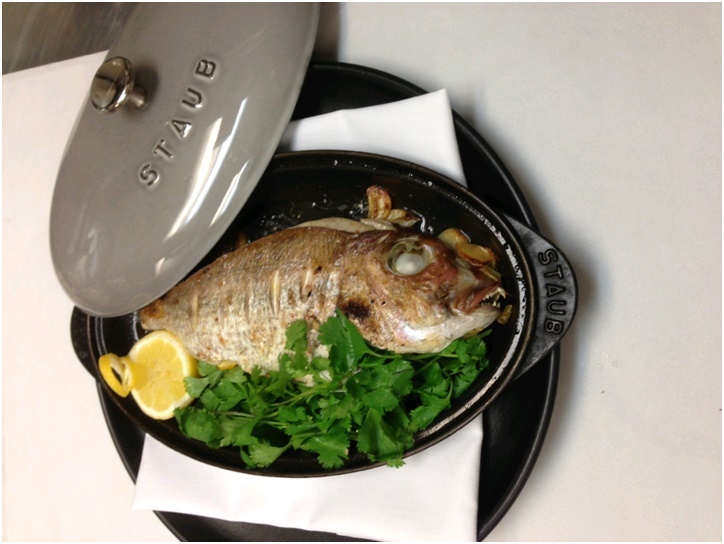
    Season the fish with salt on all sides, arrange all the slices and the herbs evenly inside the fish. In a Dover plate, pour the oil and the garlic in the bottom then lay the fish on it, baste with the olive oil. Cook in the oven at 375 F for 10 min, basting it often. When almost cooked, finish under the broiler to get a nice brown color while basting. Drain ¾ of the oil, leaving the garlic inside.

    To serve:
    1 pc of fancy lemon
    1 small bunch of cilantro
    On a big black plate, fold a white napkin squared, put the hot plate on it. Add the lemon and cilantro and cover with the lid, serve the Yuzu mayonnaise on the side.
    – The End. Go Eat. –

  • i8tonite with Arizona Taco Festival Founder David Tyda and Recipe for Rocked Guac

    i8tonite with Arizona Taco Festival Founder David Tyda and Recipe for Rocked Guac

    i8tonite with Arizona Taco Festival Founder David Tyda and Recipe for Rocked GuacIn 1912, Arizona became the forty-eighth state to enter the contiguous United States. Prior to that, the desert landscape territory was an extension of Mexico’s Sonora, the agricultural hub of our bordering ally. Arguably, you could even say that the Grand Canyon state and our friendly neighbor are conjoined twins. Instead of sharing body parts, the state and the country share a border and a unique history, especially as it relates to eats. On this northern side, we have adopted tacos and tequila as our own with fast food franchises, academic courses detailing corn tortilla virtues, and country songs such as “Ten Rounds with Jose Cuervo.” (Fortunately, Mexicans don’t have songs about throwing back a bottle of Napa cabernet.)

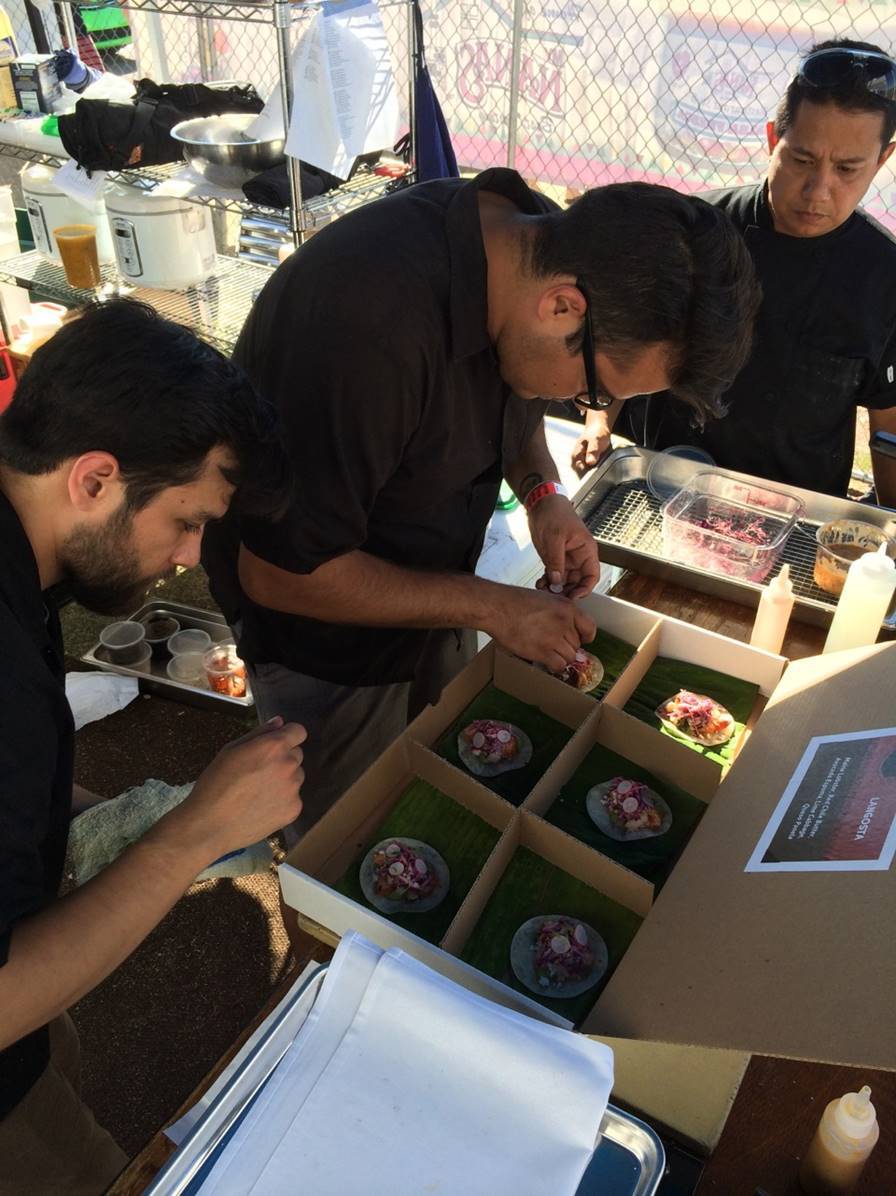
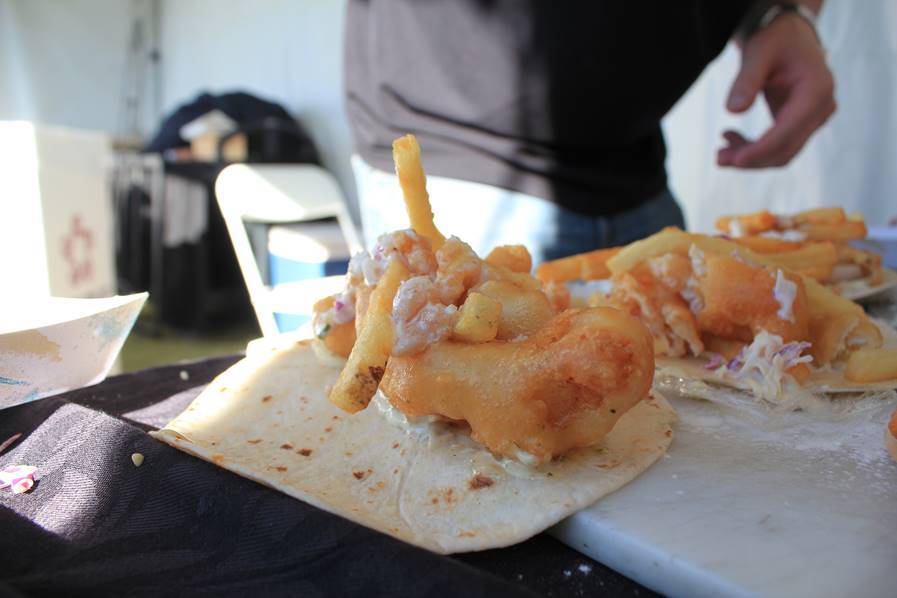
    It’s not surprising then that the state is home to the world’s largest taco festival, honoring its Mexican heritage. Entering its seventh year, the massively attended Arizona Taco Festival was co-created by David Tyda, 39, and glorifies one of the globe’s greatest food icons – right up there with hamburgers, barbeque, French fries, and pizza. There is no other state or city where an annual celebration takes place showcasing the depth of creativity folded into a flour or corn tortilla. “When my business partner, Rick Phillips, and I started the festival,” says Tyda, “we wanted to reveal how diverse the taco can be.”

    i8tonite with Arizona Taco Festival Founder David Tyda and Recipe for Rocked Guac

    Taking place annually in October, over thirty-five thousand people join in eating unusual hybrids folded or fried into flour or corn layers. The gorge get-together has become a tourism force to be reckoned with for Arizonans bringing heads in beds for the hospitality soaked town which has almost 60,000 rooms in nearly 450 hotels and resorts. (Jokingly, Tyda says, “We sold tickets in every state except Rhode Island, Hawaii, and Maine. Dunno what they’ve got against tacos in Rhode Island.”). Over fifty restaurants gather at Scottsdale Salt River Fields, serving up two dollar tacos with a chance to win a ten thousand dollar cash prize.

    i8tonite with Arizona Taco Festival Founder David Tyda and Recipe for Rocked Guac

    “Whenever someone visited me, they would always ask where they could get a good taco,” states Tyda. “Creatively, we see unusual ideas of what makes a taco. Although, I think it would be fun, to see what restaurants do who don’t make tacos – see what they come up with.” To his credit, he and his partner have also branched out to other epicurean bashes, such as Scottsdale Beer Palooza highlighting craft brews, and Arizona BBQ Festival featuring The Redneck Games.
    Long before he was an advocate of Mexico’s leading export, Tyda was one of the state’s finest journalists, working as the editor of Ritz-Carlton Magazine, the now defunct Desert Living, Stratos, and many other glossy titles. Over the years, he’s witnessed a decline in the writing world. In an interview with 26Blocks, he says about journalism, “That art is dying and I’m sad about that.” Yet, gratefully, the Midwest-born, Arizona State University graduate has smartly created a whole new work category for himself and Arizona, turning the Valley of the Sun into a Mexican taco fest.

    i8tonite with Arizona Taco Festival Founder David Tyda and Recipe for Rocked Guac

    Food People Questionnaire (with a nod to Proust):

    What is your favorite food to cook at home?
    My famous mojito pancakes – they have all the ingredients of a mojito in the batter.

    What do you always have in your fridge at home?
    An open box of baking soda, though I’m not convinced it’s doing a damn thing to keep stuff fresh.

    What marked characteristic do you love in a person with whom you are sharing a meal?
    Willingness to share their food.

    What marked characteristic do you find unappealing in a person with whom you are sharing a meal?
    Bad tippers.

    i8tonite with Arizona Taco Festival Founder David Tyda and Recipe for Rocked GuacBeer, wine, or cocktail?
    All of the above. I believe in democracy.

    Your favorite cookbook author?
    Dr. Andrew Weil. His recipes are simple and healthy.

    Your favorite kitchen tool?
    A good knife.

    Favorite types of cuisine to cook?
    No favorites – stir fry, Italian sauces, grilled wings, you name it.

    Beef, chicken, pork, or tofu?
    Tofu – only because I rarely encounter it.

    Favorite vegetable?
    Prosciutto-wrapped asparagus, hold the asparagus.

    Chef you most admire?
    Any talented sous chef because they’re doing a ton of the work and getting almost none of the credit.

    i8tonite with Arizona Taco Festival Founder David Tyda and Recipe for Rocked Guac

    Food you like the most to eat?
    Tacos, of course!

    Food you dislike the most?
    Anything poorly designed, where the chef didn’t think about the user experience (i.e., tacos that fall apart, a burger with a soggy bun, pizza with too much cheese, etc.)

    What is your favorite non-food thing to do?
    Netflix and chill with my fiancé (and I really mean Netflix and chill, lol)

    Whom do you most admire in food?
    Any chef who can achieve consistency. It’s truly a moving target.

    i8tonite with Arizona Taco Festival Founder David Tyda and Recipe for Rocked GuacWhere is your favorite place to eat?
    At the bar.

    What is your favorite restaurant?
    Dick’s Hideaway.

    Do you have any tattoos? And if so, how many are of food?
    Nope.

    Recipe: Rock Out with your Guac Out

    2 avocados, peeled and pitted
    1 cup chopped roma tomatoes
    1/4 cup chopped red onion
    1/4 cup chopped cilantro
    2 Tbsp lime juice
    1 jalapeno pepper, seeded and minced
    Sea salt and ground black pepper, to taste
    Chips

    Scoop avocados into a medium bowl, and cut/smash with a fork to desired consistency. Stir in all other ingredients. Serve with chips.

    The End. Go Eat.

  • i8tonite with Phoenix Chef Jennifer Russo of The Market Restaurant + Bar & Recipe for Rack of Lamb with Pinot Noir Sauce

    i8tonite with Phoenix Chef Jennifer Russo of The Market Restaurant + Bar & Recipe for Rack of Lamb with Pinot Noir Sauce

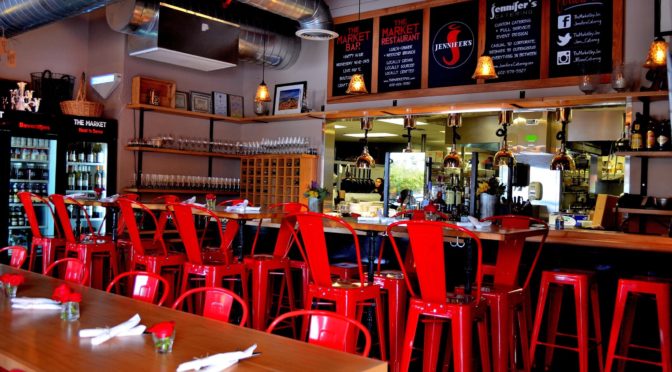
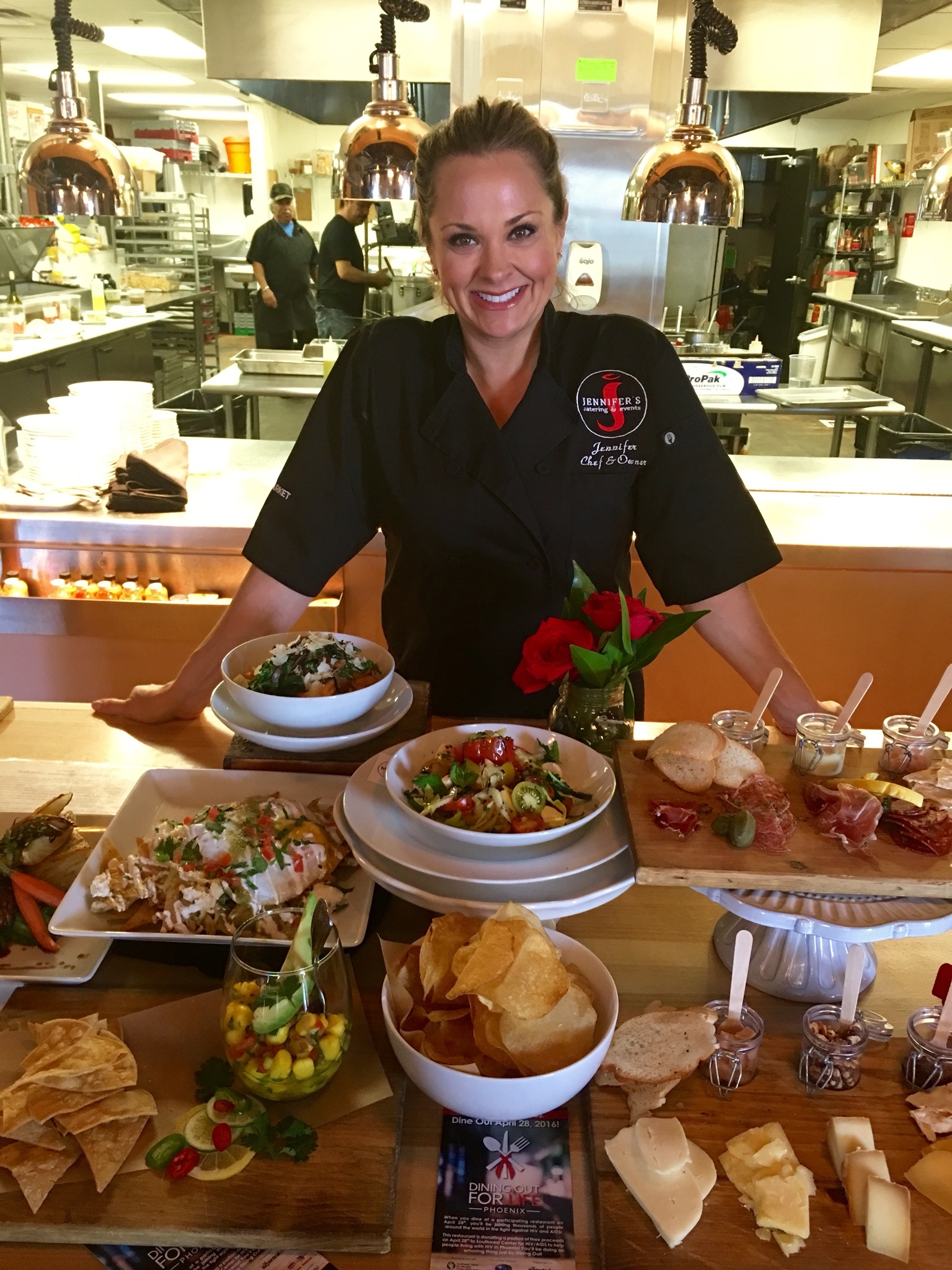
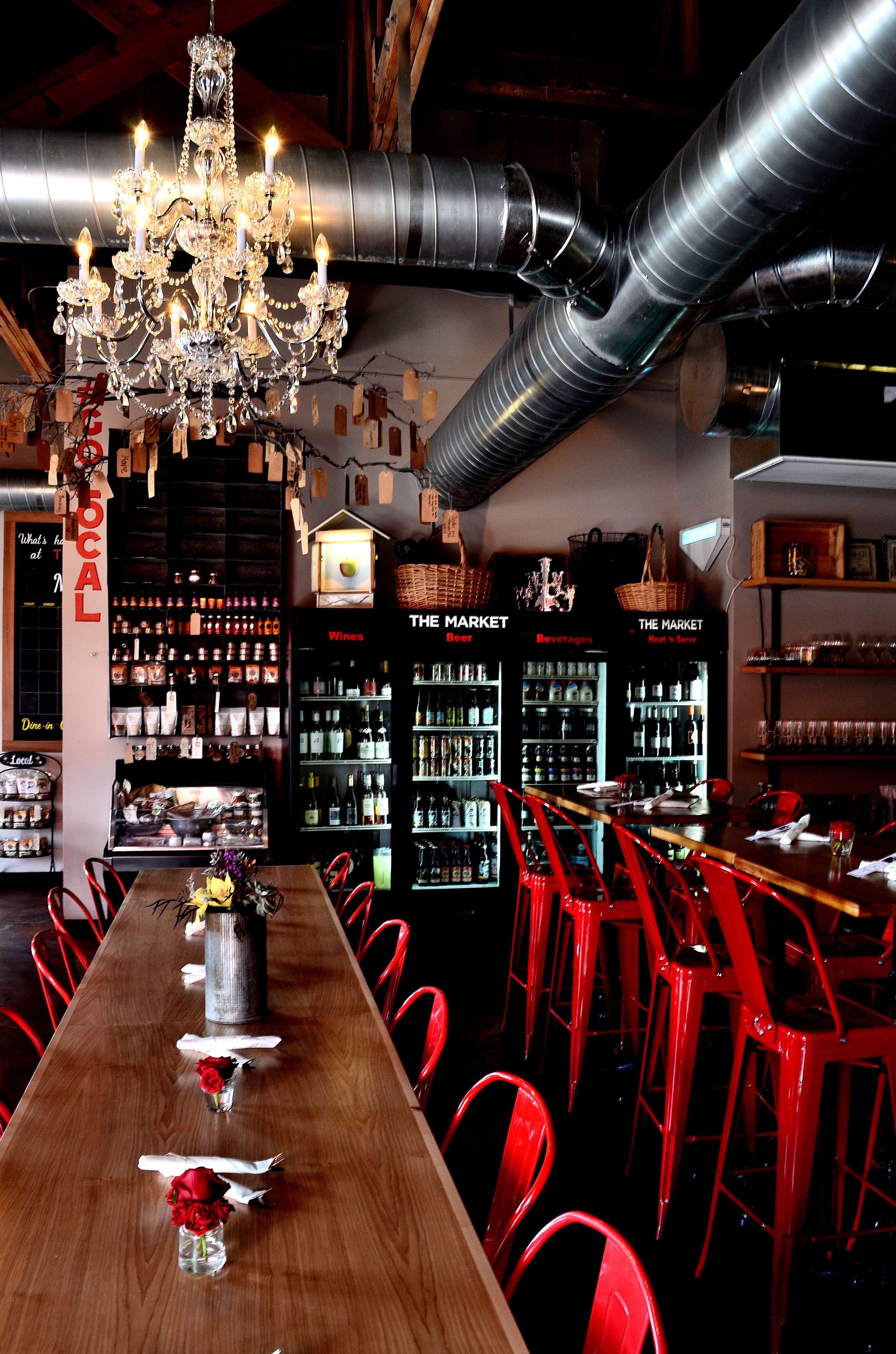
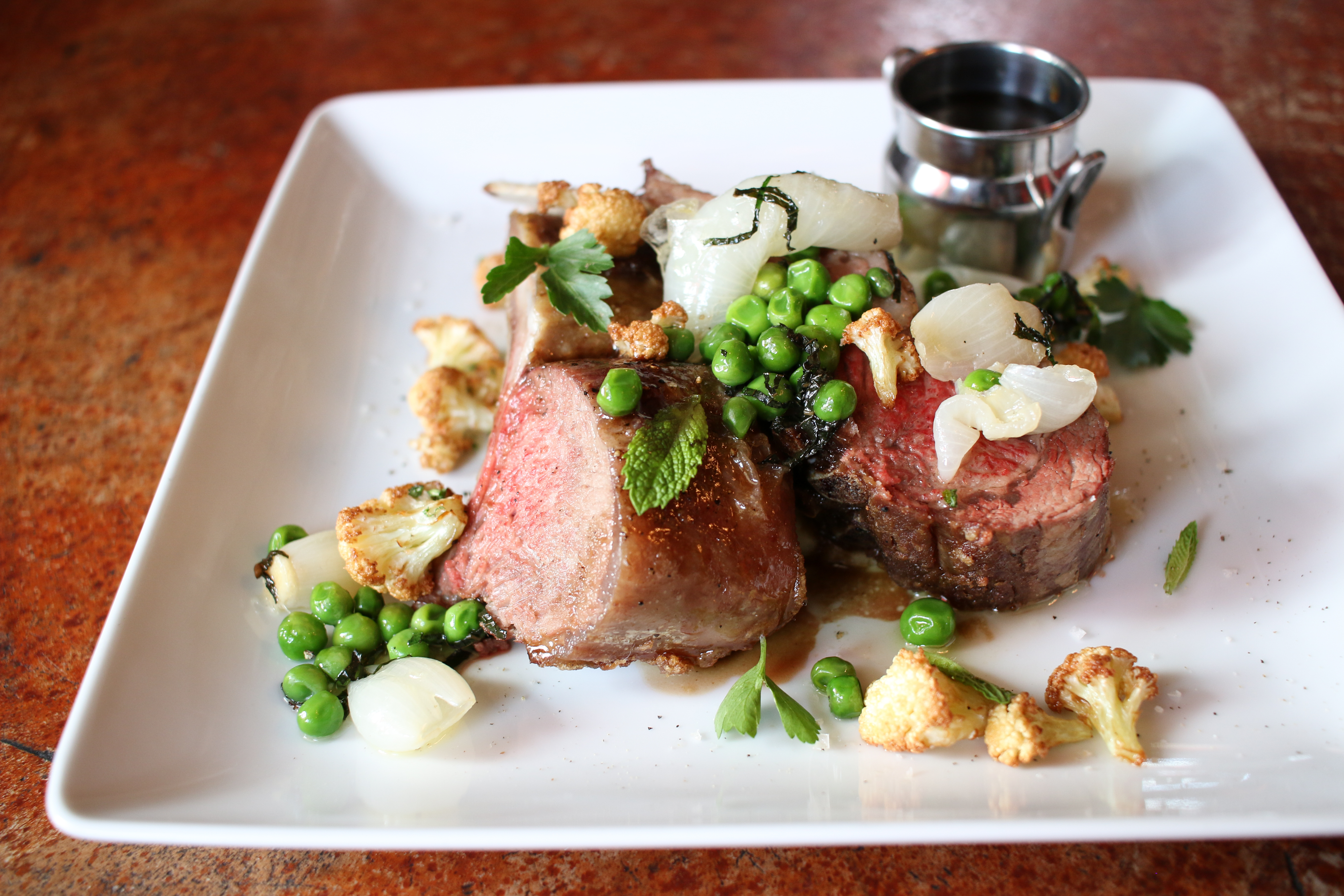
    i8tonite with Phoenix Chef Jennifer Russo of The Market Restaurant + Bar & Recipe for Rack of Lamb with Cabernet SauceA little more than two years ago, Chef Jennifer Russo opened The Market Restaurant + Bar in Phoenix’s burgeoning Arcadia neighborhood. The restaurant with a neighborhood vibe is reflective of Russo’s use of Arizona-grown produce, dairy, and meats in both her catering and brick and mortar. More importantly, Russo’s growth as a decade-long successful caterer to a full-fledged restauranteur is an indicator of the quality of chefs and restaurants being developed out of the forty-eighth state. The Valley of the Sun, known for safe, corporate restaurants, is literally hungry for independent chefs.

    i8tonite with Phoenix Chef Jennifer Russo of The Market Restaurant + Bar & Recipe for Rack of Lamb with Cabernet Sauce

    Born in New Jersey but raised in Arizona, Russo has long been cooking. She started learning some of the family secrets with her father’s grandmother, who emigrated from Italy. As a teen, Russo’s passion for cookery led to a variety of food schools in her Scottsdale-area home but eventually – at the age of twenty-one – became a San Francisco transplant at one of the city’s noted gastronomic institutions. Russo says, “I waited to go to school so I could learn the cocktail classes. I wanted to be of legal age.”
    After graduating, realizing the expense of living in the City by the Bay, she returned to The Grand Canyon state and worked with two venerated Sonoran desert chefs continuing her epicurean education. It began with Vincent Guerithault of Vincent’s on Camelback, which led her to a sous chef position with Mark Tarbell at Tarbell’s.

    i8tonite with Phoenix Chef Jennifer Russo of The Market Restaurant + Bar & Recipe for Rack of Lamb with Cabernet SauceAfter working the line for years, Russo’s knees needed medical recuperation which led to the founding of her catering company. As her enterprise grew, so did the demand for her wares; clients would constantly ask when she was opening a restaurant.

    Now, with a young son and several decades of operating her businesses, Russo has become as renowned as the gentlemen she worked with in Phoenix.

    Below, Russo shares recipes for Rack of Lamb with Cabernet Sauce, Braised Baby Peas with Pearl Onions and Herbs, and Hot, Buttered Cauliflower Puree

    Chef Questionnaire with a nod to Proust:

    How long have you been cooking?
    For as long as I can remember. But as soon as I could get a job, I started prep cooking @ Lewis Steven’s Catering Company at the age of 16.

    What is your favorite food to cook?
    I love working with proteins and seasonal veg.

    i8tonite with Phoenix Chef Jennifer Russo of The Market Restaurant + Bar & Recipe for Rack of Lamb with Cabernet Sauce

    What do you always have in your fridge at home?
    Beverages…Let me be honest, wine and water.


    What do you cook at home?
    I don’t get a chance to cook at home since opening The MARKET restaurant+bar. It seems silly to dirty my kitchen at home, especially when I can do that at work. But if I am cooking at home we go pretty big. As long as someone brings the dessert. You don’t want me making dessert.

    i8tonite with Phoenix Chef Jennifer Russo of The Market Restaurant + Bar & Recipe for Rack of Lamb with Cabernet Sauce

    What marked characteristic do you love in a customer?
    The excitement they have for the food, wine, and cocktail menus. It makes it all worth it when they love it!

    What marked characteristic do you find unappealing in a customer?
    When they share their negative thoughts on social media. I’m here a lot. Just tell me to my face and I will do everything in my power to fix it.

    Tupperware, Rubbermaid, or Pyrex?
    I seem to have a lot of items in delis.

    Beer, wine, or cocktail?
    Wine

    Your favorite cookbook author?
    I love cookbooks from restaurants, so anything Thomas Keller is high on the list. I like how visual they are. But if I had to choose one go to, it would be Julia Child’s Mastering the art of French cooking.

    Your favorite kitchen tool?
    Knives

    i8tonite with Phoenix Chef Jennifer Russo of The Market Restaurant + Bar & Recipe for Rack of Lamb with Cabernet SauceYour favorite ingredient?
    That’s not possible. Flaky salt.

    Your least favorite ingredient?
    Peanuts * I’m allergic!

    Least favorite thing to do in a kitchen?
    Peeling things

    Favorite types of cuisine to cook?
    Mediterranean. So everything…

    Beef, chicken, pork, or tofu?
    Beef

    Favorite vegetable?
    Mushrooms, if I had to choose one

    Chef you most admire?
    Julia Child past, Thomas Keller present

    Recipe: Rack of Lamb with Pinot Noir Sauce

    i8tonite with Phoenix Chef Jennifer Russo of The Market Restaurant + Bar & Recipe for Rack of Lamb with Cabernet Sauce

    INGREDIENTS
    Three 8-bone racks of lamb (1 1/2 pounds each), trimmed of all fat, bones frenched
    Coarse salt and freshly ground pepper
    1 T minced garlic
    1 1/2 tablespoons olive oil
    Zest of one lemon
    1 cup Pinot Noir
    1 garlic clove
    1 thyme sprig
    1 cup chicken stock or canned low-sodium broth
    2 tablespoons cold unsalted butter, cut into 4 pieces

    METHOD
    Preheat the oven to 425°. Season the lamb racks all over with coarse salt, pepper, minced garlic, & lemon zest. Heat 1 tablespoon of the oil in a large skillet and the remaining 1/2 tablespoon of oil in a medium skillet; both skillets should be ovenproof. Add 2 of the lamb racks to the large skillet and 1 rack to the medium skillet, meaty side down. Cook the racks over moderately high heat until well browned, about 4 minutes. Turn the racks and brown the other side, about 3 minutes longer.

    Transfer the skillets to the oven and roast the lamb for 15 to 20 minutes, or until an instant-read thermometer inserted in the thickest part of the meat registers 120°or rare and 125° for medium rare. Transfer the racks to a carving board and let rest for 10 minutes.

    Meanwhile, set the medium skillet over high heat. Add 1/2 cup of the wine and bring to a boil, scraping up any browned bits. Pour the wine into the large skillet and add the garlic and thyme. Set the large skillet over high heat, add the remaining 1/2 cup of wine and boil until reduced by one-third, about 3 minutes. Add the chicken stock and boil until reduced to 1/2 cup, about 8 minutes. Remove the skillet from the heat and discard the garlic and thyme sprig. Whisk in the butter, 1 piece at a time. Season with salt and pepper and strain the sauce into a warmed gravy boat.

    To serve, cut the lamb into chops and arrange 3 chops on each dinner plate. Pass the Pinot Noir sauce at the table along with a little coarse salt for sprinkling on the lamb.

    Recipe: Hot, Buttered Cauliflower Puree

    INGREDIENTS
    Two 2-pound heads of cauliflower, cored and separated into 2-inch florets
    2 cups heavy cream
    1 cup mashed potato
    1 1/2 sticks unsalted butter
    Salt
    Pepper
    Chives, chopped

    METHOD
    Preheat the oven to 325°. In a large pot of boiling salted water, cook the cauliflower florets until tender, about 7 minutes. Drain well. Spread the cauliflower on a large rimmed baking sheet. Bake for about 5 minutes, to dry it out.
    In a small saucepan, combine the heavy cream with the butter and bring to a simmer over moderate heat just until the butter is melted.

    Working in batches, puree the cauliflower and mashed potatoes in a blender with the warm cream mixture; transfer the puree to a medium bowl. Season with salt, pepper, and chives.
    Recipe: Braised Baby Peas with Pearl Onions and Herbs

    INGREDIENTS
    12 pearl onions
    2 tablespoons unsalted butter
    1 pound baby peas, blanched
    3 tablespoons low-sodium chicken broth
    1 tablespoon finely chopped mint
    1 tablespoon snipped chives
    Kosher salt and freshly ground pepper

    METHOD
    Bring a medium saucepan of water to a boil. Add the pearl onions and boil for 10 minutes. Drain and rinse under cold water. Peel the onions, leaving the root end intact.

    In a medium, deep skillet, melt the butter. Add the pearl onions and cook over moderately high heat until browned, about 3 minutes. Add the peas and simmer over moderate heat until the peas are tender and bright green, about 3 minutes. Remove from the heat. Add the mint and chives, season with salt and pepper and serve. When plate is complete,  garnish with roasted cauliflower florets and fresh mint.


    The End. Go Eat. 

    Photos: Joanie Simon

  • I8tonite: with Tucson’s Casino del Sol Mixologist, Aaron de Feo, and a Tom Turner Overdrive

    I8tonite: with Tucson’s Casino del Sol Mixologist, Aaron de Feo, and a Tom Turner Overdrive

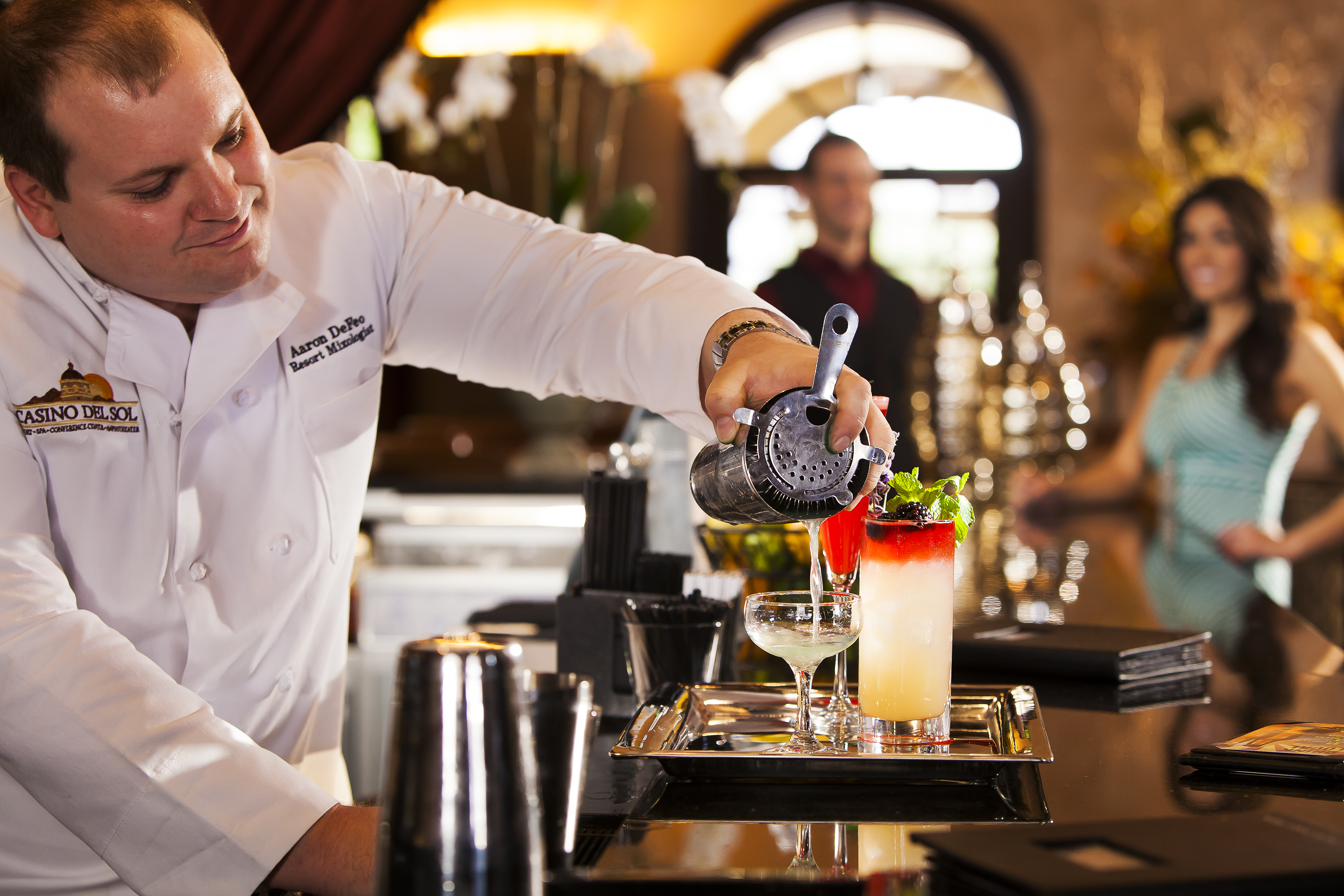
    I8tonite: with Tucson's Casino del Sol Mixologist, Aaron de Feo, and a Tom Turner Overdrive Right out of college, Casino del Sol’s renowned mixologist Aaron de Feo was turned down for a journalism job in his hometown of Tucson, Arizona. As the saying goes, “When someone hands you lemons, you make margaritas.” And, that’s exactly what de Feo did. He has become the one of the country’s prominent mixologists while working at the 215 room property owned by the Pascua Yaqui Indian tribe, a native area nation of the forty-eighth.

    Before he landed at Arizona’s only Forbes Four Star and AAA Four Diamond casino resort, de Feo also worked at the landmark Hotel Congress, the city’s only other exciting property, perfecting his craft of blending liquors. Since he’s landed at Casino del Sol, however, his creative drinks have been showcased, turning de Feo into one of the I8tonite: with Tucson's Casino del Sol Mixologist, Aaron de Feo, and a Tom Turner Overdrivecountry’s leading libations makers. His business card names him Beverage Director, but he has been called by GQ as “Top 10 Most Inspired” and “Celebrated Doctor of Mixology” by Nightclub & Bar Magazine. He even has a nickname, “Doc,” used by his Old Pueblo liquor networks and friends, turning him into a cocktail cowboy of sorts – although de Feo’s more likely to pull out six shots of his favorite gin, rather than a six bullet shooter.

    Importantly, one of the first things he accomplished when opening the four-diamond property was to invigorate Arizona’s growing swizzle stick scene on his turf.  He ensured that all staff learned how to master scratch beverages using simple syrups, freshly squeezed juices, and macerated herbs. De Feo’s distinguishing mark is to insure that any customer had a thirst-quencher made from wholesome ingredients, nothing made with food coloring or preservatives.

    I8tonite: with Tucson's Casino del Sol Mixologist, Aaron de Feo, and a Tom Turner Overdrive“People are more adventurous now,” says De Feo. “We were being out-gunned by Los Angeles and smaller cities like Nashville. Because we have a good, local music and cultural scene, many of the bar owners didn’t care about changing. They now do. There is a difference which is because of the hotel.”

    According to Visit Tucson, the area’s bureau on tourism, there has been an uptick of yearly visitors from 3.4 nights in 2011 to 4 full nights in 2015. It can be attributed to many factors. Since the progressions occurred during de Feo’s term at Casino del Sol, the safe conclusion about the growth is the word is out about his crafty liquor potables. Resort and area guests want a drink from “Doc,” knowing that what he concocts will surely cure what ails them.

    Food People Questionnaire (with a nod to Proust):

    I8tonite: with Tucson's Casino del Sol Mixologist, Aaron de Feo, and a Tom Turner Overdrive
    Tom Bergeron

    What is your favorite food to cook at home? I tend to cook rather simple meals, mostly lean, grass-fed meat, vegetables, and legume pasta. However I’m very partial to making sauces, which I think comes from how often I am working with flavoring agents in cocktails.

    What do you always have in your fridge at home? A galaxy of various syrups and house-made ingredients for cocktails, which is funny because I don’t drink cocktails at home that often.  Mostly they are experiments that I have elected to save for posterity.

    What marked characteristic do you love in a person with whom you are sharing a meal?  Honesty.

    What marked characteristic do you find unappealing in a person with whom you are sharing a meal?  Anyone who tries to decide for me what “we” are having at a restaurant.

    Beer, wine, or cocktail? A Gin Rickey.

    I8tonite: with Tucson's Casino del Sol Mixologist, Aaron de Feo, and a Tom Turner Overdrive
    Casino Del Sol Resort 2011

    Your favorite cookbook author? Maybe not a cookbook, but certainly Harold McGee’s work on the science of food is fascinating.

    Your favorite kitchen tool? A really great Y peeler.  So many of them are garbage.

    Favorite types of cuisine to cook? Italian, without question.  Focus on the ingredients and their harmony more than intricacy.

    Beef, chicken, pork or tofu? Beef.  Chicken gets re-heated so often in fast casual places.

    Favorite vegetable? I’m a huge fan of green peas with truffle salt & olive oil, and brussel sprouts, of course.  Baked cauliflower is about the greatest thing ever.

    Chef you most admire? I don’t go in for celebrity chefs much.  I certainly admire many of the chefs I’ve worked with, especially the ones whose cuisine has inspired me behind the bar.  I admire Phoenix-area chef Cullen Campbell (Crudo, OKRA) quite a bit because he has managed to do extraordinary things with styles of food that I’m not entirely comfortable with, and still has me coming back for more.  His take on Southern cuisine is simply incredible.

    Food you like the most to eat? Really great pasta with really great sauce.  Nothing better.

    I8tonite: with Tucson's Casino del Sol Mixologist, Aaron de Feo, and a Tom Turner Overdrive
    Casino Del Sol Resort 2011

    Food you dislike the most? I guess I just don’t get the phenomenon of tartare and paté.  Texture and aroma mean a lot to me, and the mushy, raw consistency of those things triggers a flight mechanism in my mind.  I guess that makes me the foodie equivalent of a hillbilly, but I don’t care.

    What is your favorite non-food thing to do? I suppose that excludes going to cocktail bars.  I spend a lot of time working out late at night, by myself.  There’s something extraordinarily calming about it, almost like hitting a sweaty reset button on my day.

    Who do you most admire in food? Dave Arnold, for making that leap from food to beverages and showing us all how it’s done.

    Where is your favorite place to eat? Sonoran Mexican restaurants, no doubt.

    What is your favorite restaurant? Mercantile Dining & Provision in Denver is not only one of the coolest spaces I’ve dined in, but the food and service were mind-blowing.

    Do you have any tattoos? And if so, how many are of food? I think I’m one of the last people in the industry with no tattoos, and honestly it’s getting to the point where that’s almost a disadvantage… like I’m not in the cool club.

    Drink Recipe

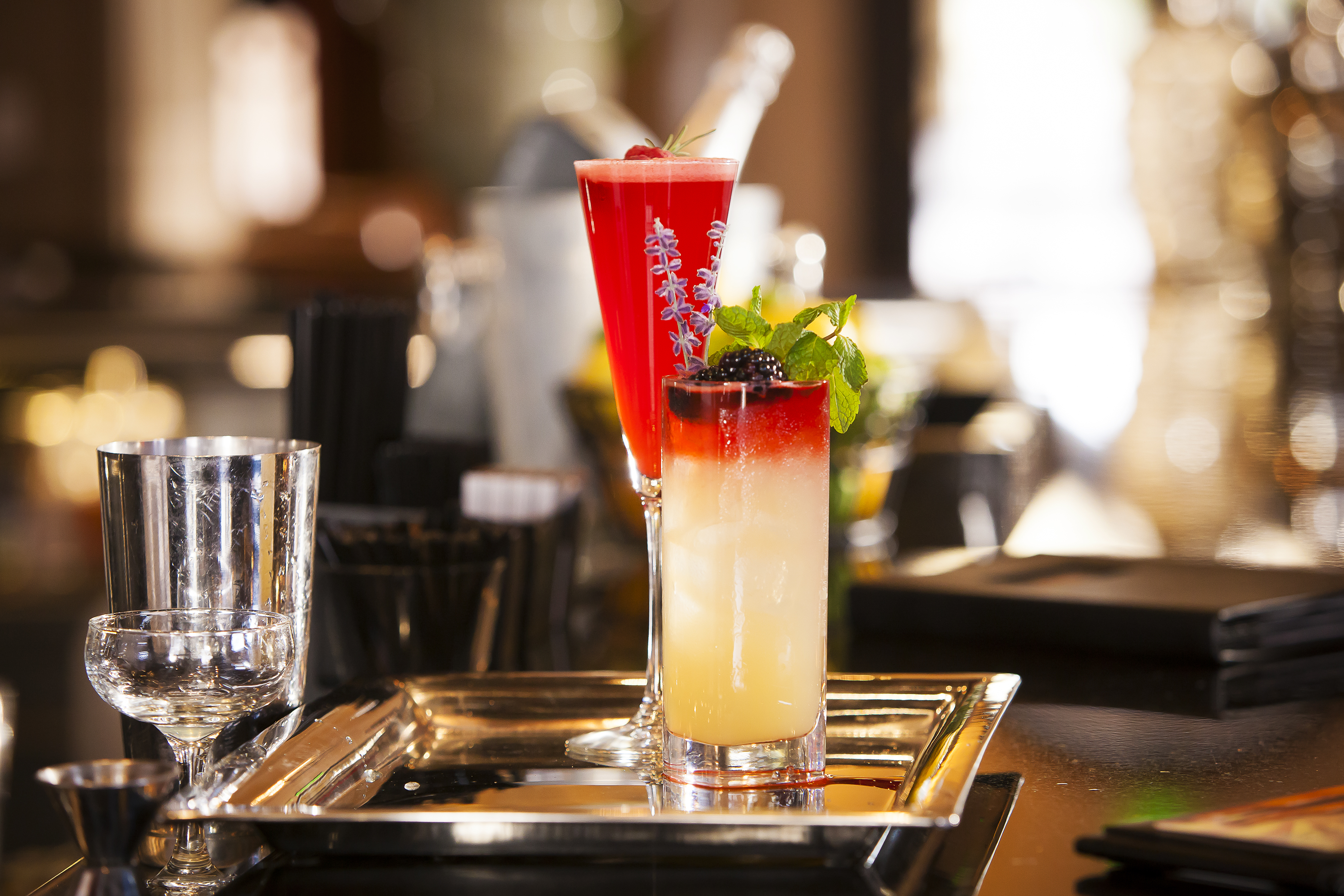
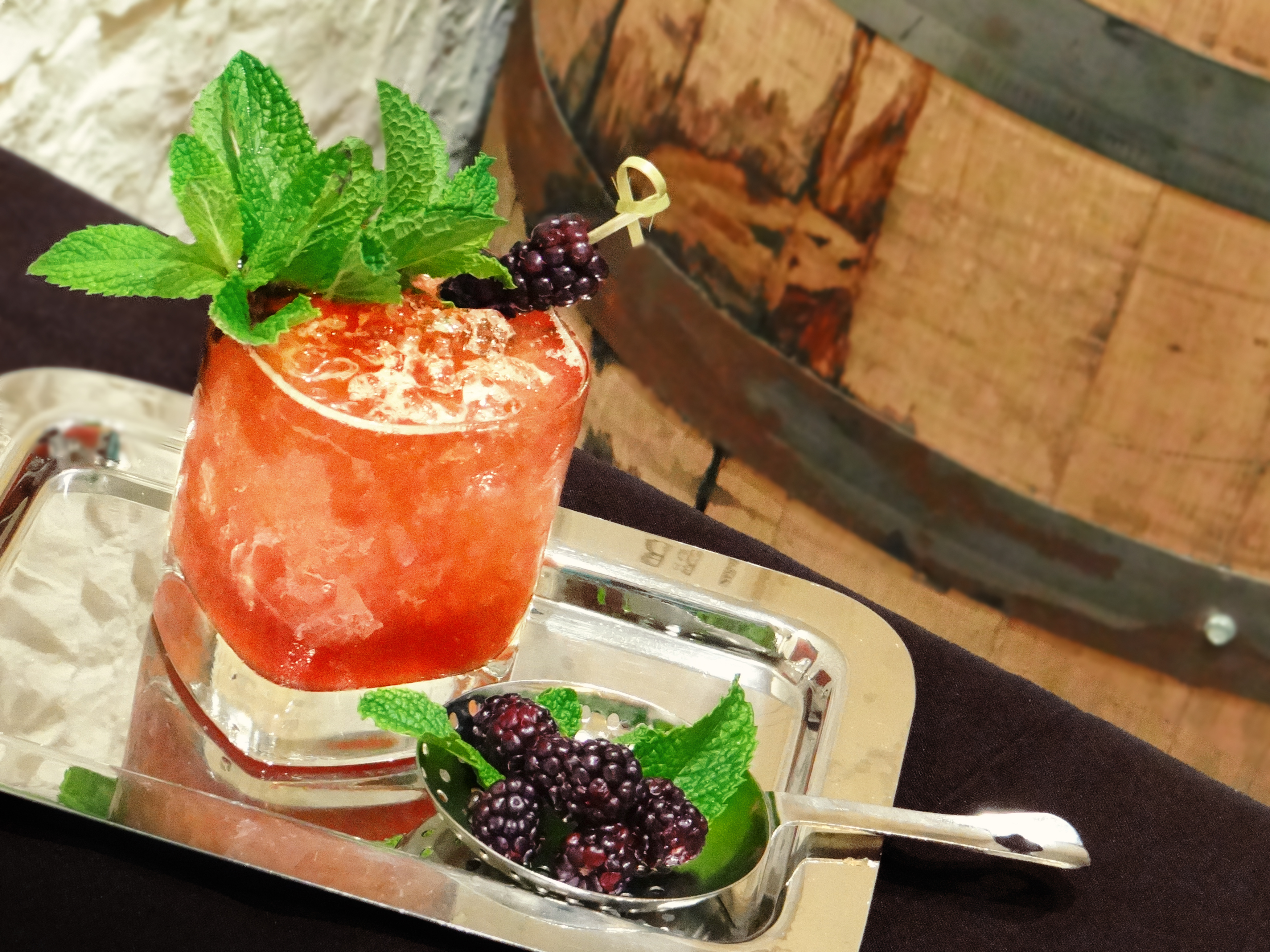
    Tom Turner Overdrive. Created by Aaron DeFeo, Casino Del Sol Resort Mixologist.

    I8tonite: with Tucson's Casino del Sol Mixologist, Aaron de Feo, and a Tom Turner Overdrive

    • George Dickel Select Barrel Tennessee Whiskey (1.5 oz)
    • Creme de Mure (1 oz)
    • Fresh lemon (.5 oz)
    • Mint (4-6 leaves)
    • Shaken and double-strained over crushed ice with four dashes of house aromatic bitters. Garnish with mint and blackberries (if available)

    NOTE: Thomas Turner is the Master of Whiskey for the Diageo whiskey portfolio.

    The end. Go drink.