
Category: Recipes

  • i8tonite with Philosophy Professor and American Foodie Author Dwight Furrow

    i8tonite with Philosophy Professor and American Foodie Author Dwight Furrow

    i8tonite with Philosophy Professor and American Foodie Author Dwight FurrowSan Diego Mesa College Professor Dwight Furrow specializes in the philosophy of food and wine, aesthetics, and ethics. He is also a Certified Wine Specialist with certification from the Society of Wine Educators and an advanced level certification from the Wine and Spirits Educational Trust. Furrow is the author of Edible Arts, a blog devoted to food and wine aesthetics, and evaluates wine for the Sommelier Company. I am fascinated by his writings on Mindful Eating, and since discovering them, have enhanced my dining experiences with thoughtful practice.
    i8tonite with Philosophy Professor and American Foodie Author Dwight FurrowFurrow’s new book, American Foodie: Taste, Art, and the Cultural Revolution, will change the way you think about food. In this book, he shares:

    * How food preparation and consumption is both an art form and one of life’s essential pleasures.
    * How slow and purposeful approaches to food can improve our lives as opposed to fast and convenient.
    * Elements of American history that have kept the nation from developing its own respected cuisine – until now.
    * The philosophy of the foodie craze as a search for aesthetic authenticity in our increasingly pre-packaged world.
    * 10 reasons to eat mindfully (that have nothing to do with losing weight)
    * Why food bloggers are the heart of the food revolution.

    It’s time for a new way to look at food and how we eat – and Furrow does just that.

    Food People Questions:

    What is your favorite food to cook at home?
    Soups. They can easily be adapted to any situation, are the perfect medium for creativity in the kitchen, and hard to screw up.

    What do you always have in your fridge at home?
    A good cheese, preferably a little stinky.
    i8tonite with Philosophy Professor and American Foodie Author Dwight Furrow
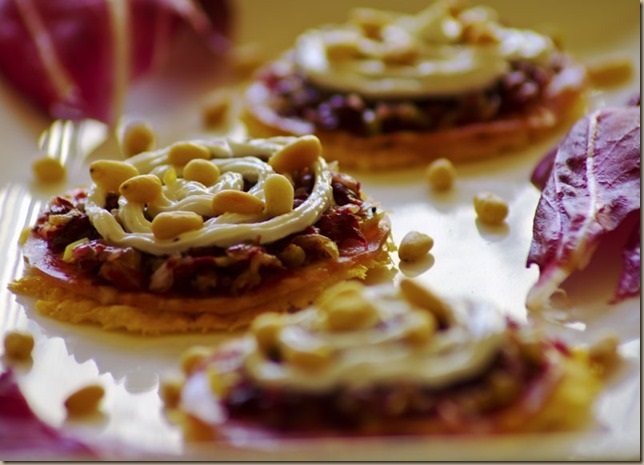
    Parmesan crisps with soppreseta and Radicchio

    What marked characteristic do you love in a person with whom you are sharing a meal?
    A belief that the most important thing in the world is a good meal.

    What marked characteristic do you find unappealing in a person with whom you are sharing a meal?
    A mile-long checklist of foods they don’t like. (Exceptions for health issues, of course.)

    Beer, wine, or cocktail?
    Oh, definitely wine. Nothing goes better with food than wine.

    Your favorite cookbook author?
    Peter Kaminsky and Gray Kunz. To my knowledge they only wrote one cookbook, The Elements of Taste, but it was a revelation for me.

    Your favorite kitchen tool?
    Cast Iron Frying Pan. Versatile, indestructible, and holds up to high heat.

    Favorite types of cuisine to cook?
    Spanish (especially Tapas), Italian, Mexican
    i8tonite with Philosophy Professor and American Foodie Author Dwight Furrow
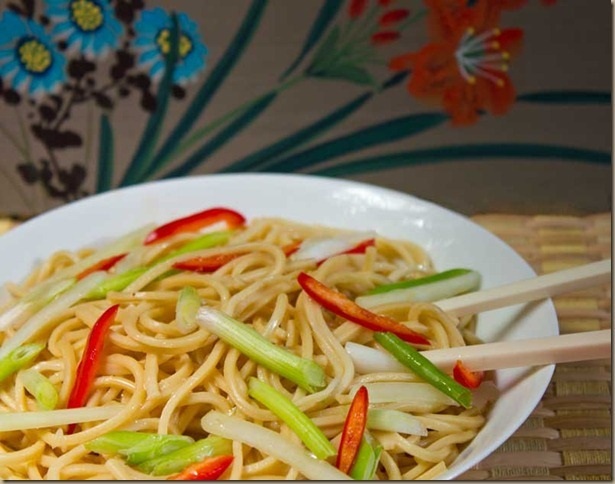
    Peanut sesame noodles with Sichuan pepper

    Beef, chicken, pork, or tofu?
    Pork – nothing beats braised pork. Why is tofu on this list?

    Favorite vegetable?
    The ones that are really fruit: avocado and tomato

    Chef you most admire?
    Ferran Adrià. A genuine artist in the kitchen. Of course, his restaurant El Bulli closed. Knowing when to quit is a virtue.

    Food you like the most to eat?
    Tapas-style, lots of flavor sensations in one meal. If you don’t like something, you can just move on.

    Food you dislike the most?
    Eggs. They are fascinating, fun to cook, and I hate that I don’t like them. But I just don’t.

    What is your favorite non-food thing to do?
    Read, especially philosophy. No, I’m not a masochist.

    Who do you most admire in food?
    Artisan winemakers, brewers, coffee-roasters, and small build-from-scratch restaurant chefs/owners. They are doing it for love.

    Where is your favorite place to eat?
    Home. It’s where I can be creative and where my most appreciative audience resides.

    What is your favorite restaurant?
    Juniper and Ivy (San Diego), Uchi (Austin), Curate (Asheville), Pok Pok (Portland)

    Do you have any tattoos? And if so, how many are of food?
    No

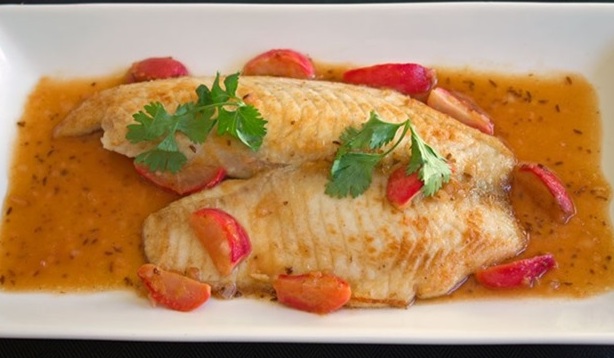
    Recipe: Pan-Fried Fish Filet with Radish and Citrus Sauce
     

    i8tonite with Philosophy Professor and American Foodie Author Dwight Furrow

    The red radish is an afterthought – a colorful garnish or peppery accessory to a salad, but seldom the star of the show. This strikes me as a great injustice. After all, the radish is brightly colored, pleasingly plump, crunchy, and distinctively flavored. It’s not boring, offensive, or unwelcoming. It doesn’t deserve to be ignored.

    I will make it my mission in life to rectify this injustice. The problem is that radishes lose their crunch and peppery flavor when you cook them. Boredom looms. But with just enough heat, they acquire a pleasing nutty/earthy flavor that pops when you pair them with caraway seeds.

    So here is the launch of the Radish Redemption Project. Plenty of citrus and ginger, some soy to provide umami depth, and gently roasted radishes enhanced by the pungent notes of caraway make a fascinating sauce for buttery pan-fried fish.

    Serves 4

    Ingredients:
    8 radishes, cleaned and trimmed
    2 tablespoon olive oil (divided use)
    2 small garlic cloves, minced
    1/2 small onion, minced
    1/2 cup fresh lime juice
    1 cup fresh orange juice
    2 tablespoons grated fresh ginger
    2 tablespoons soy sauce
    2 tablespoons honey
    1 tablespoon caraway seeds, crushed
    1/2 teaspoon cumin
    1/2 cup flour seasoned with salt and pepper
    4 fish fillets, mildly flavored, such as tilapia or halibut
    2 tablespoons butter
    cilantro for garnish

    Directions:
    1. Preheat oven to 400 degrees.
    2. Slice radishes in half, pole to pole, then place the cut side down and cut each half into thirds. (Each radish is cut into 6 equal portions)
    3.  Toss sliced radishes with 1 tablespoon olive oil and roast in the oven for 6-8 minutes. Reserve. (Radishes should still have some crunch but lose their raw flavor. Be careful not to overcook)
    4. Warm olive oil over medium heat. Saute onions and garlic until soft.
    5. Add ginger and cook briefly, then add citrus juices soy sauce, honey, caraway seeds, and cumin and stir. When sauce begins to simmer, reduce heat to low then cover so the sauce does not reduce too much.
    6. Pat fish dry and put seasoned flour on a dish or pan.
    7. Heat frying pan to medium high and melt butter (be careful not to burn the butter).
    8. Dredge fish in flour and fry in frying pan until fish is lightly browned and cooked through. (If your frying pan is too small for 4 filets, cook them 2 at a time and keep warm in the oven.)
    9. While fish is cooking, adjust consistency of the sauce if necessary, add radishes to the sauce and increase the heat briefly so they will warm.
    10. To serve, distribute sauce on plates with radishes on the border, top with fish filet and garnish with cilantro.

    The End. Go Eat.
  • i8tonite: Illustrator and author Niya Sisk & Salmon with Lemon and Dill Recipe

    i8tonite: Illustrator and author Niya Sisk & Salmon with Lemon and Dill Recipe

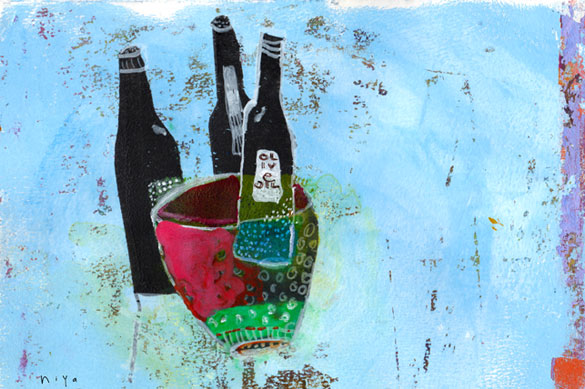
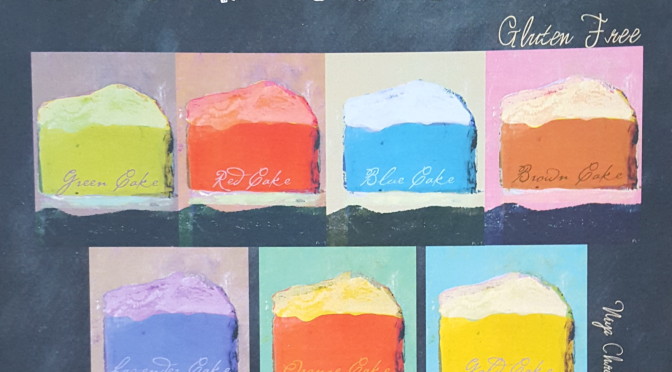
    i8tonite: Illustrator and author Niya Sisk & Salmon with Lemon and Dill RecipeNiya Sisk is an editorial illustrator, designer, and author. She is happiest in the with either a wooden spoon or pencil in hand. Niya was raised in Northern California, where she built tree forts to host pretend dinner parties for the kids in the neighborhood. Luckily, she now has a real kitchen for real dinner parties.  She recently created a gluten free cake cookbook, Cakes of Color—a purse size portable gallery of cake art with modern organic cake recipes. Cakes of Color: Gluten free recipes, illustrated and catalogued by color, was inspired by the Food and Wine section of The Art of Daily Cultivation. They Draw and Cook features  her Green Tea Cake recipe in their wonderful world of food illustration.

    Cakes of Color is a gorgeous cookbook, full of inspiration, joy, and, of course, color. Cakes of Color was approved to retail in 5 Whole Foods stores in the Bay Area in 2015. She’s currently illustrating a coloring book featuring food & wine and a portable gift book featuring her favorite recipes for clients and friends. Find more colorful inspiration at Niya’s Instagram.

    i8tonite: Illustrator and author Niya Sisk & Salmon with Lemon and Dill Recipe

    Chef’s Questionnaire (with a nod to Proust):

    What is your favorite food to cook at home?
    I have a few of those.
    Native American Crab & Corn Cakes with Abodo Sauce comes to mind immediately. I learned of this dish while in Sedona at the Enchantment Resort Mii Amo Cafe. The cookbook is simply exquisite. I brought it home with me, along with a beautiful wool cape. The cape has nothing to do with how good the food turned out. Well, who knows, maybe it did. Food and ritual are so closely tied. The Crab and Corn Cakes are very authentic and so delicious with the Abodo Sauce. I love to serve them with Champagne and arugula salad.

    i8tonite: Illustrator and author Niya Sisk & Salmon with Lemon and Dill RecipeAnother favorite is a simple comfort food recipe my mother taught me growing up – rosemary chicken. It’s such a flexible recipe. The staples are rosemary, garlic, salt, and pepper. But I will add ingredients like a bit lemon or olives and roast some red potatoes.
    And I haven’t even begun to talk about Salmon. That’s nearly a staple in my home.

    What do you always have in your fridge at home?
    Carrots with parsley for my pet rabbit.

    What marked characteristic do you love in a person with whom you are sharing a meal?
    Slow eating, passion for the art of conversation, and a love for red wine. Okay that was 3 characteristics. But they all go together in a person who loves life.

    What marked characteristic do you find unappealing in a person with whom you are sharing a meal?
    That’s easy. Mobile phone at the table. Looking at a person while enjoying amazing food is such a luxury these days. I’m a redhead. A statistic when it comes to all that means. Fiery and quirky, often unpredictable. If a mobile phone is on the table, I simply can’t take responsibility for my actions after that. ; D

    i8tonite: Illustrator and author Niya Sisk & Salmon with Lemon and Dill RecipeBeer, wine, or cocktail?
    A full bodied Spanish wine. Smooth, complex and opens up in rhythm with the conversation in play.

    Your favorite cookbook author?
    This is the hardest question yet. Alice Medrich is right up there. She has a gift for bringing history alive with her use of flours in baking. Baking is my main passion. I’ve learned so much from her. She’s such a master at gluten-free she’s removed the word from her taster’s vocabulary.

    Your favorite kitchen tool?
    My bright lime green spatula. I swear it’s my new power tool.

    Favorite types of cuisine to cook?
    Salads, Cakes (desserts), Seafood.

    Beef, chicken, pork, or tofu?
    Chicken.

    Favorite vegetable?
    Jicama. But my rabbit is convincing me (with his abundant enthusiasm) that kale is best thing on earth.

    Chef you most admire?
    Maggie, the chef at Omnivores Cookbook, is amazing. She has recently captivated my imagination with how authentic, fresh and accessible her Chinese cooking recipes are. And her photographs are stunning. I’ve always been afraid of cooking Chinese but she makes it so captivating and easy. So delicious.

    i8tonite: Illustrator and author Niya Sisk & Salmon with Lemon and Dill Recipe
    coffee on the beach (SF)

    Food you like the most to eat?
    Unfortunately, I’m crazy about CAKE. Luckily I also mountain bike and swim. ; D

    Food you dislike the most?
    No matter how amazing and awesomely cooked a beet is, I still can’t like it. People have tried. Oh, have they!

    What is your favorite non-food thing to do?
    Paint on a large canvas to loud and gorgeous music. Or illustrate whatever book I have in process. Coloring books, art books, cookbooks have been the theme the past 4 years.

    Who do you most admire in food?
    Deborah Madison, Greens Cookbook San Francisco. I have admired her for 20 years. I’ve worked through most of the recipes in Greens Cookbook. I have to say, I think she is a genius. Her meals, like Eggplant Gratin with Saffron Custard, could save the planet. So good.

    Where is your favorite place to eat?
    France. So creative and delicious. So much history. I never worry, I’m always up for all food adventures in France. Especially Paris and a few tiny village towns in the South of France.

    What is your favorite restaurant?
    That changes every month. I’m always food adventuring wherever I am. Right now, it’s Mediterranean Exploration Company in Portland, Oregon. I was blissed out for days after just one meal there.

    Do you have any tattoos? And if so, how many are of food?
    All my tattoos are on paper. I love to sketch, watercolor, monoprint the many colors and shapes of food. Food illustration is big passion.

    Salmon and dinner party prep. Salmon recipe included. Illustrated for the Food & Wine section of The Art of Daily Cultivation by Niya C Sisk.

    Recipe: Salmon with Lemon and Dill
    Recipe adapted from Shauna Prince, Portland, Oregon

    i8tonite: Illustrator and author Niya Sisk & Salmon with Lemon and Dill Recipe
    Illustrated for the Food & Wine section of The Art of Daily Cultivation by Niya C Sisk.

    Ingredients – serves 8

    Two whole fillets of salmon (skin on/or skin off, ideally wild, around 2 ½ pounds each fillet)
    Four medium lemons – two sliced in rounds (with skin on), one juiced, one sliced in wedges for garnish
    1½ oz butter
    Half a medium white or brown onion, cut in thin slices or wedges
    3 tablespoons of white wine (optional)
    1½ teaspoons of Dijon mustard
    2 tablespoons of fresh dill – chopped. Plus sprigs for garnish
    Salt (approx. ¼ tsp Kosher salt)
    Freshly ground pepper (approx. ¼ tsp)
    1½  tablespoons of olive oil

    Method

    Lightly sweat onion in butter until soft, but not browned. Add white wine, Dijon mustard, and lemon juice. Stir together and cool.

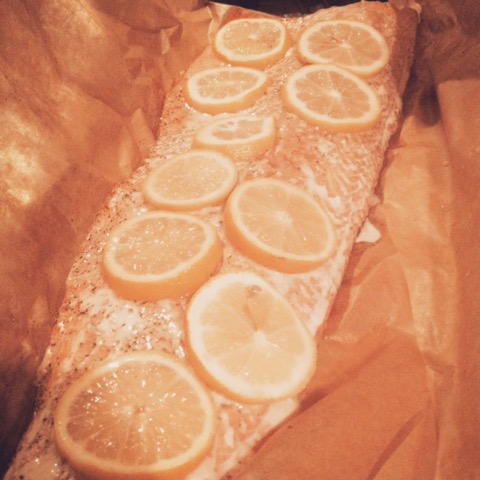
    i8tonite: Illustrator and author Niya Sisk & Salmon with Lemon and Dill RecipeFor each fillet, cut a piece of aluminum foil and a piece of parchment each slightly more than twice as long as your piece of fish. Be sure it’s large enough to fold over and seal your fish lengthwise. Lay the foil on the counter, then add the parchment paper on top of the foil. Place the fillet on top of the parchment – near one of the ends, skin side down. Repeat with the second fillet.

    i8tonite: Illustrator and author Niya Sisk & Salmon with Lemon and Dill Recipe
    For the love of Olive Oil

    Brush the top and bottom of each fillet lightly to coat with olive oil and season with salt and pepper. Pour half the butter/wine/mustard/lemon juice mixture evenly over each fillet. Lay round slices of lemon, and chopped dill on top of the fish. Close up the foil packets to seal.

    Heat up barbecue to 350F or medium-high heat (or your oven to 350F). Place fish packets on grill. Cook until the fish flakes lightly (be careful not to overcook it). Timing will depend on how thick your fish is – likely 10+ minutes for 1½ inch thick.

    Serve with additional lemon wedges and dill sprigs. You can also make an easy accompanying sauce with good mayonnaise mixed with a small amount of lemon juice and salt. Add chopped capers and dill to the sauce if you like.

    * Leftover salmon makes amazing fish cakes. Flake the fish, add 1- 2 lightly beaten raw eggs, any herbs that you want (e.g. dill, tarragon, sorrel), and enough breadcrumbs to hold the mixture together (panko works well). Add additional salt/pepper to your taste. Form into balls, and cook in a lightly oiled or buttered frying pan until brown. Turn and brown on the other side, and serve with lemon aioli.


    The End. Go Eat.
  • Our Pastured Chicks Kill Fascists

    Our Pastured Chicks Kill Fascists

    This is the second of the ongoing series on Food Musings written by award-winning poet and writer Julie Fisher. She is also the founder of Litmore, Baltimore’s Center for the Literary Arts.

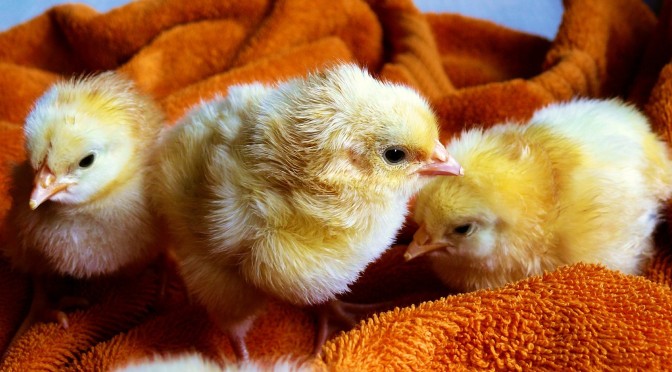
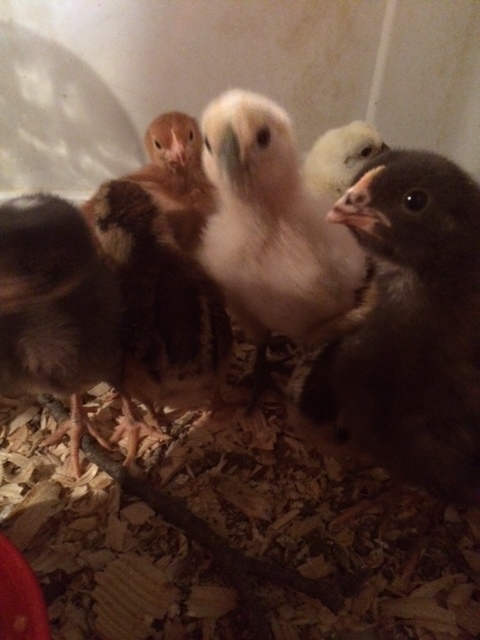
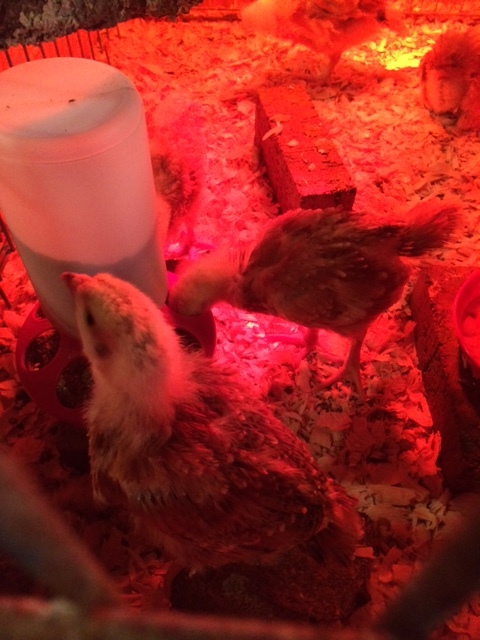
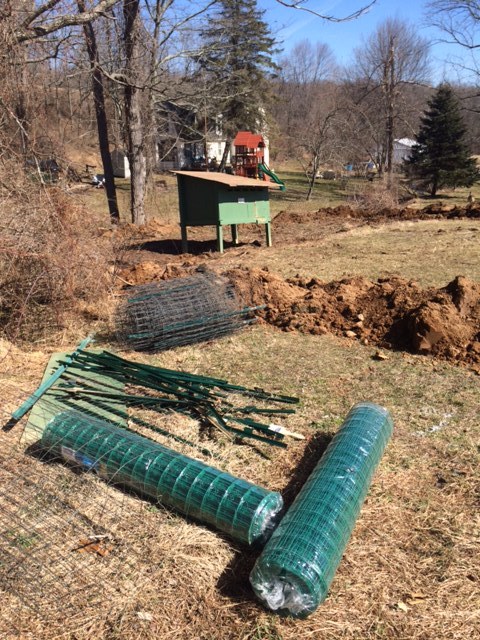
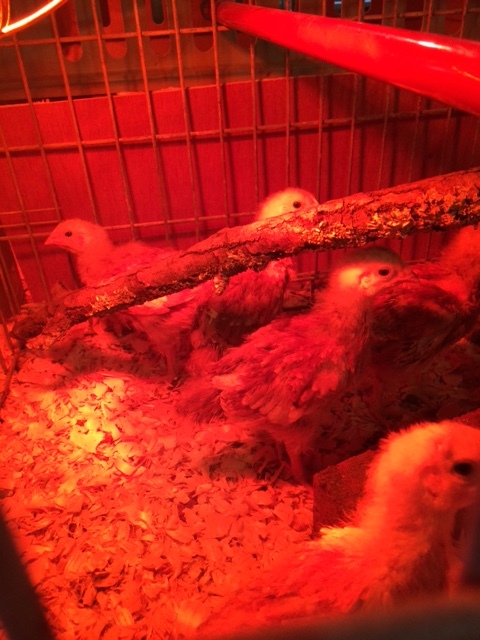
    Our Pastured Chicks Kill Fascists. Musings by Julie FisherSo! Hateful Acres has chickens! Fifteen at the moment. Six who are in the weird feathered but still slightly fluffy, huge feet, awkward stage and nine fluff balls with emerging feathers. I am SO excited. I have wanted chickens of my own for AGES. Our wonderful outdoor space coupled with shared labor and generosity is making it possible.

    Chickens are a fun mix of endearing and industrious. I’m repeatedly surprised how long I can just watch them and listen to their little conversations. Even my mostly city slicker kids are enchanted by the chicks and their antics. It’s not that chickens do anything particularly dramatic, they are simply a little silly in their seriousness.

    Before I go any further, a disclaimer: I make sweeping generalizations and OVER simplify complex politics and science. I do this hesitantly, but with the goal of opening conversations and encouraging us to investigate for ourselves. End of disclaimer.

    Chickens are currently an excellent symbol for the controversy over where our food should come from. In the United States, the science, technology, and expectations of our food culture changed dramatically post World War II. Advertising from food manufacturers waxed poetic and seduced us with promises that new convenience foods would grant us more leaisure time. After war time years of rationing and Victory gardens and let’s face it, quite a bit of labor, we were ready for some convenience.

    But behind the scenes and with little media coverage, relationships were forged between chemical manufacturers who had a surplus of stock post war, agricultural colleges, and food regulating branches of the federal government. Strategies were put in place for a long term process to move wealth from the large number of traditional American family farms to a tiny sliver of corporate owned mega farms. In a kind of stealth mode, farmers were “taught” that modern farming informed by space age science could be very profitable. Agricutural colleges were at the forefront of the new science and praised introduction of chemical feritlixers and pesticides. The resulting high volume yields could be farmed with very expensive machinery. It was expensive but it was modern machinery with perks like air conditioning and fast processing speeds. Not to worry, the money for the purchases of all these chemicals and machines could be easily borrowed and the fat cat life would soon be in the palm of the farmers’ hands.

    Our Pastured Chicks Kill Fascists. Musings by Julie Fisher

    But Willie Nelson and John Mellencamp alerted us back in 1985 that American farmers weren’t making a living anymore…farmers were finding out that all those loans became a heavy burden. The market that promised to make them rich instead got flooded with crops and prices plummeted. No profits mean no money to pay back all those loans. The banks didn’t want to hear what happened to the market, they just wanted their money. So, many farmers lost farms that had sustained their families for generations. Despite the best funds raised by FarmAid, auctions for farms and equipment became common place and farm families were evicted from their farms.

    Can you guess who swooped in and bought all those deeply discounted farms? Property developers who build Mcmansions? Sure, a few. But the bulk was purchased by corporations like Purdue and Tyson. Farming became food manufacturing. Instead of pockets of farms raising small numbers of animals based on what the land could support and the farm families could sustain. Food production rather than farming became the new normal. For example, here is some information from the United States Department of Agriculture’s Economic Research Service:

    U.S. poultry meat production totals over 43 billion pounds annually: over four-fifths is broiler meat; most of the remainder is turkey meat; and a small fraction is other chicken meat. The total farm value of U.S. poultry production exceeds $20 billion. Broiler production accounts for the majority of this value, followed by eggs, turkey, and other chicken.

    Broiler production is concentrated in a group of States stretching from Delaware, south along the Atlantic coast to Georgia, then westward through Alabama, Mississippi, and Arkansas.
    Most U.S. broiler production is under contract with a broiler processor. The grower normally supplies the growout house with all the necessary heating, cooling, feeding, and watering systems. The grower also supplies the labor needed in growing the birds. The broiler processor supplies the chicks, feed, and veterinary medicines. The processor schedules transportation of the birds from the farm to the processing plant. In many cases, the processor also supplies the crews who place broilers into cages for transportation to the slaughter plant.

    The U.S. turkey industry produces over one-quarter of a billion birds annually, with the live weight of each bird averaging over 25 pounds. Production of turkeys is somewhat more scattered geographically than broiler production.

    The United States is by far the world’s largest turkey producer, followed by the European Union.

    U.S. egg operations produce over 90 billion eggs annually. Over three-fourth of egg production is for human consumption (the table-egg market). The remainder of production is for the hatching market. These eggs are hatched to provide replacement birds for the egg-laying flocks and to produce broiler chicks for growout operations. The top five egg-producing States are Iowa, Ohio, Pennsylvania, Indiana, and Texas.

    The large majority of the U.S. table-egg production is consumed domestically. U.S. egg and egg product exports are a relatively minor proportion of production. U.S. per capita consumption of eggs and egg products is around 250 eggs per person.

    Did you catch that? 43 BILLION pounds of poultry. Also notice the language in the obove excerpt. Does it sound like the USDA is discussing sentient animals that breathe and have feelings and enjoy the sun on their feathers? No. The language refers to products. Units, not actual animals.

    That staggeringly immense number of birds are not raised on a farm and they are not treated like animals. Food manufacturers, otherwise known as factory farms, raise chicken-like animals in sunless warehouses where they sit in their own excrement or in tiny cramped wire cages, eating and fattening up or laying eggs in an endless succession. Factory-farmed chicken-like animals don’t get to manifest their “chicken-ness,” to borrow a term from farmer/ food activist Joel Salatin. Factory chicken-like animals are not given the chance to act on the chicken behaviour impulses embedded in their chicken biology. They don’t get to scratch for tasty stuff outside like grubs or caterpillars or peck at vegetation to hunt aphids. They don’t get to select their own obscure egg laying spot or even get to choose which roost to claim for the evening.

    Our Pastured Chicks Kill Fascists. Musings by Julie FisherMaking space for these distinctive chicken activities is the hallmark of a good chicken farmer. In my opinion, genuine farming includes, no – plans, the space for animals to be themselves. A good farmer helps chickens produce eggs and offspring or fattens them to be food in exchange for a steady food supply and thwarting predators and illness. But in this exchange, a good farmer RESPECTS his animals are alive and have feelings and sensations. A good farmer doesn’t try to just ignore this fact.

    Factory farming subjugates an animal ONLY according to its use and with zero respect. Factory farms don’t recognize consciousness or sentience, only product and profit. Even the human workers in factory farms are de-humanized. They are expected to just distribute food, dose the antibiotics, and remove corpses from the same toxic climate the where the chickens live.

    I’m drawn to raising chickens because I feel like my family and I are closer to the truth of eating. We can see how we are included in our “food chain”, not isolated from it and misled about the origins of our food. Most consumers have almost no awareness of HOW their eggs appear in a carton under flourescent lights in the refrigerated food warehouse. Or HOW the pre-butchered meat wrapped in plastic wrap gets there. This lack of awareness severs all of us intellectually from our animal-ness. The tragedy is we can pretend we aren’t predators. We are just shoppers.

    Our Pastured Chicks Kill Fascists. Musings by Julie Fisher

    This is the crux of our Earth crisis. Consumers do not recognize the consequences of being a shopper. Consumers cannot comprehend their purhases are the end point of a chain of events that ravages nature at the total expense of the future. Advertising has brainwashed us into believing all animals are raised and nurtured on bucolic red barned farms. But food manufacturers are lying to you. Only a tiny fraction of the animals we eat are raised as animals. The majority of those 43 billion birds are birthed, fed and butchered in a cruel, mechanical over medicated feedlot or warehouse and most of us don’t even know it.

    So I confess my urge to keep chickens is because I love the cluck and the scratch and the funny way they look up to swallow water and how freaking adorable the fluff muffin chicks are in the first couple weeks and the squee! I will get when we see our first eggs. But I DECIDED to raise chickens becasue pasturing chickens is one of the most subversive things you can do on a piece of land in 21st century United States. So in homage to Woody Guthrie, my bumper sticker is gonna say, “Our pastured chickens kill fascists.”

    Care to find a middle ground between total dependency on convenience foods and and raising your own animals? Find a local farm that pastures their animals and buy from that farmer. I also offer you the EASIEST chicken breast recipe ever, if you have access to a crockpot:

    3 Ingredient Salsa Chicken

    Yield: 4 servings
    Prep time: 5 minutes
    Total time: 6 hours, 5 minutes

    Ingredients

    4 chicken breasts, trimmed
    2 cups salsa
    2 cups shredded sharp cheddar cheese
    ¼ cup fresh chopped cilantro (optional)
    2 cups cooked rice (for serving)

    Directions

    Place 4 chicken breasts in your slow cooker, top with 2 cups of salsa. Cover and cook for 4-5 hours on low.
    Top with cheddar cheese, cover and continue to cook for 1-2 hours more, or until the cheese is very melted and the chicken is tender and cooked through.
    Top with cilantro and serve over rice.

  • i8tonite with Rancho Gordo Founder Steve Sando & Recipe for Posole Verde

    i8tonite with Rancho Gordo Founder Steve Sando & Recipe for Posole Verde

    i8tonite with Rancho Gordo Founder Steve Sando & Recipe for Posole VerdeRancho Gordo’s founder Steve Sando is the embodiment of an i8tonite food person. In under two decades, he has revitalized a New World food, something so grubby that it was taken for granted by most Americans – beans. Prior to Rancho Gordo’s revival of legume culture, beans were found on the lower level of supermarket shelves, holding back the dust bunnies. Thankfully, dried beans have a long shelf life – but like all things hidden in dark corners, and subjected to fluorescent lighting (besides the horrible music), commodity beans will eventually lose some flavor and become stale.

    i8tonite with Rancho Gordo Founder Steve Sando & Recipe for Posole Verde
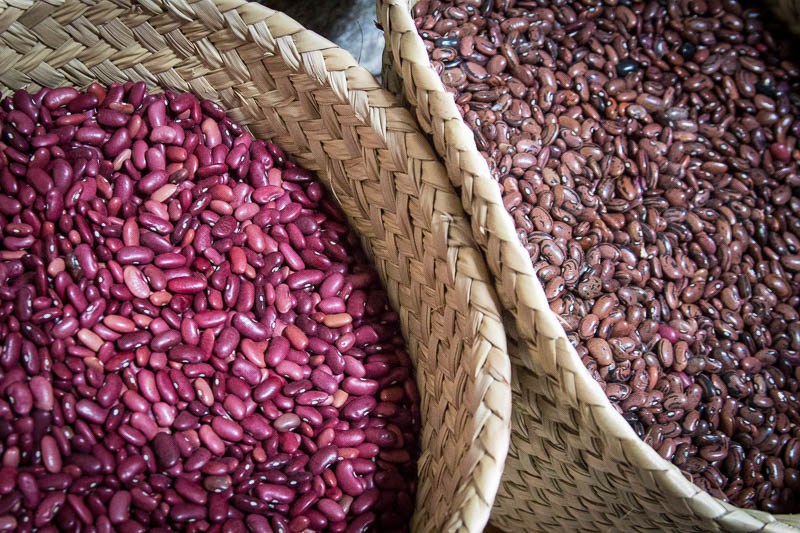
    Beautiful heirloom beans from the Rancho Gordo-Xoxoc Project

    Rancho Gordo’s beans are heirloom varieties, meaning that the origin (seed) is largely unmodified by technology or genetic science. In essence, the varieties of beans Rancho Gordo grows are dictated by the adage “let nature takes its course.” To the eater, this means more flavor, essence, and character.

    Sando was based in Napa Valley, arguably one of the world’s best agriculture regions and home to The French Laundry. Subsequently, it was only a matter of time before his products made it onto North America’s most illustrious dining menu. “Thomas Keller gave us his blessing,” states Sando…and he’s been thriving with great beans and products since.

     i8tonite with Rancho Gordo Founder Steve Sando & Recipe for Posole Verde
    Poached egg broth over a bed of Sta Maria Pinquitos

    Rancho Gordo produces almost 35 varieties of heirloom beans, using a selection of farmers from California, Oregon, and Washington – and they almost always sell out. His customers are mostly home-cooks, but there are quite a few chefs who use Rancho Gordo but don’t understand heirloom varietals. “Chefs are the worst,” Sando chuckles. “We sell heirloom beans, which means our farms produce a low yield. We run out of varieties, yet (chefs) expect them to always be available. It takes about six months to develop each crop. So when we are out, we have to reseed, replant, and re-harvest.” (Stock up, chefs!)

    Recently, Sando named one of his heirloom finds the Marcella, named after the famed Italian cookbook author Marcella Hazan. The story about their friendship and the eponymously named bean made it into the New York Times. “It killed us,” he says. “But in a good way.” His mail order business is robust, with sixty-five percent of his business coming from on-line but he also has two outlets: Napa, where Rancho Gordo is based, and in San Francisco’s legendary food emporium, the Ferry Building.

    At the end of the day, Sando, a farmer with all the accolades and outpouring of goodwill about his beans, is a normal food person like the rest of us. And he eats beans, every day.

    i8tonite with Rancho Gordo Founder Steve Sando & Recipe for Posole Verde

    Food People Questions (with a nod to Proust):

    What is your favorite food to cook at home?
    Obviously, it would be beans. But I poach a chicken every week and use the meat in other meals and the broth becomes soup. Then I tend to improvise with vegetables.

    What do you always have in your fridge at home?
    Chipotle en vinagre. It’s one of the best relishes I know. One day I’d love to make them commerically.

    What marked characteristic do you love in a person with whom you are sharing a meal?
    I love when they react to the food, the music, the table, the other people. It’s so easy to eat alone. I would hope they know how to express the joy of breaking bread with others.

    What marked characteristic do you find unappealing in a person with whom you are sharing a meal?
    My first reaction would be to say someone who talks with their mouth full, but really, I can forgive that if they’re enthusiastic. I think people who drone on and are not aware of the rhythm of the conversation. I sometimes am guilty and stop myself if I’m hearing my own voice too much.

    Beer, wine, or cocktail?
    I love a single cocktail before dinner. A nice round, ready as your guests come in the door, is welcome. But put it away and switch to wine ASAP. My crowd tends to be wine and beer people and they don’t remember how to pace themselves with cocktails. You want your guests loose, not sloppy.
    Beer or wine with dinner, depending on what is served.

    Your favorite cookbook author?
    I can read Diana Kennedy’s books like novels. But I have to add Paula Wolfert, Georgeanne Brennan, and Marcella Hazan. All strong women from an era when cookbooks weren’t just extended magazine articles.

     i8tonite with Rancho Gordo Founder Steve Sando & Recipe for Posole VerdeYour favorite kitchen tool?
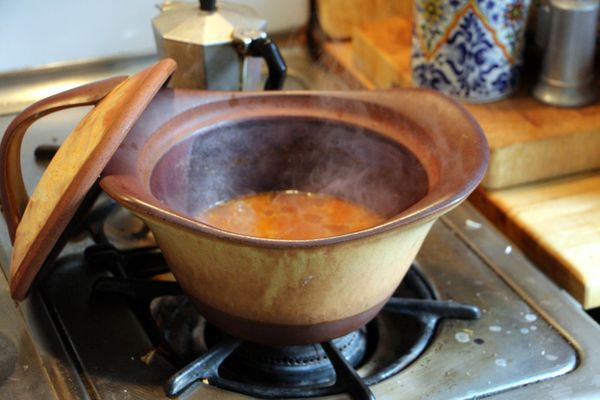
    I have a huge collection of clay pots. I don’t think I could single one out.


    Favorite types of cuisine to cook?
    Mexican is my obsession. The more I go, I realize am strictly a tourist with this cuisine. We haven’t even scratched the surface.

    Beef, chicken, pork, or tofu?
    Pork. Then Chicken.

    Favorite vegetable?
    Beans would be too obvious, so i’ll say nopales. I love harvesting green cactus paddles and eating them as a vegetable. I understand they’re healthy, too, but that doesn’t interest me much.

    Chef you most admire?
    I think Frances Mallmann. He seems to understand that you are cooking to enjoy it with friends and good wine, not just cooking to cook or be clever. I’m also loving Sean Brock these days. He’s so clearly passionate about ingredients and I think he’s presenting southern food in a really appealing way. I’ve never met either of them but I’d like to.

    i8tonite with Rancho Gordo Founder Steve Sando & Recipe for Posole Verde

    Food you like the most to eat?
    I think our local crab. It’s a workout and there’s a pay off.

    Food you dislike the most?
    I wish there were one. I love it all, to different degrees. And if I say I hate rutabagas (which is close to true), I’ll still keep an open mind and I bet there’s a chef who could turn me around.

    What is your favorite non-food thing to do?
    Road trips in rural Mexico.

    i8tonite with Rancho Gordo Founder Steve Sando & Recipe for Posole Verde

    Who do you most admire in food?
    I think the indigenous women who I’ve met in Mexico. They’re the real thing. They have no concept of food trends and just make delicious food.

    Where is your favorite place to eat?
    I think a beach with cold beers and a bucket of perfectly steamed shrimp.

    What is your favorite restaurant?
    I don’t really have one, but if pushed, I’d say Contrmar in Mexico City.

    Do you have any tattoos? And if so, how many are of food?
    Nope! One aspect of me is still virginal.

    Recipe: Posole Verde

    i8tonite with Rancho Gordo Founder Steve Sando & Recipe for Posole Verde

    Serves 6

    • 1/4 pound Rancho Gordo White Posole (prepared hominy)
    • 1 1/2 onions, white or red, peeled and halved
    • Salt
    • 4 garlic cloves, peeled
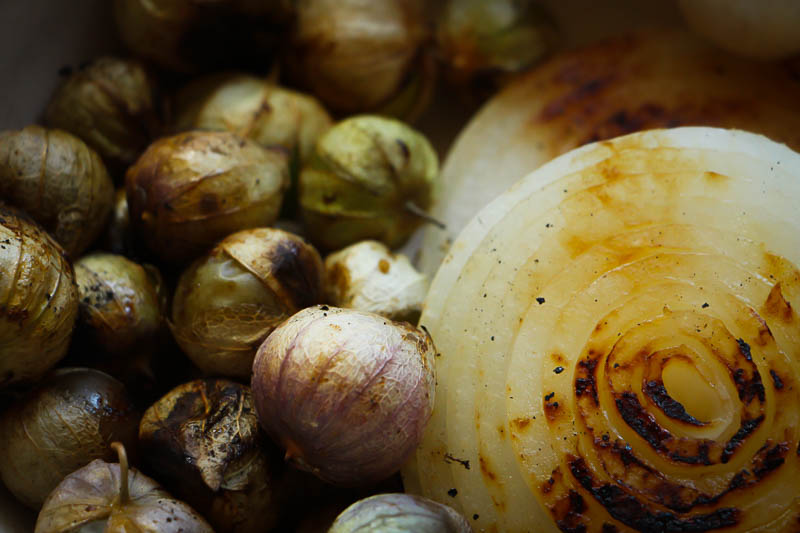
    • 15 to 20 tomatillos, paper skins removed
    • 2 poblano chiles
    • 1 serrano chile
    • 2 tablespoons extra virgin olive oil
    • 1 cup coarsely chopped cilantro
    • 2 teaspoons Rancho Gordo Mexican Oregano
    • 1 1/2 quarts vegetable or chicken broth
    • Freshly ground black pepper

    1. Soak posole overnight in water to cover generously. Drain.

    2. Place it in a saucepan with fresh water to cover generously.

    3. Add 1/2 onion, bring to a simmer, cover partially and cook at a gentle simmer until the corn kernels are tender, 2 to 3 hours; many will split open. Season with salt and cool in the liquid.

    4. On a hot, dry griddle or skillet, roast the remaining halved onions, garlic, tomatillos and chiles, turning occasionally, until they are charred and slightly softened, 15 to 20 minutes. Work in batches if necessary.

    5. Put the roasted poblano chiles in a paper bag to steam until cool.

    6. Transfer the other vegetables to a bowl and let cool, collecting their juices.

    7. Skin the poblanos, discarding seeds and stems. Discard the serrano chile stem but don’t skin or seed.

    8. Put all the roasted vegetables in a blender, in batches if necessary, and puree until smooth.

    9. Heat the oil in a large stockpot over moderate heat.

    10. Add the vegetable puree and adjust heat to maintain a simmer. Cook, stirring occasionally, for 10 minutes to blend the flavors.

    11. In the blender, puree the cilantro, oregano and 1 cup of the broth. Add to the vegetable mixture along with 4 cups additional broth.

    12. Drain the posole and add it to the pot. Season with salt and pepper and return to a simmer. Thin with additional broth if necessary. Serve in warm bowls.


    The End. Go Eat. 
  • i8tonite with Eat Smart Culinary Travel Guides’ Susan Chwae & Shepherd’s Pie Recipe

    i8tonite with Eat Smart Culinary Travel Guides’ Susan Chwae & Shepherd’s Pie Recipe

    i8tonite with Eat Smart Guides' Susan Chwae & Shepherd's Pie RecipeSusan Chwae, along with her mother Joan Peterson, are publishers of the award-winning Eat Smart Culinary travel guidebook series. To date, they have published guides to Brazil, Denmark, France, Germany, India, Indonesia, Mexico, Morocco, Norway, Peru, Poland, Sicily, and Turkey. Note: the links are to my interviews with the authors! I love these guides and have enjoyed reading and sharing them for many years. This series? It’s the best thing you can read if you love food and are traveling.

    In 2014, Susan designed the Eat Smart Abroad App that pulls the menu guide and foods and flavors chapters from each book so you never have to wonder what’s on the menu or in the market with easy-to-use translators for food and beverage terminology.

    Susan also co-leads the Eat Smart Culinary Tours. Their annual Eat Smart Culinary Tour to Turkey is their most popular tour. Here’s a video from one of their tour participants:

    They also lead tours to Morocco, India, Peru, Sicily, and in 2016 will be launching the 2016 Culinary Tour to Indonesia, with William Wongso, who is considered one of Indonesia’s national treasures.

    Joan Peterson and Susan Chwae of Eat Smart Guides. From i8tonite with Eat Smart Guides' Susan Chwae & Shepherd's Pie Recipe
    Joan Peterson and Susan Chwae of Eat Smart Guides


    Food People Questionnaire (with a nod to Proust):

    i8tonite with Eat Smart Guides' Susan Chwae & Shepherd's Pie Recipe

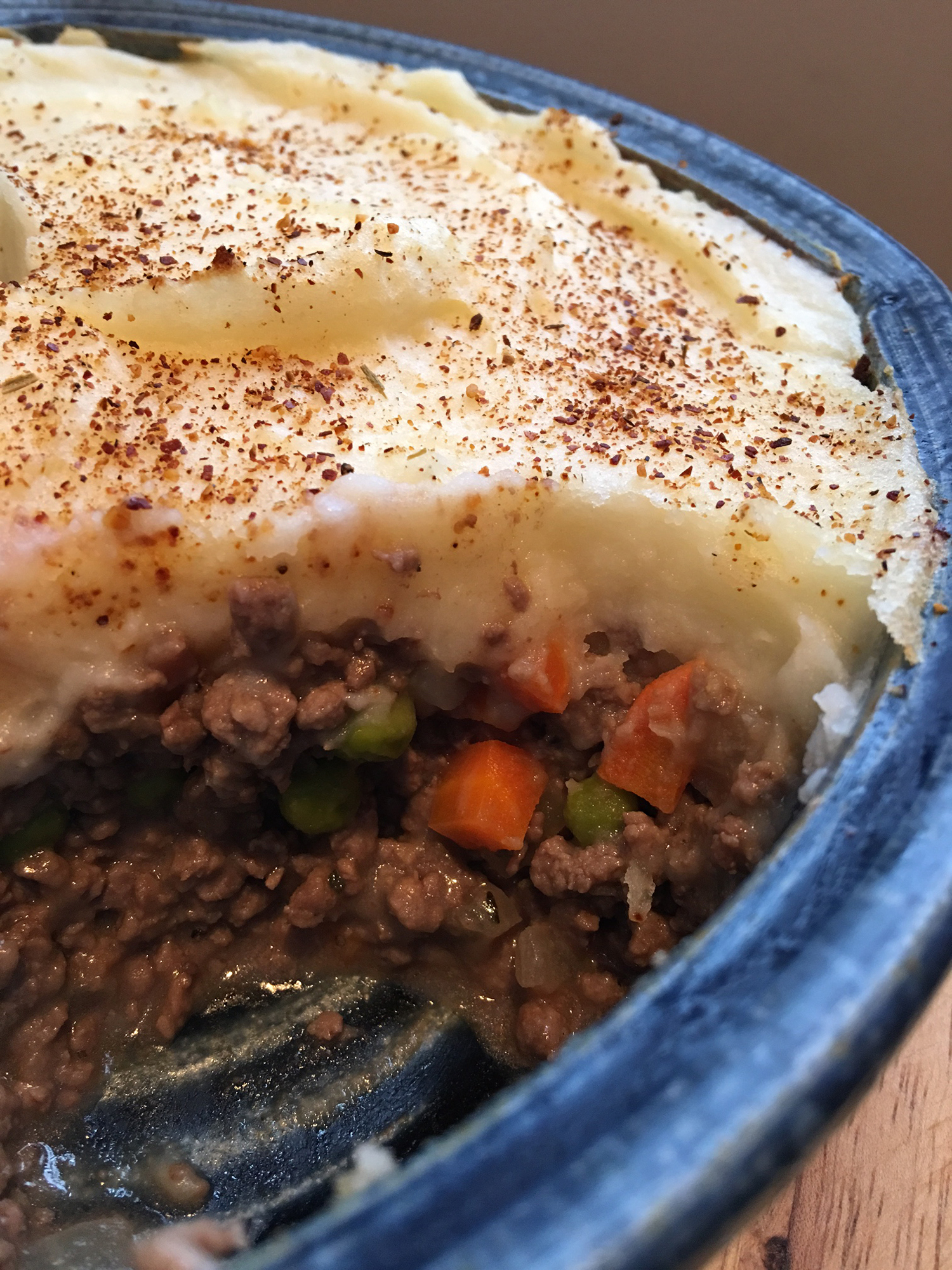
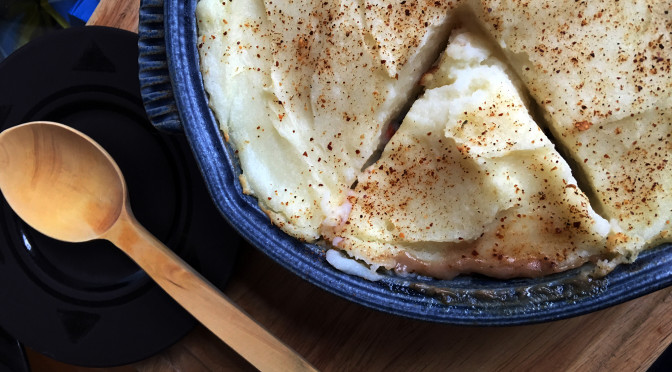
    What is your favorite food to cook at home?  My grandma’s Shepherd’s Pie. It’s simple and a real comfort food in the winter months. I tend to cook with what I have available at the moment and this recipe is perfect to use what you have on hand, or that single parsnip or rutabaga you received in your CSA share.

    What do you always have in your fridge at home? Cheese, a Wisconsin kitchen staple.

    What marked characteristic do you love in a person with whom you are sharing a meal? A mutual appreciation for the thought and creativity that went into preparing the meal.

    What marked characteristic do you find unappealing in a person with whom you are sharing a meal? Eating too fast, and making me clean up the kitchen.

    Beer, wine, or cocktail? Wine or cocktail.

    Your favorite cookbook author? When I went away to college, my dad bought me the Better Homes and Garden cookbook collection. He wrote a message on the inside cover in each of them. I grab those first for ideas and then create my dishes with what I have on hand.

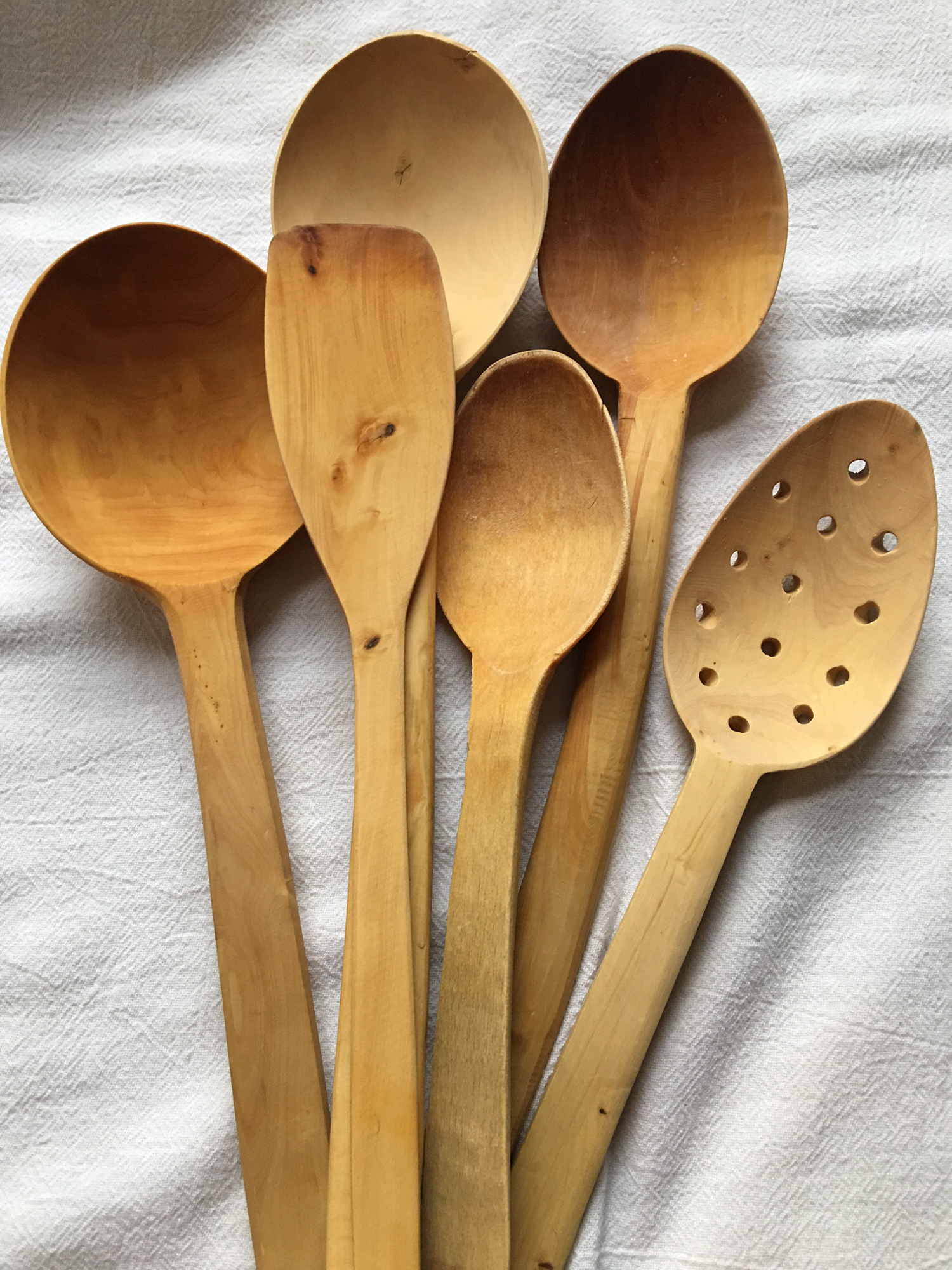
    Turkish spoons. i8tonite with Eat Smart Guides' Susan Chwae & Shepherd's Pie Recipe
    Turkish spoons

    Your favorite kitchen tool? My Şimşir wood spoon collection from Turkey. There are shops behind the Spice Market in Istanbul where they are made and sold and we always stop to shop as part of our tour itinerary.

    Favorite types of cuisine to cook? I’m a casserole fan. And I love traditional Mexican foods.

    Beef, chicken, pork, or tofu? Chicken

    Favorite vegetable? Asparagus

    Chef you most admire? My husband. When he starts creating a dish, he absolutely has to master it and I admire his dedication.

    Food you like the most to eat? King crab legs

    Food you dislike the most? Pearl onions

    What is your favorite non-food thing to do? Watch my daughters perform in dance and music. Both of them are passionate about the arts.

    Who do you most admire in food? Right now, William Wongso. He’s going to be co-leading our upcoming culinary tour to Indonesia. His dedication and drive to promote the cuisine of Indonesia is awe-inspiring.

    Where is your favorite place to eat? Home. I am surrounded by great cooks.

    What is your favorite restaurant? Salvatore’s Tomato Pies in Madison.

    Do you have any tattoos? And if so, how many are of food? If I did, I wouldn’t be able to say because my mother will read this.

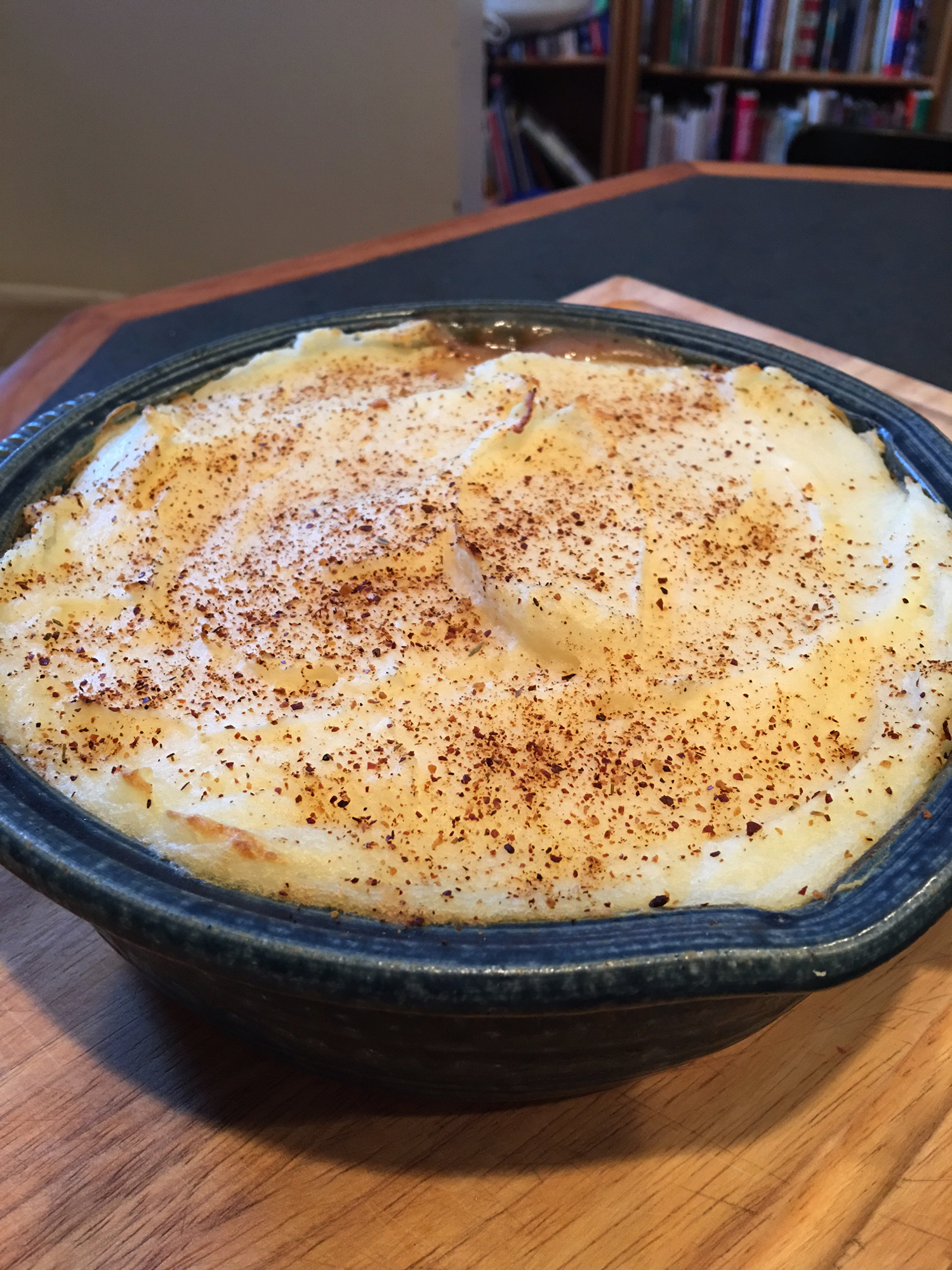
    Recipe: Thelma’s Shepherd’s Pie

    i8tonite with Eat Smart Guides' Susan Chwae & Shepherd's Pie Recipe

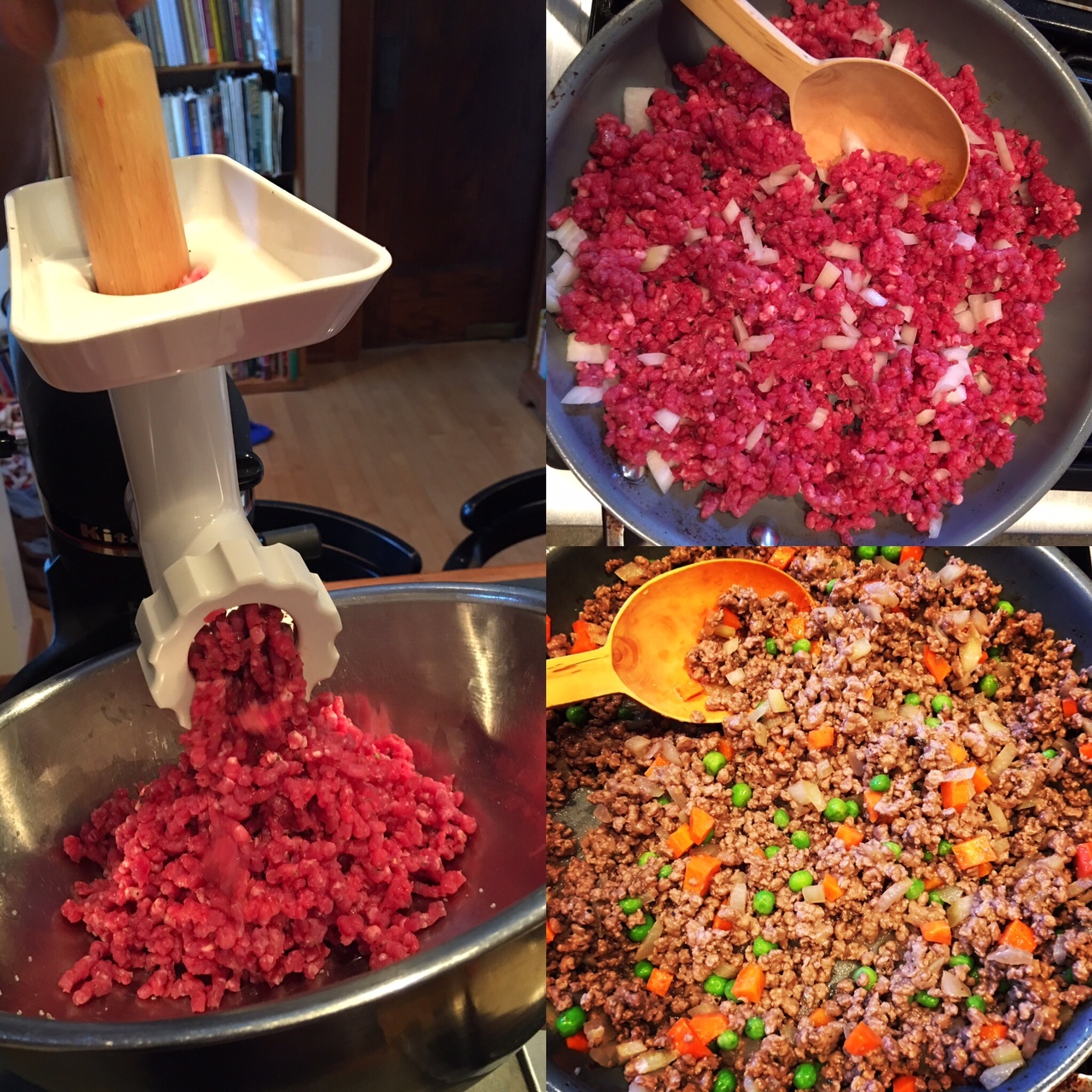
    Brown ground or diced lamb with chopped onions.

    i8tonite with Eat Smart Guides' Susan Chwae & Shepherd's Pie Recipe

    Add a variety of small or diced vegetables you have on hand, some flour, worcestershire sauce, some herbs, salt and pepper, and enough water to thicken the mixture.

    Place in a deep casserole dish and top with prepared mashed-potatoes.

    Sprinkle with paprika and bake at 350 degrees, uncovered, around 30 minutes.


    -The End. Go Eat.-

  • i8tonite with St. John’s, Newfoundland Chef Mark McCrowe & Seafood Chowder Recipe

    i8tonite with St. John’s, Newfoundland Chef Mark McCrowe & Seafood Chowder Recipe

    Chef Mark McCrowe, Food Day Canada 2015
    Chef Mark McCrowe at Food Day Canada 2015

    I first met Chef Mark McCrowe at RANL‘s Food Day Canada event in St. John’s, Newfoundland, on my very first day in town. Held in a large ballroom, the event showcased several dozen chefs from around Canada – and some extraordinary local dishes. Newfoundland is in the middle of a culinary renaissance – so much good food, so many excellent and creative chefs, and an eat local ethic that is impressive, given the northern Atlantic locale on an island called The Rock.

    I was impressed with his presentation and flavor of his dish – a salt beef and potato crusted cod with mustard pickle puree, collard greens, and a whelk beurre blanc sauce. It was the perfect introduction to Newfoundland.


    i8tonite with St. John's, Newfoundland Chef Mark McCrowe & Seafood Chowder Recipe

    Mark was born and raised in St. John’s, NL. Growing up around simple Newfoundland dishes, using fresh seafood and wild game, inspired an appreciation of the local style of food and where it comes from. After studying culinary and baking and pastry arts in British Columbia and working in some of Van city’s best kitchens, he returned home to further his own individual style as a chef. Mark opened his first restaurant, Aqua, at the age of 26 and his second more casual gastropub, The Club, at the age of 29. Mark is living his dream: cooking the food he loves to cook and doing it in the place and for the people that mean so much to him…………Happy cooking!!

    i8tonite with St. John's, Newfoundland Chef Mark McCrowe & Seafood Chowder Recipe

    Find him in St. John’s, Newfoundland, at EVOO in the Courtyard.

    Chef’s Questionnaire (with a nod to Proust):

    How long have you been cooking?
    Since I was about 13. I would record all the Wok With Yan episodes on VHS and recreate them for my family. Still my favourite show!

    What is your favorite food to cook?
    I’m obsessed with the wide variety of flavours and ingredients in Asian food, but I like to work my way around the globe though ingredients without ever spending the money to travel :p

    i8tonite with St. John's, Newfoundland Chef Mark McCrowe & Seafood Chowder Recipe

    What do you always have in your fridge at home?
    I use way too much sambal olek and sriracha.

    What do you cook at home?
    I’m a one pot wonder kinda guy. I like simple flavourful food and dislike doing the dishes.

    What marked characteristic do you love in a customer?
    I like when customers are having fun and are just plain into what they are eating. Life is too short to be a stuffy loser.

    What marked characteristic do you find unappealing in a customer?
    You never know what kind of day someone has had or what they may be going through in their personal life, but there is never an excuse for treating a server like garbage.

    Tupperware, Rubbermaid, or Pyrex?
    I’m all about the ziplock, baby.

    Beer, wine, or cocktail?
    All of the above, please.

    Your favorite cookbook author?
    Jacques Pepin is and always will be.

    Your favorite kitchen tool?
    My hands

    Your favorite ingredient?
    Pork and pork related products

    Your least favorite ingredient?
    Kiwi (I’m allergic)

    Least favorite thing to do in a kitchen?
    Inventory

    i8tonite with St. John's, Newfoundland Chef Mark McCrowe & Seafood Chowder Recipe
    Catching Capelin

    Favorite types of cuisine to cook?
    I adore so many types of food. What really interests me is the simple recipes using local Newfoundland ingredients that my grandparents would use. I always like applying them to modern day cooking.


    Beef, chicken, pork or tofu?
    Pork with tofu, if I could

    Favorite vegetable?
    Onion

    Chef you most admire?
    Shaun Hussey of Chinched bistro in St.John’s, Newfoundland. He’s a good friend and the type of chef that is always pushing himself. The real deal.

    Food you like the most to eat?
    I like anything you have to get into and eat with your hands…like a platter of Newfoundland seafood with lobster and crab.

    Food you dislike the most?
    I hate food that looks to pretty to eat and is too smart for its own good. Sometimes a tomato is nicer than a tomato gel.

    How many tattoos? And if so, how many are of food?i8tonite with St. John's, Newfoundland Chef Mark McCrowe & Seafood Chowder Recipe
    I do have “Jiggs dinner” tattooed on my forearm. It is the quintessential Newfoundland one pot meal that involves salt beef and root vegetables. It’s my death row last meal and by far the most popular dish from Newfoundland, but my Nan makes it the best, so everyone else is out of luck!


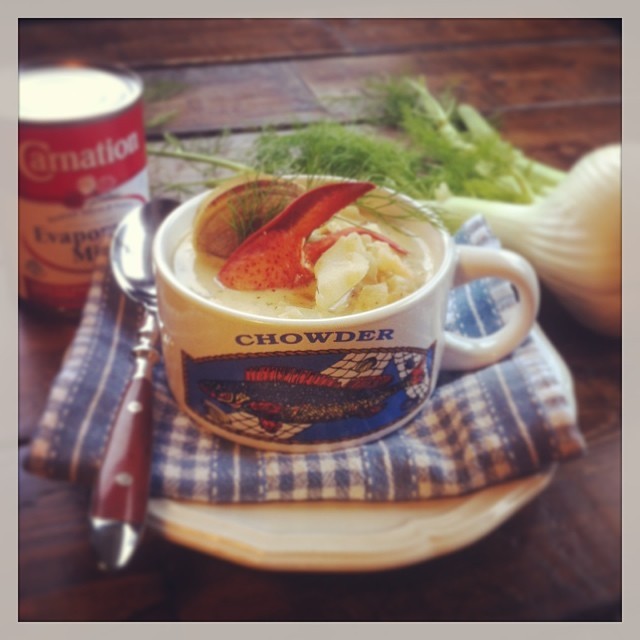
    Recipe: Newfoundland Seafood Chowder with Roasted Fennel, Dill, and Evaporated Milk

    i8tonite with St. John's, Newfoundland Chef Mark McCrowe & Seafood Chowder Recipe
    Newfoundland Seafood Chowder

    This chowder is a canvas to show off some of the Rock’s best seafood. You can use whatever you have available here. The flavors of roasted fennel, dill, and lemon really make it special – and by using evaporated milk, you really get that authentic chowder flavour.
    Serves: 10-12 portions

    FOR THE CHOWDER
    ½ cup unsalted butter
    ½ cup all purpose-flour
    1 onion (diced)
    2 stalks celery (diced)
    2 heads fennel (diced)
    2 potatoes (diced)
    ¼ cup Pernod
    1 cup dry white wine
    1 litre fish stock
    ½ litre heavy cream
    2 cans evaporated milk
    ½ cup chopped dill
    5 tbsp lemon juice
    3 dashes Tabasco
    3 dashes Worcestershire
    Salt
    Cracked black pepper
    1 cup cold water shrimp (peeled)
    1 lb fresh cod
    ½ lb mussels
    ½ lb clams
    1 lb cooked lobster meat
    ½ lb cooked snow crab meat

    In a large roasting tray, mix the diced fennel with 4 tbsp of olive oil, salt, pepper and roast in a 400 degree oven until lightly caramelized. In a large heavy bottomed pot, melt the butter and flour together, forming a roux, and cook for 2 minutes.

    Add all of the vegetables and cook them for roughly 5 minutes or until translucent. Add the roasted fennel and deglaze the pot with the pernod and white wine while stirring constantly.

    Add the remaining liquids, bring to a boil, and reduce to a simmer to cook slowly for roughly 30 minutes or until the vegetables are soft and the soup has slightly thickened. Season with salt, pepper and add all the seafood to cook for just a couple of minutes. In a separate pan, cook the mussels and clams with 2 cups of the chowder base until the shells open, then add back into the main pot. At the last minute before serving, add the fresh dill and adjust the seasoning.

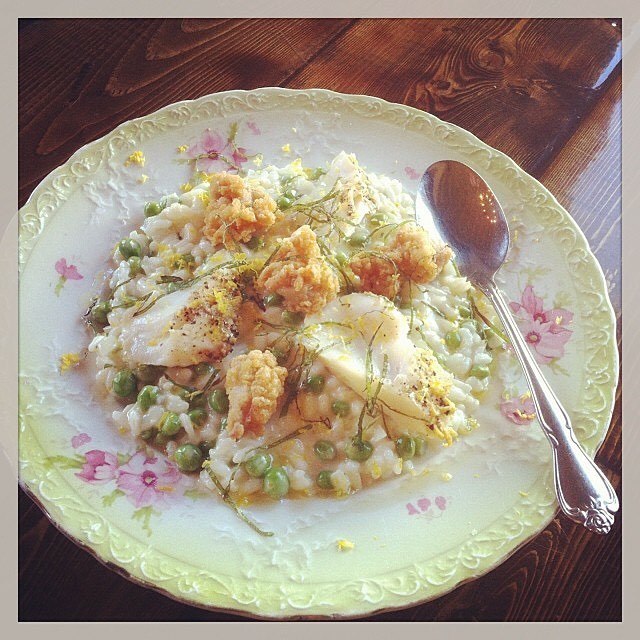
    Recipe: Lemon Pepper Smoked Cod and Crispy Britches with Mint, Lemon, and Green Pea Risotto

    Lemon Pepper Smoked Cod and Crispy Britches with Mint, Lemon, and Green Pea Risotto. i8tonite with St. John's, Newfoundland Chef Mark McCrowe & Seafood Chowder Recipe
    Lemon Pepper Smoked Cod and Crispy Britches with Mint, Lemon, and Green Pea Risotto

    Cod britches are the roe sac of a female cod and are named for their resemblance to a pair of baggy trousers. In this dish, we smoke cod loin with lemon zest and cracked pepper, fry the cod britches till crispy, and serve it on top of a creamy mint and pea risotto. So good!
    Serves: 4

    FOR THE LEMON PEPPER SMOKED COD
    1-8 oz cod loin
    1 lemon (zested)
    Sea salt
    Cracked black pepper
    1 cup wood chips (soaked in water)

    To smoke the cod loins, put the woodchips in the bottom of a frying pan or wok and put it over a burner on medium heat. Once it starts to smoke take the cod loin and sprinkle it with the lemon zest and cracked pepper. Place on a rack that can fit in the frying pan. By this time there should be quite a bit of smoke, so you want to cover it tightly with tinfoil to capture all that smoke. Let them go for about 10-12 minutes, then take them off the heat. The cod should be flakey and cooked through.

    FOR THE CRISPY BRITCHES
    2 cod britches (cut into small pieces)
    Sea salt
    Cracked black pepper
    1 cup all-purpose flour
    Canola oil for frying

    Season the cod britches and dust them in the flour, shaking off any excess. Fry them in a household deep fryer set at 375 degrees until golden brown. Drain on paper towel and season again with sea salt.

    FOR THE MINT, LEMON, AND GREEN PEA RISOTTO
    5 to 6 cups fish stock
    4 Tbsp unsalted butter
    1 onion (finely diced)
    Sea salt
    2 cups arborio rice
    1/2 cup dry white wine
    2 cups frozen peas
    1/3 cup chopped fresh mint
    2 Tbsp fresh lemon juice
    1 Tbsp finely grated lemon zest
    1/4 cup freshly grated Parmigiano Reggiano

    Heat the fish stock in a saucepan over medium-high heat until very hot and then reduce the heat to keep the broth hot.

    In another heavy saucepan, melt 2 Tbsp of the butter over medium heat. Add the onion and a generous pinch of salt and sautée, stirring occasionally with a wooden spoon, until the onion softens and starts to turn lightly golden, 3 to 5 min. Add the rice and stir until the grains are well coated with butter and the edges become translucent, 1 to 2 min. Pour in the wine and stir until it’s absorbed, about 1 min.

    Add another generous pinch of salt and ladle enough of the hot broth into the pan to barely cover the rice, about 1 cup. Bring to a boil and then adjust the heat to maintain a lively simmer. Cook, stirring occasionally, until the stock has been mostly absorbed, 2 to 3 min. Continue adding broth in 1/2-cup increments, stirring and simmering, until it has been absorbed each time, at intervals of about 2 to 3 min. After about 16 to 18 minutes, the rice should be creamy but still fairly firm.

    At this point, add the peas and another 1/2 cup broth. Continue to simmer and stir until the peas are just cooked and the rice is just tender to the tooth, another 3 to 4 min. Stir in another splash of broth if the risotto is too thick. Remove the pot from the heat and stir in the mint, lemon juice, lemon zest, the remaining 2 Tbsp butter, and the Parmigiano. Season with salt to taste.

    Serve the risotto immediately with a sprinkling of chopped mint and grated lemon zest. Top with some crispy britches, flakes of the smoked cod loin and Bob’s your uncle.


    -The End. Go Eat.-

  • i8tonite: On the Joy of Deviled Eggs

    i8tonite: On the Joy of Deviled Eggs

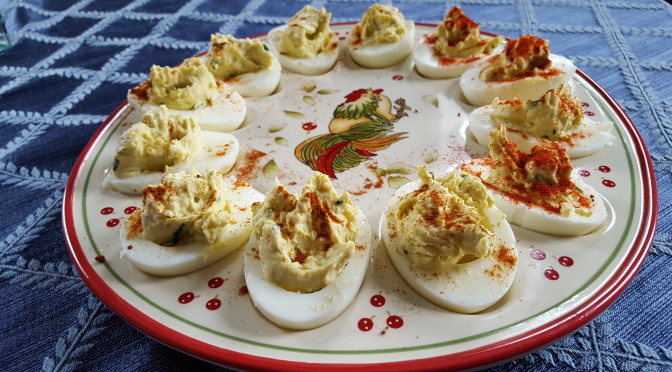
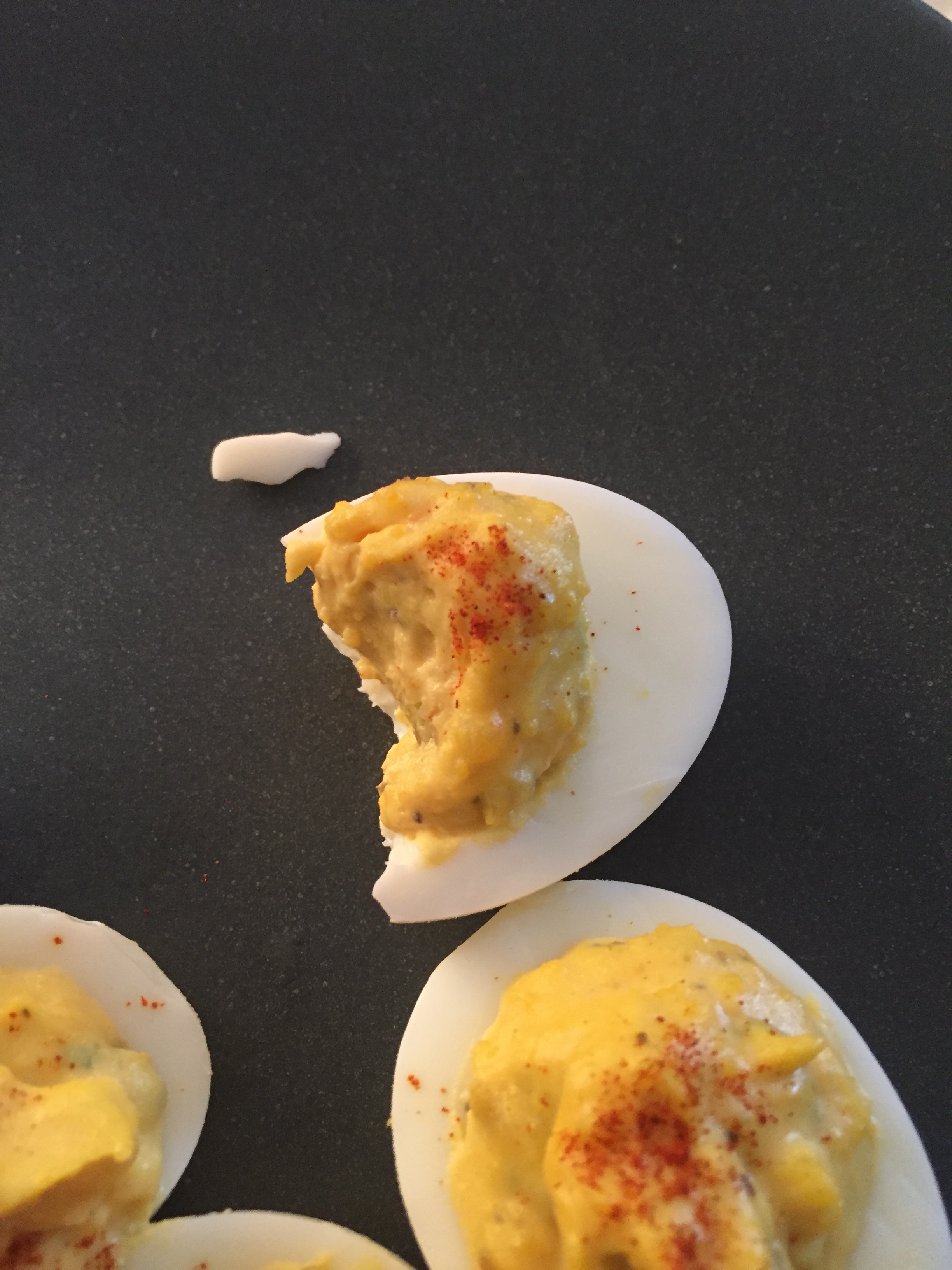
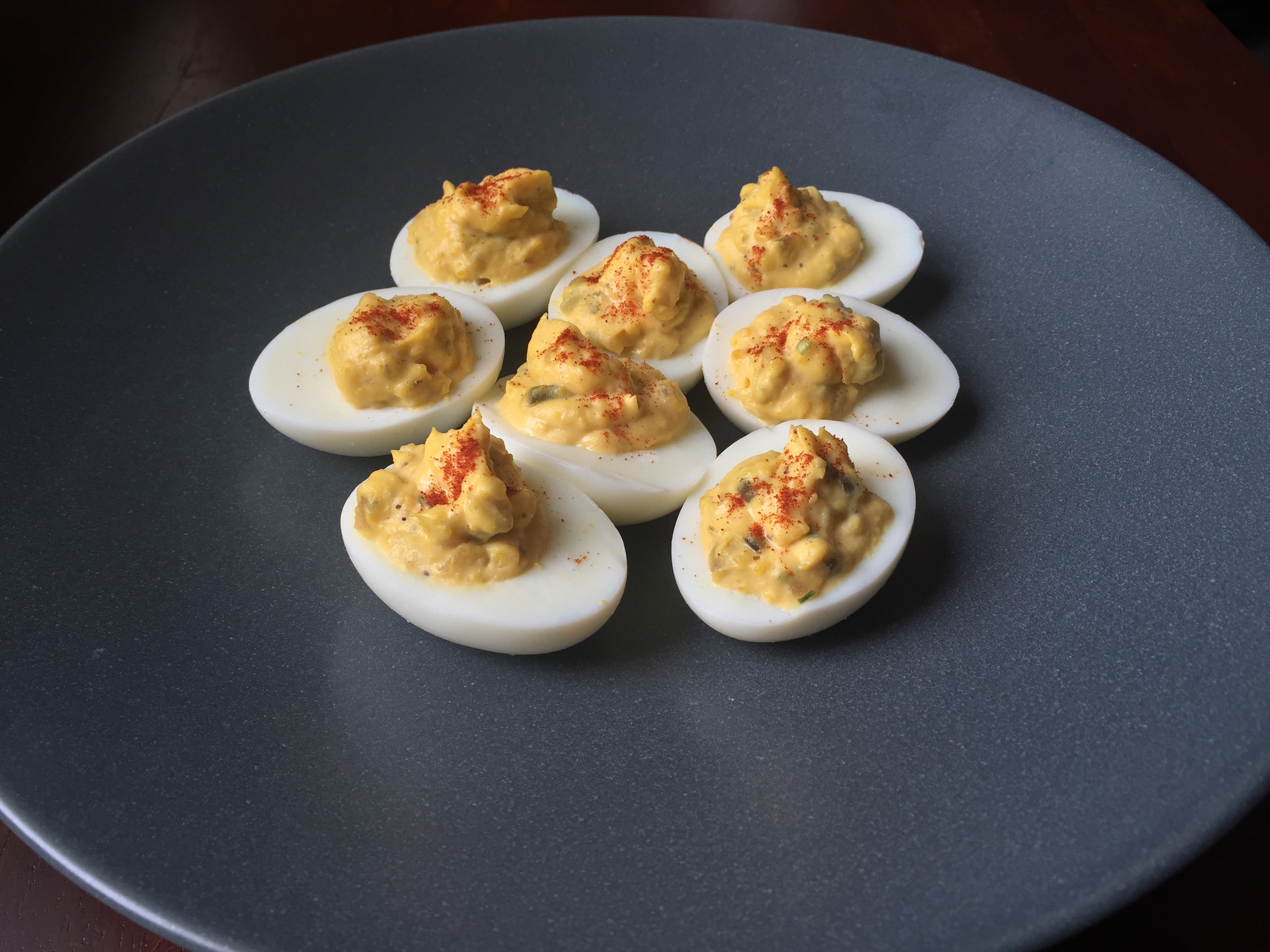
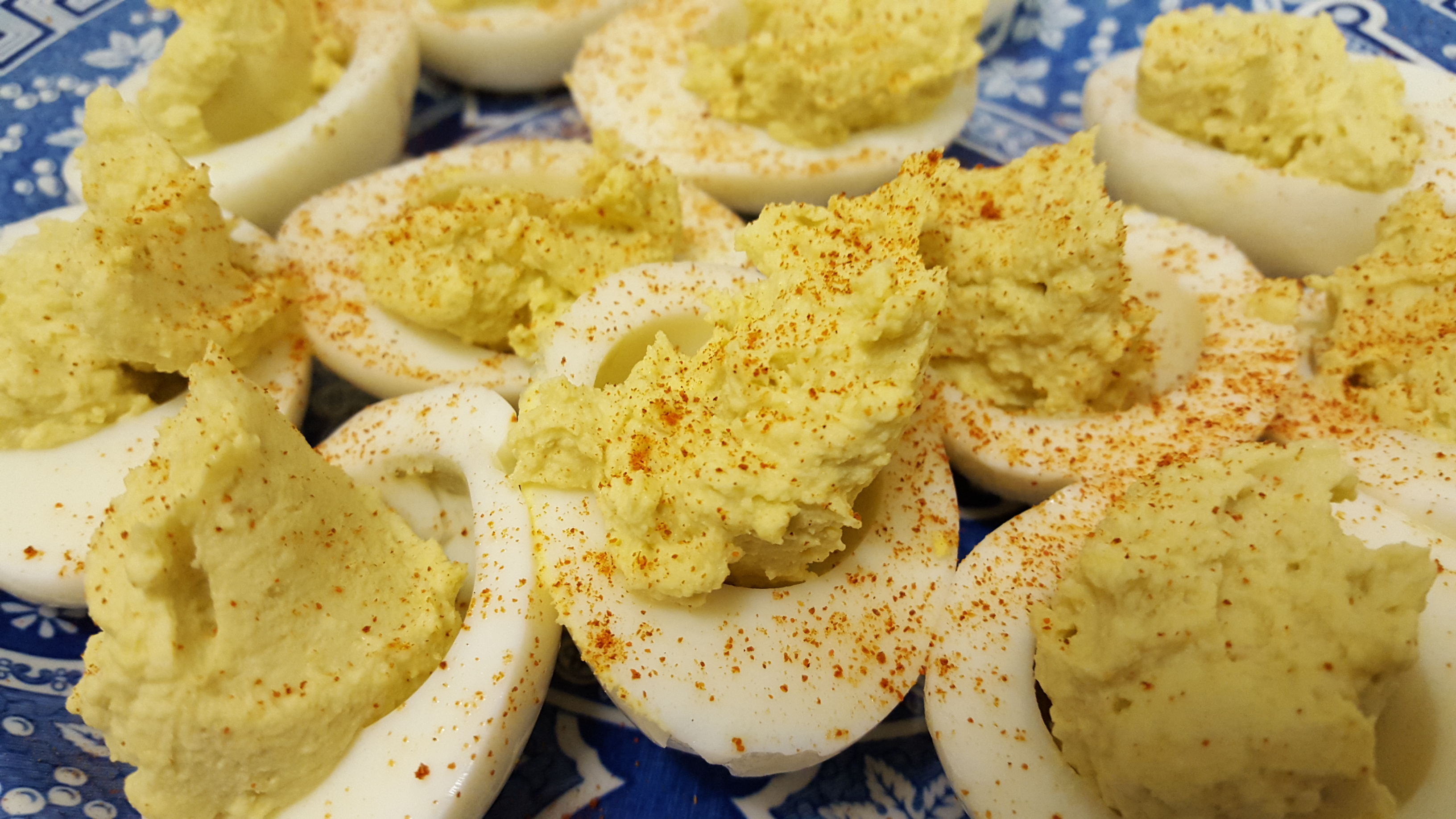
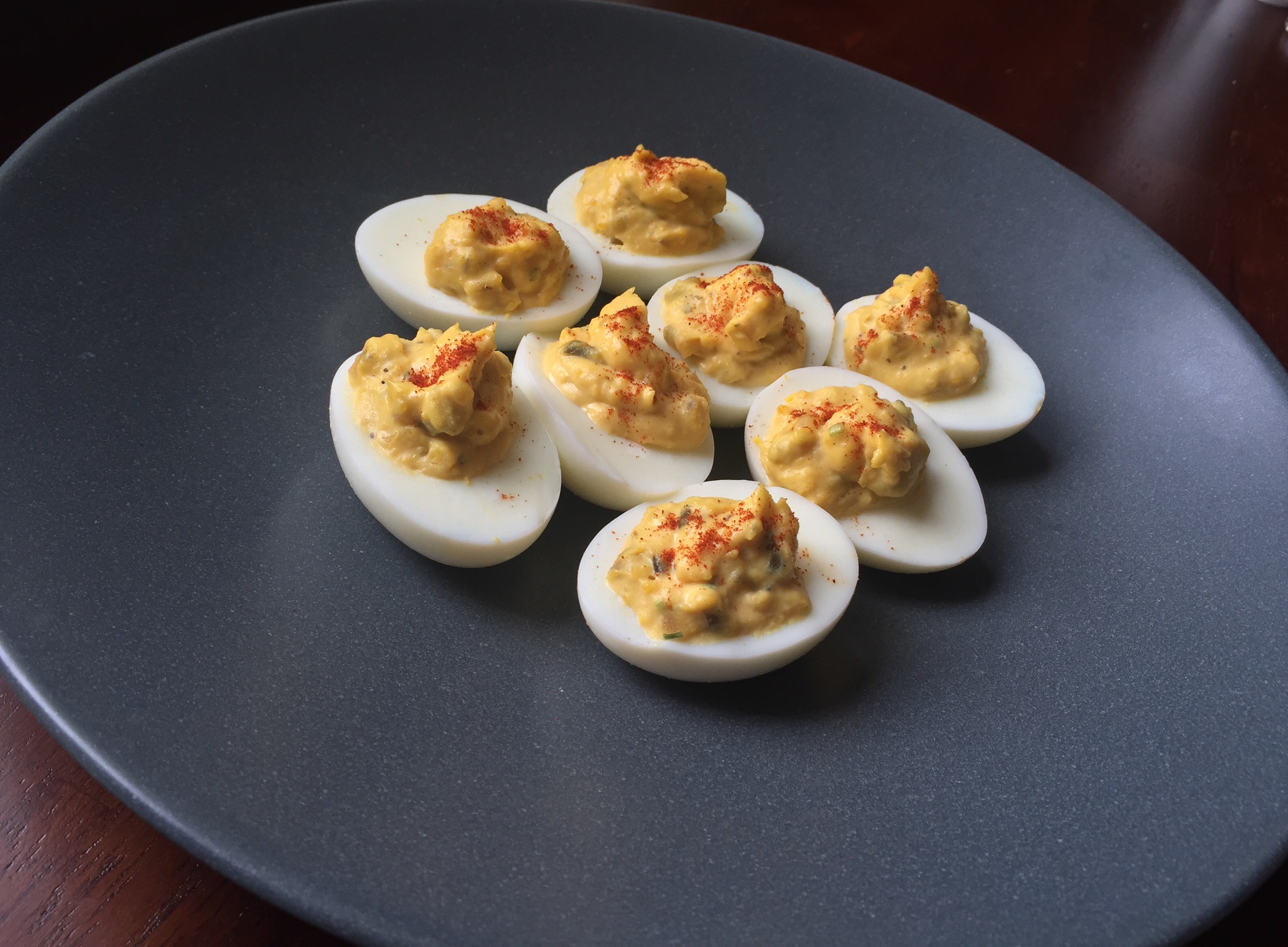
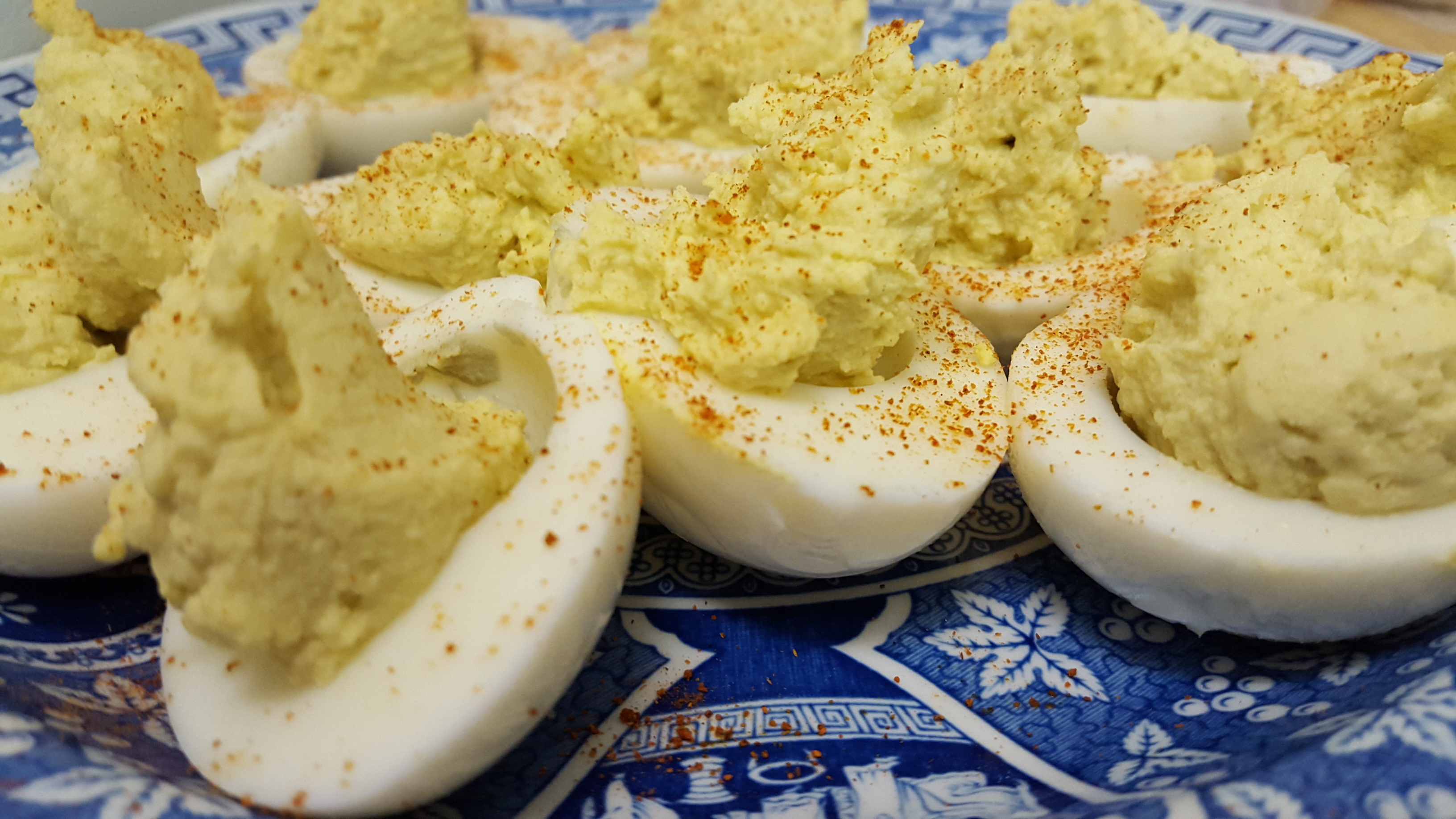
    Deviled Eggs – the highlight of any group gathering…one look and people cluster to snag some, long for more, become sad when they are gone too soon.

    What is it about deviled eggs that we so love? It could be the variations – from Chef Thomas Keller’s classic deviled eggs for the Oscars last night to the blasphemy/brilliance of buzzfeed’s deep fried deviled eggs. It could be that they are comfort food, or holiday food, or party food, or deeply nourishing food.

    I don’t know one person who doesn’t love deviled eggs – if I met one, I’d be suspicious (Are they human? Do they have taste buds? Who are these people?).

    i8tonite: On the Joy of Deviled Eggs

    While in Milwaukee last month (“researching” our great food recommendations for our Cheat Sheet to eating in Milwaukee), my friend Amy Sobczak and I started discussing deviled eggs (because Vanguard was OUT of them. Oh, the sadness). The longer Amy and I talked, the more I realized how important deviled eggs are – to our meals, families, and celebrations.

    i8tonite: On the Joy of Deviled Eggs

    Here are some deviled egg musings from Amy and I – and a few family recipes.

    i8tonite: On the Joy of Deviled Eggs

    What is your first memory of deviled eggs?
    A: Ah, the deviled egg… a cherished treat made for holidays and celebrations. I realized as a young girl that these little delights go fast at family functions, so the hover and snatch move at the serving table was necessary to enjoy as many as possible. Once they’re gone, they’re gone!
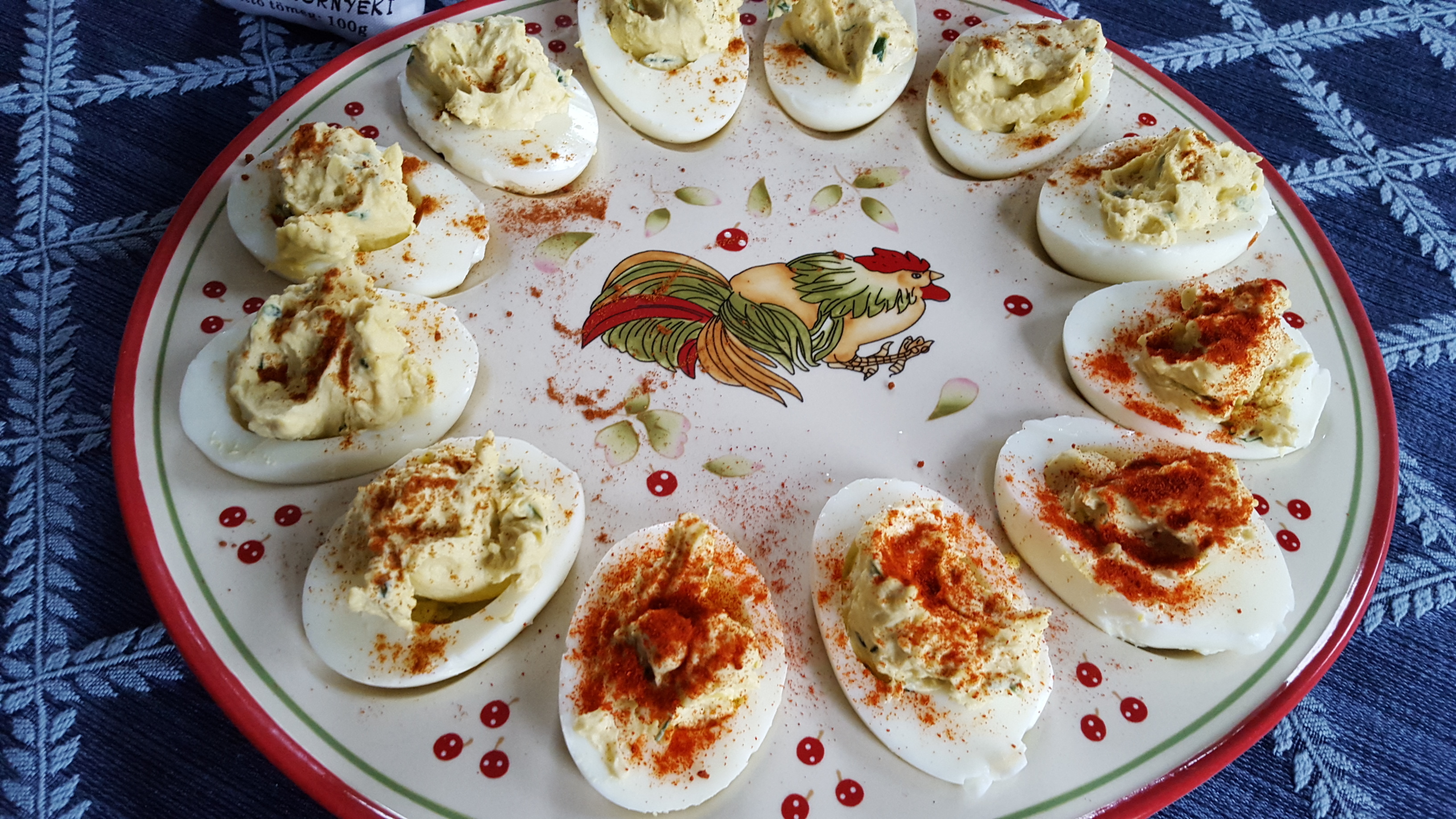
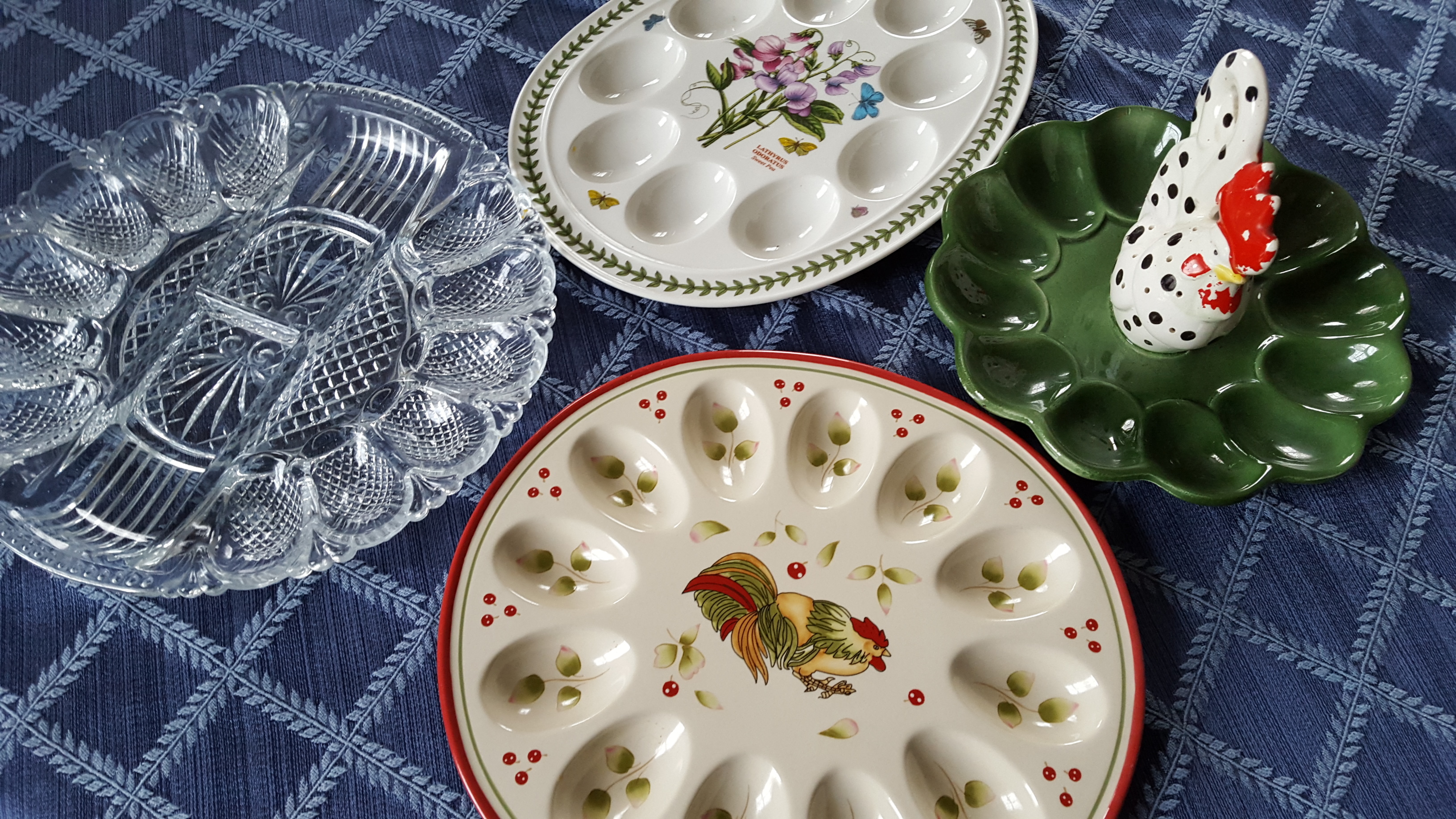
    J: I remember peeking over the table when I was small, eyeing that platter of deviled eggs and wondering if “they” would know if I took one out. Of course, I was too short to see that the deviled eggs were placed on special dishes that had egg-shaped indentations on them, thus letting anyone know that there had been a egg-snitcher. Two words: WORTH IT. And, I went back for more.

    What family traditions do you have around deviled eggs?
    J: Well, deviled eggs are holiday food in my extended family. My aunt brings them at Christmas. Others bring them to summer gatherings. In our house, I make them often because they are good protein, and good snacks, and we can’t get enough of them.
    A: Deviled eggs are a special occasion treat for us as well, rarely made for just your typical day. A family member or friend would always bring them to showers, birthday parties, and holiday get togethers.

    egg plates. From i8tonite: On the Joy of Deviled Eggs
    My mom’s collection of deviled egg plates

    What ingredient can’t you stand in deviled eggs?
    A: I never met a deviled egg ingredient I didn’t like.
    J: Pickles. Onions. Anything super strong or crunchy. My granny added olives, and/or topped them with caviar and I’d (gasp) avoid them.

    i8tonite: On the Joy of Deviled Eggs

    Favorite part of the deviled egg… Yolk or white?
    J: YOLK all the way!
    A: The yolk… hands down!


    What’s with the name ‘deviled egg?’
    A: Hmm… perhaps it’s deviled because of the mixing and mashing of several ingredients.
    J: I add a titch of horseradish – devil-ish? Or maybe that the Hungarian paprika we sprinkle on top can be spicy?

    i8tonite: On the Joy of Deviled Eggs
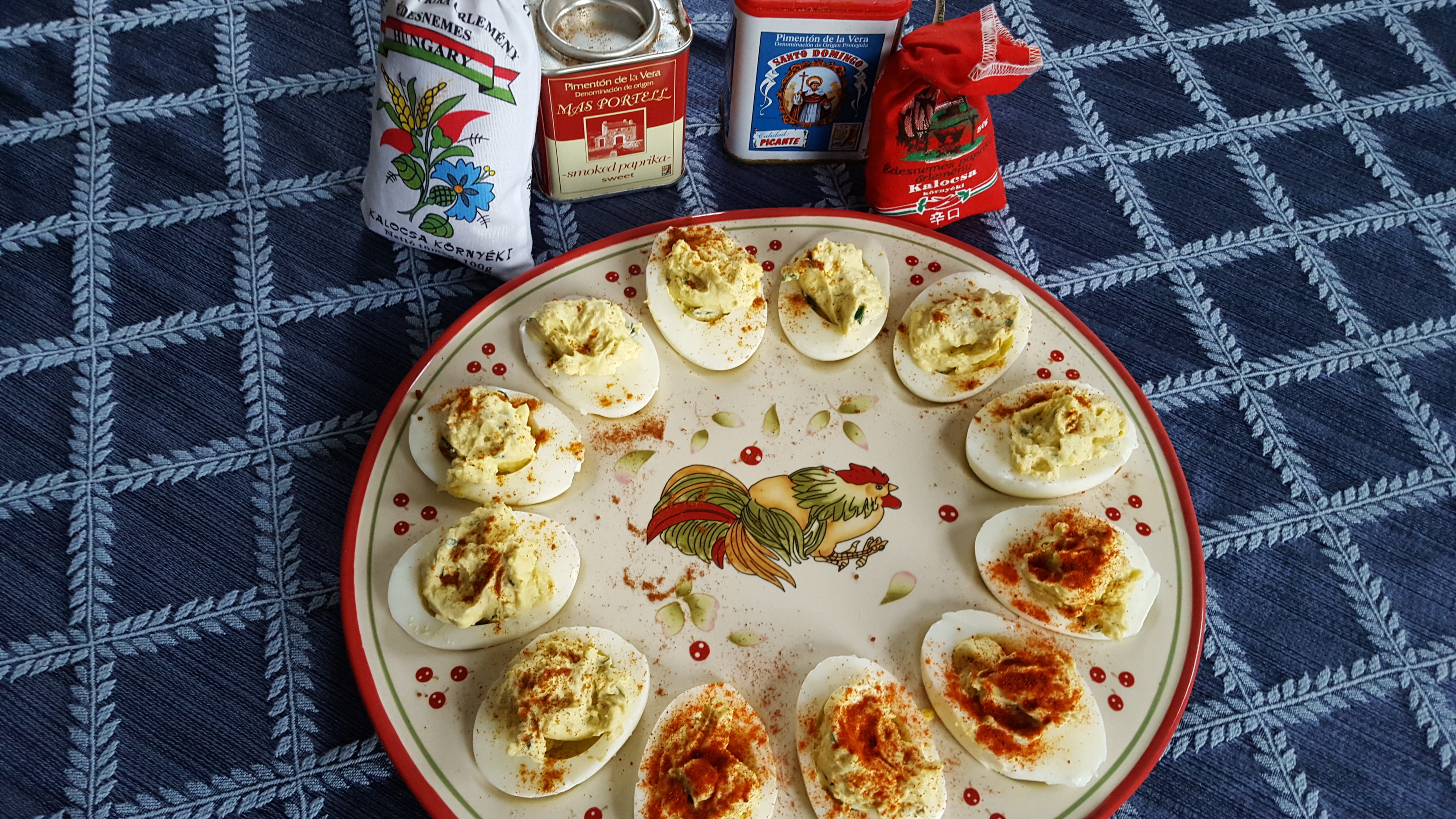
    Why yes, there are *four* kinds of Paprika here.

    Why do you think deviled eggs are so popular? They are always first to go, at a potluck!
    J: Maybe because they can be tedious to make (although easier than many) and people reserve that cooking effort for holidays? I’m not sure, but when I see them anywhere, I grab a few!
    A: They go with anything and everything!

    We’ve seen some pretty crazy things (such as deep fried deviled eggs!) – would you eat them? why or why not?
    A: Look, I love to try new things but I’m old school when it comes to the deviled egg. There’s something about that delicate balance between the firm white against the tangy yolk mixture. It’s just so delicious. Can’t mess with that.
    J: Um, NO. Just no. It’s blasphemy. Eggs need to be cold, not warm; soft, not fried. Please stop.

    Our favorite ingredients:
    A: A good horseradish, pickle relish, and celery seed
    J: Mayo, mustard, horseradish, chives, topped with paprika and salt

    How to boil eggs

    You can’t beat the directions from Food 52 and Serious Eats.

    Recipe: Amy’s Deviled Eggs

    i8tonite: On the Joy of Deviled Eggs
    Amy’s Deviled Eggs

    6 eggs, hard boiled, shelled, cut in half
    1 tbsp Dijon mustard
    2 tbsp mayonnaise
    1 tbsp pickle relish (drained)
    ½ tbsp cream style horseradish
    ¼ tbsp dried chopped chives
    ⅛ tbsp dried green onion flakes
    ⅛ tbsp dried onion powder
    ¼ tbsp dried celery seed
    Hungarian paprika to taste/finish

    Remove the yolk from each egg half and place in a small bowl. Put whites aside. Mash yolks with a fork add next eight ingredients and mix well to a fluffy consistency. Add relish juice if mixture is too dry (¼ tsp at a time). Fill egg whites full to heaping and sprinkle with paprika. Store in refrigerator.


    Recipe: Jessie’s Deviled Eggs

    i8tonite: On the Joy of Deviled Eggs
    Jessie’s Deviled Eggs. See the ones my dad loves at the bottom?

    1 dozen eggs (from a local farm is best. Trust me, I grew up reaching under chickens to grab them)
    Squirt of yellow mustard
    Mayonnaise, to taste
    Grated horseradish, to taste
    Fresh chives, snipped to small pieces
    Salt, to taste
    Sweet and Hot paprika, to taste

    Boil your eggs. Run them under cold water and crack the shells a tiny bit, to let the cold water in and cool them down. Drain. Peel the eggs and cut in half.

    i8tonite: On the Joy of Deviled Eggs

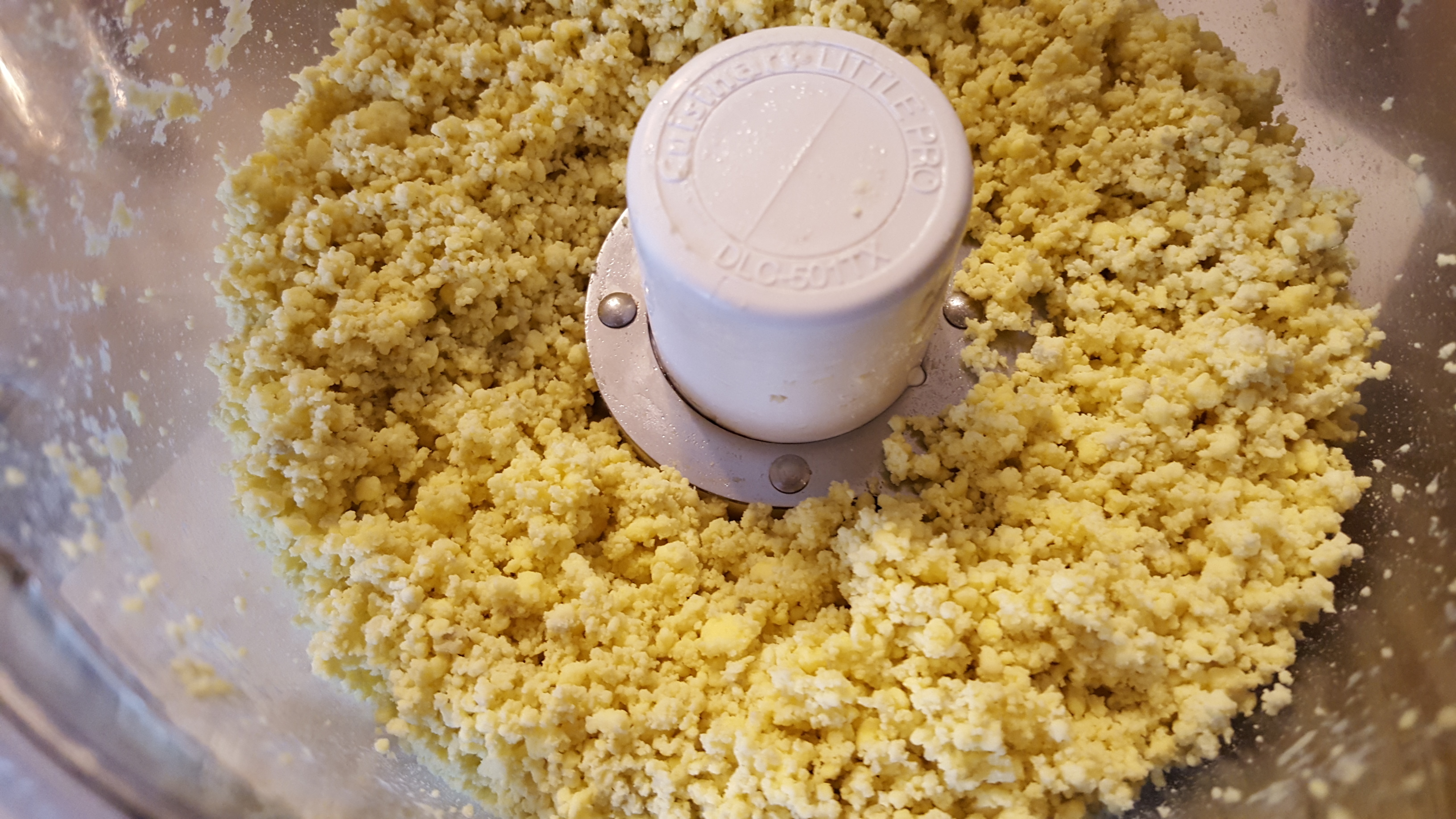
    Place the whites onto your special deviled egg plate (or a regular plate, if you don’t have one yet). Put the yolks into a food processor and buzz a few times to create crumbles. Scrape into a bowl and add your ingredients.

    Be careful with how much mayonnaise you put in – you can always add more, but you can’t take it out. Stir carefully until all is blended. Then scrape with a spoon into the hollows of the whites. Sprinkle with paprika, to taste. Keep them chilled until serving.

    My husband and dad love the hot paprika. I love the sweet. Everyone loves different amounts, so start with a light hand and keep the paprika next to the plate, for those that like to add more. We usually have several kinds of paprika around – the latest is some very delicious paprika direct from Budapest, brought back by my best friend (thank you!).


    What do you add to your deviled eggs? How often do you make them?

    i8tonite: On the Joy of Deviled Eggs
    – The End. Go Eat. –
  • i8tonite with Toronto Chef, Consultant, and Entrepreneur Joanna Sable

    i8tonite with Toronto Chef, Consultant, and Entrepreneur Joanna Sable

    i8tonite with Toronto Chef, Consultant, and Entrepreneur Joanna SableToronto-based Joanna Sable is a Cordon Bleu-trained chef who grew up with gourmet foods – her mother started Sable and Rosenfeld (love their Tipsy Olives!) with one condiment – Russian Mustard – and expanded it to the global company we know today. Her grandparents moved to North America after WWI – and by then, people didn’t want to get their groceries from a farm anymore – opening a can of food was a sign of prestige! She grew up in a family that opened said cans, and learned to cook from those humble beginnings. She remembers being quite young and making an after-school snack for her sister of sautéed zucchini – and her life in cooking snowballed from there.

    Her innate love of food has inspired her interesting and full career in the food industry, from consulting to writing to chefing to recipe development and testing for cookbooks. Her gourmet canning business, Bumpercrop (which she has since sold), turned unwanted items on farms and made it into good food, such as pickled garlic scapes and green tomato garlic jam. She is currently a consultant to the food industry, and helps food businesses maximize their potential within their existing spaces.

    i8tonite with Toronto Chef, Consultant, and Entrepreneur Joanna Sable
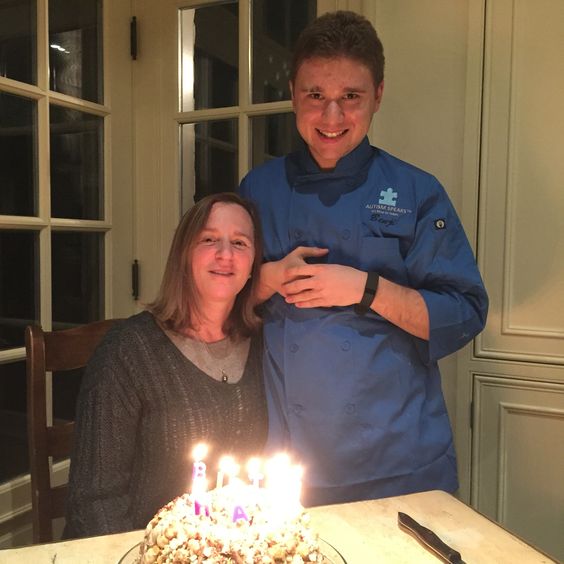
    Blowing out the candles on the birthday cake Benj made me. Gotta love the jacket. I think he is proud to wear it.

    When we talked, I was inspired by her love for good, delicious, interesting food. She is also passionate about educating and giving back. Joanna cooks every Sunday with her 20 year old autistic cousin, Benj – and these cooking classes make a difference not only for Benj, but also for other autistic people, to learn to connect with food and cooking. You can follow Benj’s cooking classes on pinterest.

    i8tonite with Toronto Chef, Consultant, and Entrepreneur Joanna Sable
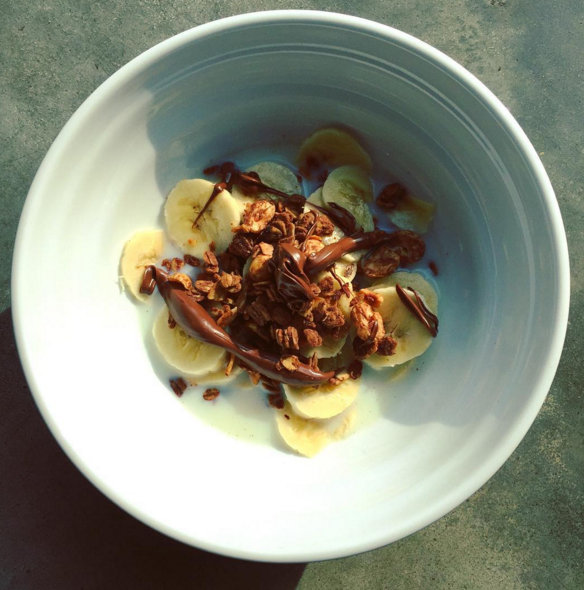
    Nutella granola, drizzled with more Nutella and ripe bananas. Here’s the kicker….skim milk

    When I asked Joanna about her work, she noted, “This is the most wonderful industry – the people in it have bigger hearts than anywhere in the world- they are passionate, givers, and every day I am proud to be in this place that I am. There’s not a minute of the day that I don’t love my industry and most of the people in it.”

    Chef Questionnaire (with a nod to Proust):

    How long have you been cooking? Since I was born! My first food job was in a gourmet food shop and the owner pulled me into the kitchen and put me to work! My first recipe as a chef was chocolate mousse.

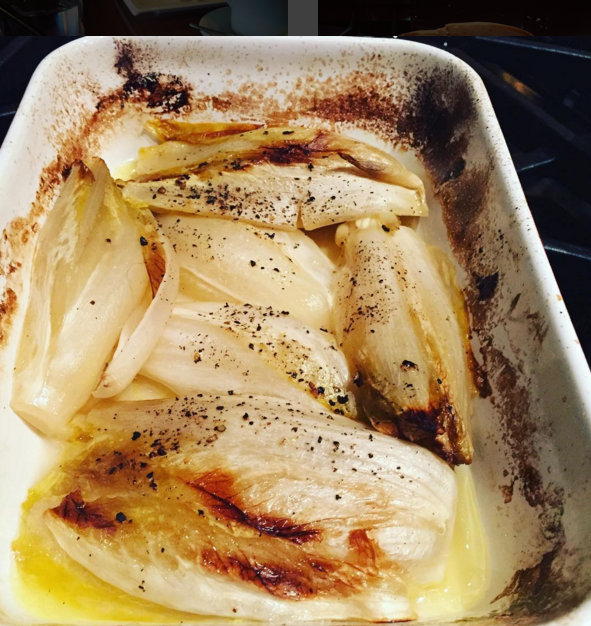
    Braised Endive. i8tonite with Toronto Chef, Consultant, and Entrepreneur Joanna Sable
    Without a doubt, braising is one of my favourite ways to cook veggies. Halved Belgian Endive with a hit of lemon and @stirlingbutter Whey butter, a good sprinkling of sea salt and cracked pepper and into the oven they go.

    What is your favorite food to cook? Italian. The reason is because you have to buy the best quality of the simplest products. It has to be perfect to start with – the best olive oil, beautiful fresh lemons – there are so few components that everything has to shine. I love the challenge of starting from square one with the most perfect thing.

    What do you always have in your fridge at home? Water, eggs, lots of condiments, bread, pickles, dog food, Sable and Rosenfeld goods. Always good cheese, always good breads.

    i8tonite with Toronto Chef, Consultant, and Entrepreneur Joanna Sable
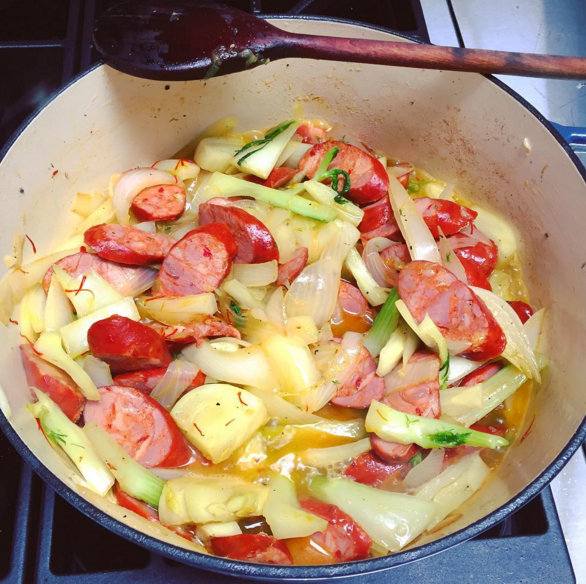
    Flecks of saffron and spicy Portuguese chorice are a perfect base with loads of fennel, garlic, onions, white wine and soon tomatoes for a brilliant seafood stew.

    What do you cook at home? Everything. It depends on if I am having a dinner party or just home. When I became a chef, I became bored with the same thing every night – I really like cooking like a caterer. When I have a dinner party, everything can be ¾ done before the guests come. The other night, I made a San Francisco style seafood stew – chorizo, seafood, fennel, etc. and everything was ready – just dumped it together 10 min before we sat down to eat and called it dinner. I like to cook where it looks effortless. Simplistic, easy things – what country do I want to cook from tonight? That challenges me. As a chef, I want to be challenged.

    What marked characteristic do you love in a customer?
    Someone who is willing to make changes and allows me to do the job they hired me for.

    What marked characteristic do you find unappealing in a customer?
    People who are stuck and who hire me and waste their money and my time. Procrastinators.

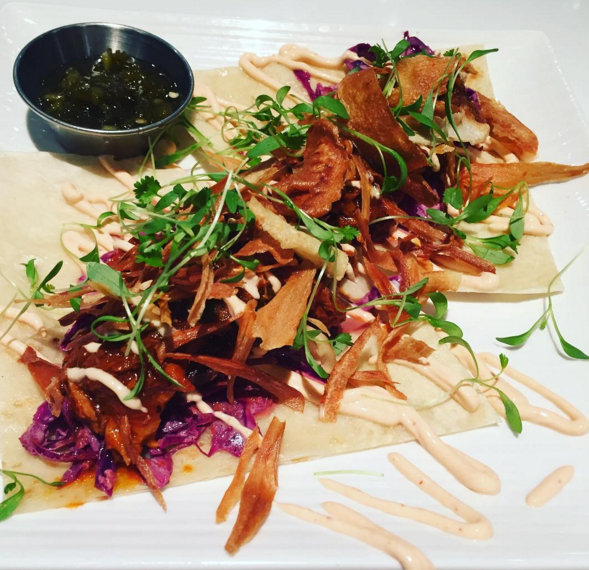
    Gorgeous tacos filled with the most lovely moist pulled park and plenty of good crunchy veg. Best part is the sweet hot jalapeño relish. i8tonite with Toronto Chef, Consultant, and Entrepreneur Joanna Sable
    Gorgeous tacos filled with the most lovely moist pulled park and plenty of good crunchy veg. Best part is the sweet hot jalapeño relish. From @Morocochocolat

    @Morocochocolat

    Tupperware, Rubbermaid, or Pyrex? Pyrex

    Beer, wine, or cocktail? Wine

    Your favorite cookbook author? Fanny Farmer and Craig Claiborne. These were my first two books when I was 19 and going to Europe to cook for the first time just before I went to Cordon Bleu in London – my best friend gave me those two books and to this day, they are my go to for reference. Also Mark Bittman’s How to Cook Everything – a phenomenal book for the start out cook. The other cookbook author I think is truly genius is Jamie Oliver – every recipe works.

    Your favorite kitchen tool? My 8 inch chef knife.

    Your favorite ingredient? Olive oil

    Your least favorite ingredient? Anything processed

    Least favorite thing to do in a kitchen? Wipe down appliances

    i8tonite with Toronto Chef, Consultant, and Entrepreneur Joanna Sable
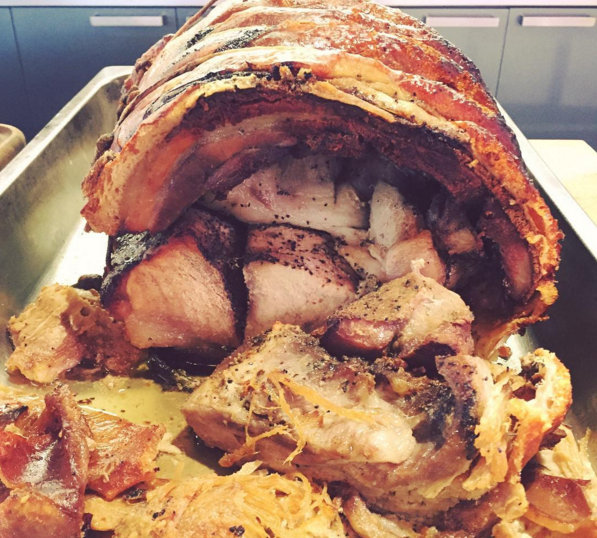
    Cavernous heaven. Porchetta the way it should be. Crack, crunchy, moist and tender. Inspirational. From @porecllocantina

    Favorite types of cuisine to cook? Italian, French, Mediterranean, Spanish, Portuguese, Jewish

    Beef, chicken, pork, or tofu? Pork

    Favorite vegetable? Artichokes

    Chef you most admire? Daniel Boulud, Dan Barber – and for his generosity of spirit, Paul Boehmer

    Food you like the most to eat? Simple, perfectly made food from any cuisine

    Food you dislike the most? Bad pizza, soggy, gross, yucky pizza

    How many tattoos? And if so, how many are of food? 0


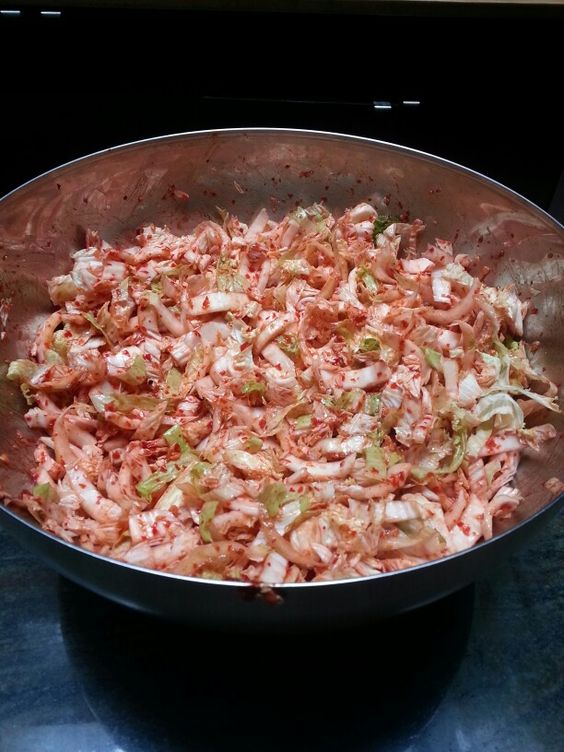
    Recipe: 5 Ingredient Mock Kimchi

    Shred Napa cabbage and chinese cabbage – use both or whatever you can find. Dump it in a bowl with a jar of Chinese Chili Garlic Sauce, a few shots of Tamari, a few spoons of rice wine vinegar, and a sprinkle of sugar. Massage well and leave in bowl. Every once in a while, give it a mix. Cover overnight, drain, and use as a side for pork tenderloin or on sandwiches.

    Joanna Sable's Mock Kimchi. From i8tonite with Toronto Chef, Consultant, and Entrepreneur Joanna Sable
    Joanna Sable’s Mock Kimchi


    More of Joanna Sable’s recipes without amounts.


    – The End. Go Eat. – 
     

    All photos courtesy and copyright Joanna Sable


  • i8tonite with Eleni’s New York Founder & Food Entrepreneur Eleni Gianopulos

    i8tonite with Eleni’s New York Founder & Food Entrepreneur Eleni Gianopulos

    i8tonite with Eleni's New York Founder & Food Entrepreneur Eleni GianopulosEleni Gianopulos began her career in the media world working at the venerable Time Inc., eventually moving into the editorial division of Life Magazine. Through a twist of fate, Eleni, who had a passion for baking, began a small catering business in her apartment. What began as a side business featuring Eleni’s mother’s famous oatmeal-raisin cookies quickly outgrew her home kitchen and evolved into a full-fledged cookie empire. Eleni is a business owner that is also committed to giving back to female entrepreneurs trying to start their companies today. Eleni is about to share some exciting news regarding her mission to help female entrepreneurs. Stay tuned!

    i8tonite with Eleni's New York Founder & Food Entrepreneur Eleni Gianopulos
    Language of Love cookies

    Since 1997, Eleni’s New York has been a must-stop at Manhattan’s iconic Chelsea Market, later followed by her website, where irresistibly designed custom “Conversation Cookies TM” and other treats, including Color Me Cookies, await for fans located around the world. Today, Eleni’s custom cookie creations are a favorite of celebrities, luxury brands, Fortune 500 companies, and cookie lovers alike. Her cookie concierges design cookies around events, holidays, and popular trends. All of Eleni’s cookies are certified nut free. We love them.

    i8tonite with Eleni's New York Founder & Food Entrepreneur Eleni Gianopulos
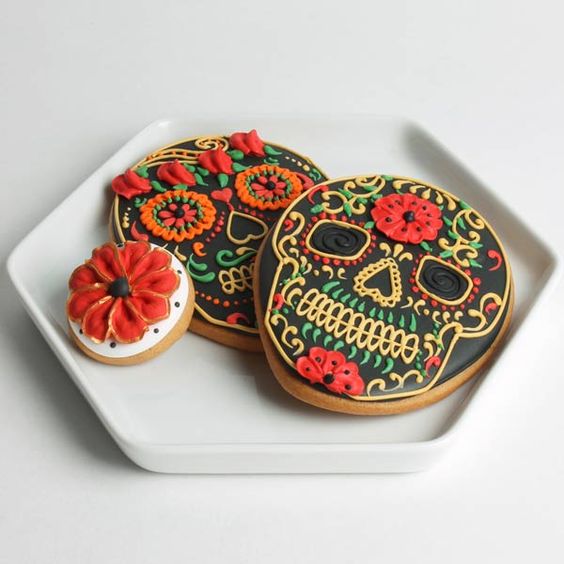
    Eleni’s Day of the Dead cookies

    Eleni and I had a lively chat about parenting, cookies, and growing and running a business. Eleni noted that it was challenging to be a mom in business, but it’s also rewarding and exciting for her kids to see that their parents have careers they love. She grew up watching her father, who owned his own company, going to work every day and loving it. Her kids are happy that their mom owns a bakery (lucky kids!), and Eleni said that she’s a better boss for having kids.

    Eleni's New York butterfly cookies. i8tonite with Eleni's New York Founder & Food Entrepreneur Eleni Gianopulos
    Eleni’s New York butterfly cookies

    Eleni remarked that she feels fortunate and is strategic in finding employees that are in different phases of their lives – many of her employees have kids of all ages. It is this wide range of experience within the company that helps Eleni’s New York continue with their business expansion – a recent Valentine’s Day partnership with 650 Target stores in the Northeast (crisp chocolate chip, butterscotch, and pink sugar cookies!), a new grocery line that will be launched at the Fancy Foods Show this coming July, as well as more retail locations and an expansion of the very popular Color Me Line of cookies.

    i8tonite with Eleni's New York Founder & Food Entrepreneur Eleni Gianopulos
    Eleni’s New York Sea Breeze cookies

    What I loved most, as a non-New Yorker, was talking about living in the city with Eleni.  She’s moved to keep close to her work – starting in Chelsea Market, when she first opened; then a move to be near her cookie plant in Long Island City; and recently a move back to the center of the city to be closer to all the action as they open locations in Manhattan this coming year. When talking about the local bakery (Maison Kaiser) that she heads to every morning with her King Charles Cavalier, Lovey Pie, to pick up croissants and breads for the kids every morning, her love of her neighborhood shone through – she mentioned stores, spaces, colors, and flavors. And while she hits the farmer’s market many times a week, it’s closed on Sundays – and is a perfect place for her young kids to ride their bikes.

    i8tonite with Eleni's New York Founder & Food Entrepreneur Eleni GianopulosEleni and her team are surrounded by design inspiration, so look for new cookies inspired by this neighborhood – as well as museums, parks, something from one of the kids’ schoolbooks, etc. And yes, they all still sketch on the back of a napkin at times, to save their ideas. But Eleni’s cookies are also influenced by technology. An exciting development in cookie design at Eleni’s is a new process which allows them to put ink onto a cookie with no sugar film. This adds more and more layers and intricacy – you can see this in the upcoming Easter cookie line, inspired by Faberge designs.

    It is this creativity, passion for her work, and inclusion of family that makes Eleni’s work shine.


    Food People Questionnaire (with a nod to Proust):

    How long have you been cooking? Over 20 yearsi8tonite with Eleni's New York Founder & Food Entrepreneur Eleni Gianopulos

    What is your favorite food to cook? Cookies, pies, cakes, and Greek specialty appetizers like dolmathes, spanakopita and baklava.

    What do you always have in your fridge at home? Milk for my coffee, butter for kids’ toast, and Pellegrino

    What do you cook at home? Mexican food. I love America’s Test Kitchen Favorite Mexican Recipes and test new recipes on my family often.

    What marked characteristic do you love in a customer? Direct and to the point.

    What marked characteristic do you find unappealing in a customer? This customer requested the most beautiful design, my team executed to perfection. The client received the order and complained that the frosting was off ¼”. From that point on, we insist on sample approval for custom work. And I just knew even if we remade the order this customer would never be satistfied, so I quickly accommodated the request and moved on. I have only seen something like this happen 2 times in 20 years, though.

    Tupperware, Rubbermaid, or Pyrex? Tupperware

    Beer, wine, or cocktail? Cocktail

    Your favorite cookbook author? America’s Test Kitchen Series of Cook Books, I love how they start off every paragraph…we made this recipe 34 times and found that …

    i8tonite with Eleni's New York Founder & Food Entrepreneur Eleni Gianopulos
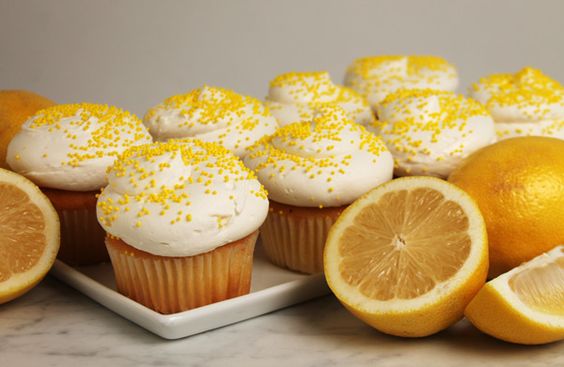
    Eleni’s Lemon Cupcakes

    Your favorite kitchen tool? The plastic pastry bags I bring home from work, I use them for everything.

    Your favorite ingredient? Lemon, I add it to everything.

    Your least favorite ingredient? Orange, I don’t like orange in desserts nor entrees.

    Least favorite thing to do in a kitchen? Dishes – my husband says when I cook at home I think I’m at work! I tend to make a big mess, and use every pot and pan in the house.

    Favorite types of cuisine to cook? Greek, Mexican, Italian

    Beef, chicken, pork, or tofu? Chicken

    Favorite vegetable? Broccoli

    Chef you most admire? Thomas Keller

    Food you like the most to eat? Indian

    Food you dislike the most? Eggs, cottage cheese, odd scary meat.

    How many tattoos? And if so, how many are of food? 0

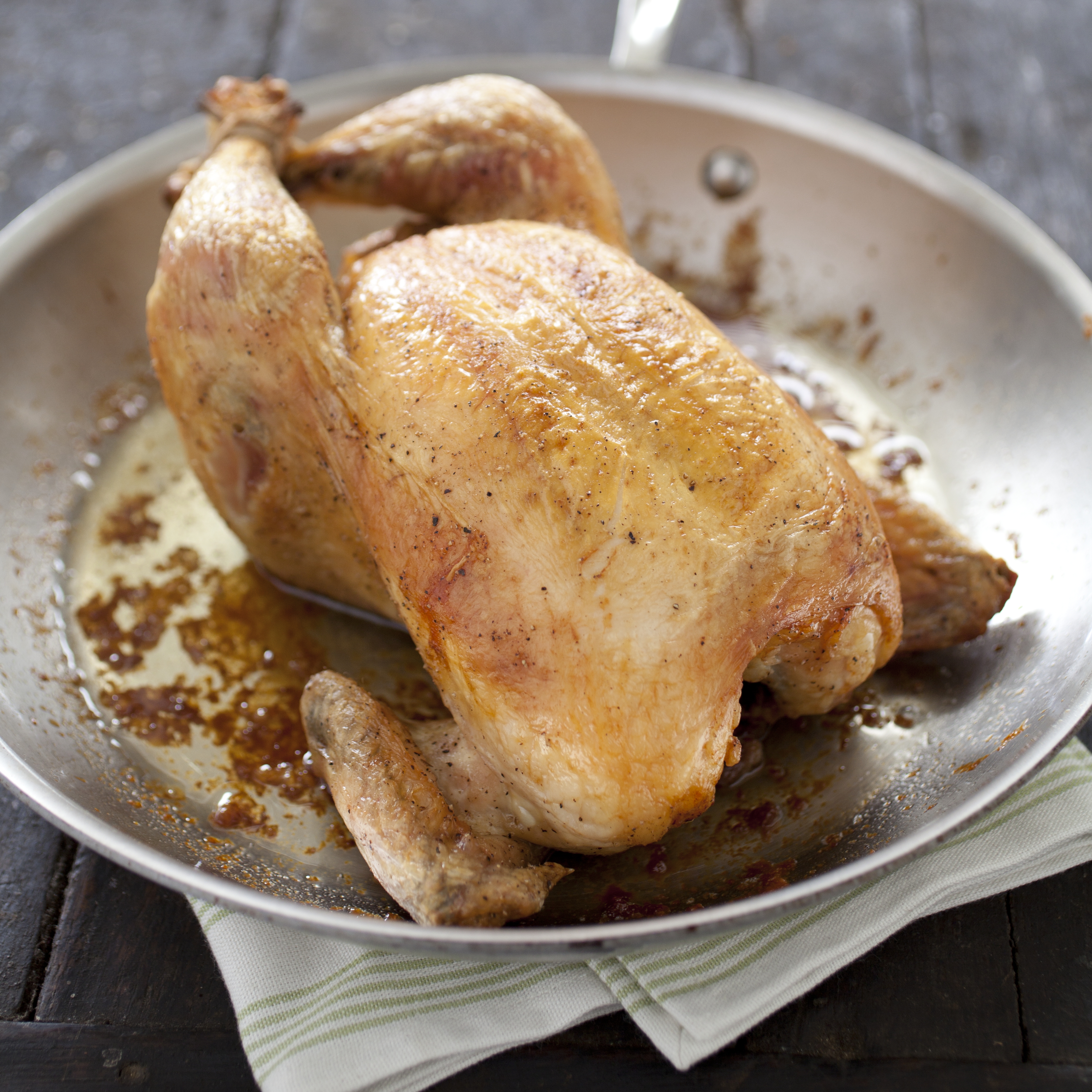
    Recipe: The Crispy Roast Chicken recipe from America’s Test Kitchen!

    The Crispy Roast Chicken recipe from America’s Test Kitchen! From i8tonite with Eleni's New York Founder & Food Entrepreneur Eleni Gianopulos -
    The Crispy Roast Chicken recipe from America’s Test Kitchen!

    For best flavor, use a high-quality chicken, such as one from Bell & Evans. Do not brine the bird; it will prohibit the skin from becoming crisp. The sheet of foil between the roasting pan and V-rack will keep drippings from burning and smoking.

    Ingredients
    1 whole chicken (3 1/2 to 4 1/2 pounds), giblets removed and discarded
    1 tablespoon kosher salt or 1 1/2 teaspoons table salt
    1 teaspoon baking powder
    1/2 teaspoon ground black pepper

    Instructions

    1. Place chicken breast-side down on work surface. Following photos above, use tip of sharp knife to make four 1-inch incisions along back of chicken. Using fingers or handle of wooden spoon, carefully separate skin from thighs and breast. Using metal skewer, poke 15 to 20 holes in fat deposits on top of breast halves and thighs. Tuck wing tips underneath chicken.

    2. Combine salt, baking powder, and pepper in small bowl. Pat chicken dry with paper towels and sprinkle all over with salt mixture. Rub in mixture with hands, coating entire surface evenly. Set chicken, breast-side up, in V-rack set on rimmed baking sheet and refrigerate, uncovered, for 12 to 24 hours.

    3. Adjust oven rack to lowest position and heat oven to 450 degrees. Using paring knife, poke 20 holes about 1 1/2 inches apart in 16- by 12-inch piece of foil. Place foil loosely in large roasting pan. Flip chicken so breast side faces down, and set V-rack in roasting pan on top of foil. Roast chicken 25 minutes.

    4. Remove roasting pan from oven. Using 2 large wads of paper towels, rotate chicken breast-side up. Continue to roast until instant-read thermometer inserted in thickest part of breast registers 135 degrees, 15 to 25 minutes.

    5. Increase oven temperature to 500 degrees. Continue to roast until skin is golden brown, crisp, and instant-read thermometer inserted in thickest part of breast registers 160 degrees and 175 degrees in thickest part of thigh, 10 to 20 minutes.
    6. Transfer chicken to cutting board and let rest, uncovered, for 20 minutes. Carve and serve immediately.

    Recipe and photo: America’s Test Kitchen


    – The End. Go Eat. –
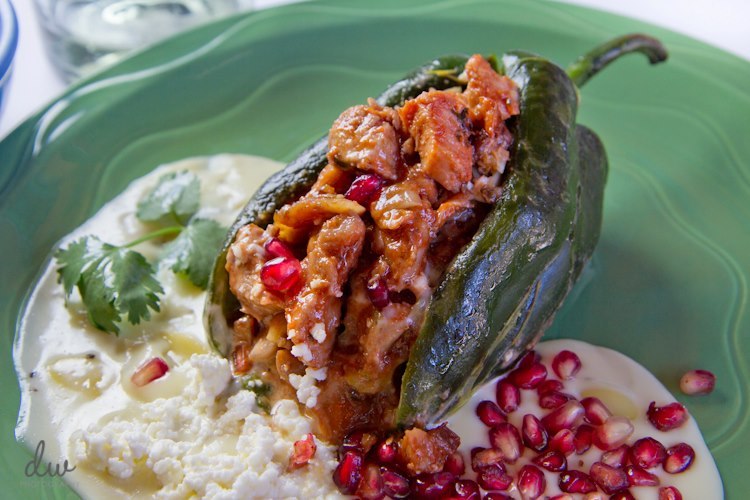
  • i8tonite with Phoenix’s Barrio Café Chef Silvana Salcido Esparza & Chiles en Nogada Recipe

    i8tonite with Phoenix’s Barrio Café Chef Silvana Salcido Esparza & Chiles en Nogada Recipe

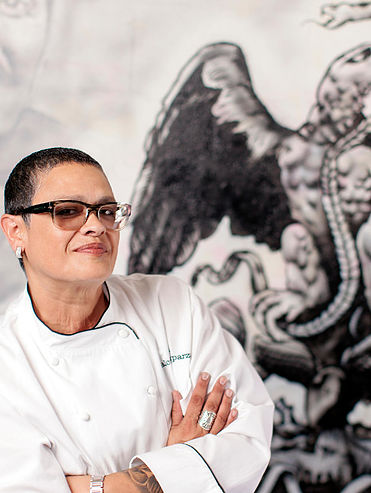
    i8tonite with Phoenix’s Barrio Cafe Chef Silvana Salcida Esparza & Chiles en Nogada RecipeThere is no doubting Chef Silvana Salcido Esparza’s immense impact in the Phoenix restaurant world. Ask any chef currently with a restaurant in the Valley of the Sun about Esparza, and they will respond, “Oh, she’s the best. She’s tough, but she is one of the best.”

    A second generation Mexican American, Esparza was born as a hija de las panaderias (baker’s daughter) in Merced County, California, America’s Salad Bowl. In her early teens, she already started using her entrepreneurial skill set and cooking acumen to fashion her first carnecaria, serving up grilled meats next to her parent’s bakery. She worked a variety of well-paying jobs as a broker, Aramark and executive chef at a variety of Arizona hotels before opening Barrio Café.

    i8tonite with Phoenix’s Barrio Cafe Chef Silvana Salcida Esparza & Chiles en Nogada Recipe

    Currently, she has four restaurants and another one on the way, Barrio Café Gran Reserve, opening in downtown Phoenix, on Grand Avenue, a hipster spot. Esparza came to Valley of the Sun prominence in 2002 with Barrio Café, serving central Mexican food with European influences, tableside guacamole, and real south of the border sauces. Her dishes include 12 Hour Roasted Pork and Posole Verde. In The Yard, a large complex housing four restaurants, Esparza created Barrio Urbano, a hipper, millennial friendly experience, which also serves breakfast, and two in the Sky Harbor International Airport. Esparza is undeterred in her quest for making the best Mexican that she can make, as she says, “I will not resort to using yellow cheese.”

    Ezparza is an outspoken, leading advocate on immigration and LGBTQ causes. To showcase the creativity the Mexican American population has brought to Arizona, she, along with other community leaders generated a non-profit organization called Calle 16, dedicated to showcasing various arts, food, and other Mexican exports to the Valley of The Sun.

    i8tonite with Phoenix’s Barrio Cafe Chef Silvana Salcida Esparza & Chiles en Nogada Recipe

    Chef’s Questionnaire (with a nod to Proust):

    How long have you been cooking? Since I was six years old.

    What is your favorite food to cook? Italian

    What do you always have in your fridge at home? Condiments, demi-glaze, anchovies

    What do you cook at home? Barbeque.

    What marked characteristic do you love in a customer? I love when they are enthusiastic.

    What marked characteristic do you find unappealing in a customer? When they lack enthusiasm. I don’t want them to be dead fish.

    Tupperware, Rubbermaid, or Pyrex? Tupperware.

    i8tonite with Phoenix’s Barrio Cafe Chef Silvana Salcida Esparza & Chiles en Nogada RecipeBeer, wine, or cocktail? Cocktail.

    Your favorite cookbook author? Patricia Quintana

    Your favorite kitchen tool? Molacajete

    Your favorite ingredient? Chile

    Your least favorite ingredient? Lavender

    Least favorite thing to do in a kitchen? If I have to…wash dishes.

    Favorite types of cuisine to cook? Italian

    Beef, chicken, pork or tofu? Pork

    Favorite vegetable? Chayote

    Chef you most admire? Patricia Quintana

    Food you like the most to eat? Italian, barbeque.

    Food you dislike the most? Fried chimichanga. Fake Mexican. Yellow cheese.

    How many tattoos? And if so, how many are of food? Too many.

    i8tonite with Phoenix’s Barrio Cafe Chef Silvana Salcida Esparza & Chiles en Nogada Recipe

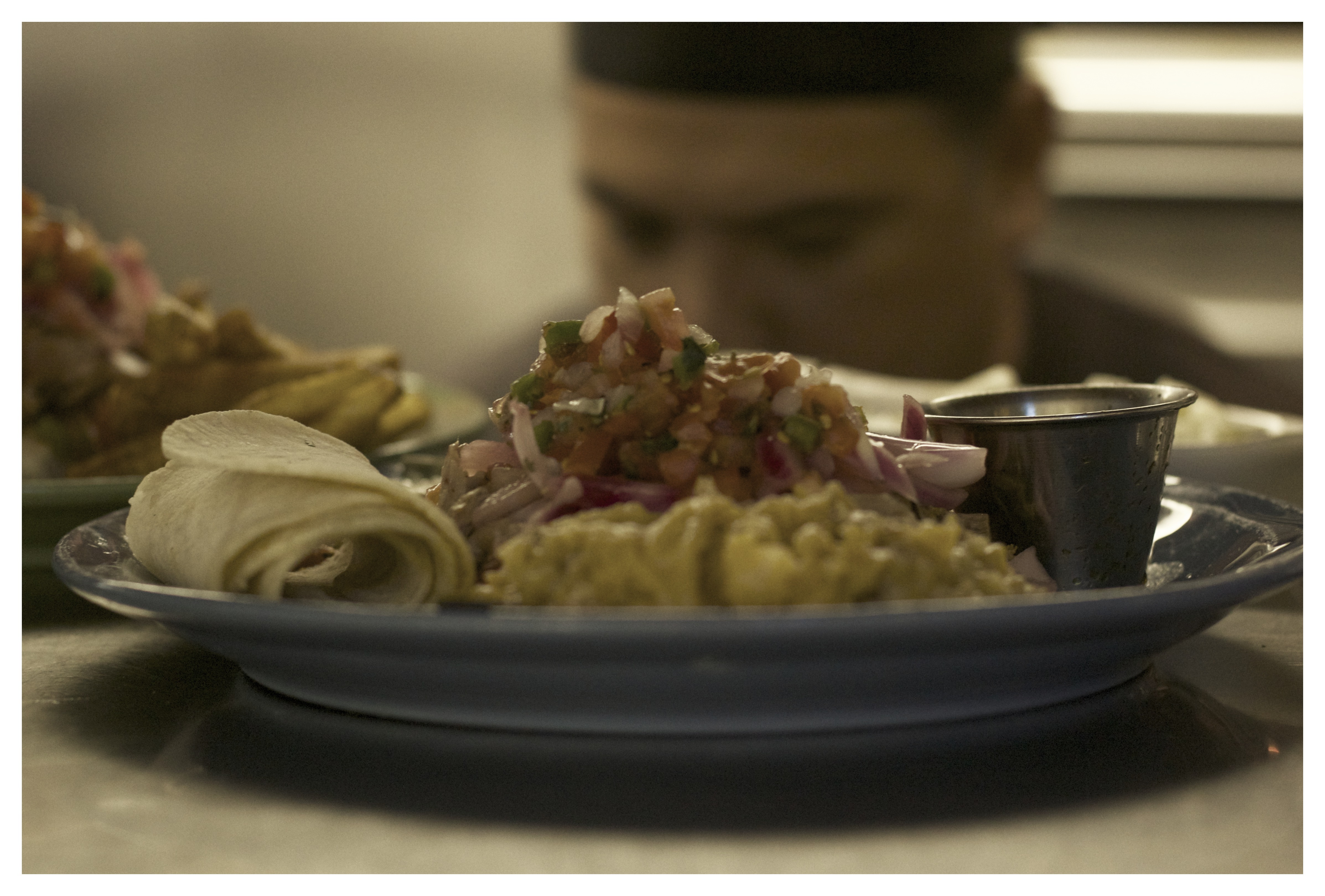
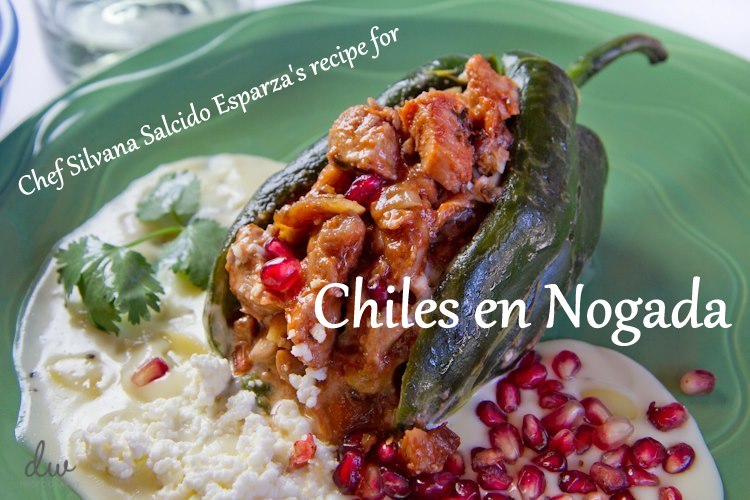
    Recipe: Chiles en Nogada

    i8tonite with Phoenix’s Barrio Cafe Chef Silvana Salcida Esparza & Chiles en Nogada Recipe
    Chiles en Nogada Recipe

    Ingredients
    Chiles:
    1 tablespoon canola oil
    2 boneless skinless chicken breasts, diced small
    2 teaspoons diced onion
    1 teaspoon diced apple
    1 teaspoon diced dried apricot
    1 teaspoon diced pear
    1 teaspoon raisins
    1 clove garlic, minced
    2 teaspoons tomato paste
    1 cup red wine, preferably Cabernet
    Kosher salt and black pepper
    4 poblano peppers, roasted and peeled

    Nogada Sauce:
    1 tablespoon canola oil
    1 shallot, minced
    1 clove garlic, minced
    1 cup white wine, preferably Chardonnay
    2 cups heavy cream
    Kosher salt and black pepper
    1/4 cup almonds, roughly chopped
    Fresh cilantro leaves, for serving
    Pomegranate seeds, for serving

    Directions
    For the chiles: Heat a large skillet over high heat. Add the canola oil when hot. Add the chicken and saute until the chicken starts to turn white, 7 to 8 minutes. Add the onions and continue to saute until the onions are translucent, 3 to 4 minutes. Add the apple, apricot, pear, raisins and garlic and saute until they begin to soften, about 1 minute. Add the tomato paste and stir so the paste coats all of the ingredients. Add the red wine and cook until the chicken is tender, about 5 minutes. Season with salt and pepper and let cool slightly. Remove the seeds from the peppers by making one long slice down the sides, stuff them with the chicken-fruit mixture and keep warm until ready to serve.

    For the nogada sauce: Heat the oil in a saute pan over medium-high heat, add the shallots and saute until translucent, about 3 minutes. Add the garlic and continue to saute until the garlic has turned a light caramel color, about 1 minute. Add the white wine and reduce until almost gone, 3 to 4 minutes. Add the cream and simmer until reduced by half, 5 to 7 minutes. Season with salt and pepper and finish with the almonds.

    For serving: Place each stuffed pepper on a plate and spoon some of the nogada sauce over top. Garnish with the cilantro and pomegranate seeds.

    Note: This recipe was originally published by Chef Silvana Salcida Esparza at http://www.foodnetwork.com/recipes/chiles-en-nogada.html

    Pin for later:

    Chef Silvana Salcido Esparza's recipe for Chiles en Nogada

    – The End. Go Eat. –