Making your own Middle Eastern dip tastes better than store bought.
After a year and a half of living in our second and newest Indy neighborhood, Nick and I had our neighbors, a couple, for a repast of small bites. He made the cocktails and I served a wheat-free pizza (gluten-free store bought), Buffalo wings, a charcuterie and cheese board with Norwegian crispbread and GF crackers and hummus.
While sipping on her New Zealand Sauvignon blanc, washing down the cracker topped with the Middle Eastern dip, Tricia commented, “Everything is delicious, but I need your recipe for the hummus. It’s really good!”
I’ve been making the chickpea and tahini dip for close to 30 years now, long before its ubiquity in the refrigerator section of the grocery store. I discovered it at Yaffa Cafe, an East Village eatery which opened in the early eighties but closed in 2014. It was an eclectic spot in an area growing with creativity. Then, I ate as a vegan and this was one of the few restaurants that I could afford that offered meat and dairy free dishes. It also expanded my horizons with food. I wasn’t stuck with eating rice and beans anymore. I discovered Mediterranean foods.
In order to make this delicious item, I would walk a few blocks to a natural grocery store called Commodities in Tribeca. (I saw Blondie’s Chris Stein and the late John F. Kennedy, Jr. there). Housed in a massive cast-iron building, I found freshly ground nut butters like peanut, almond and sesame (tahini) by the pound and also lots of meat substitutes like seitan and tofu. Going there for groceries felt like heaven, although it wasn’t inexpensive by any stretch. I relegated my purchases to specific items.
The only special thing I needed was a food processor. Unless you’re into hand grinding things into a paste with a molcajete, it’s a must have. A NYC boyfriend had one which he never used. Purchased by his parents when he moved to Manhattan, it was an unwieldy contraption that was as heavy as a cement brick. And that is how I started making this hummus.
During my time in New York, I made the bean spread for every party at the loft I lived in with two roommates. We served guacamole, crackers, chips and sliced baguettes and sangria nearly every weekend.
While I would say taking a trip to Manhattan and eating Middle Eastern food on the Lower East Side would be divine, staying home can be just as fun.
While I started with the Silver Palate cookbook recipe, I adapted it to suit my tastes over the years. Add roasted vegetables such as red peppers or carrots if you like. Pop them in as you hit pulse or blend on the machine. For a bit of fun, make a traditional pesto, omitting the nuts. Or leave them in and stir in before serving for a swirl of color and flavor.
Manhattan to Indy Hummus
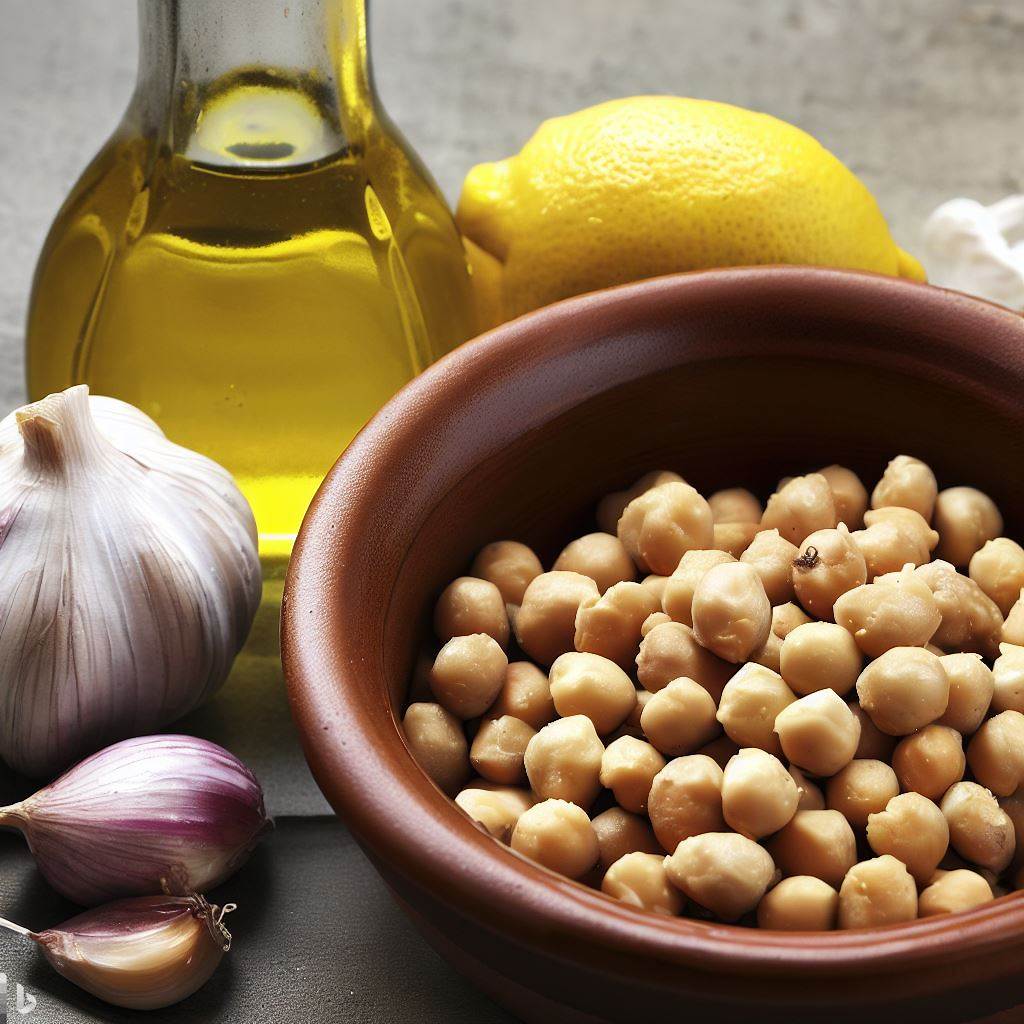
1 can of chickpeas (garbanzo beans), drained and rinsed
3 cloves garlic, minced
Juice of half a lemon. Remove seeds. (I can see someone saying, “Do I remove the seeds?”)
1/2 cup of tahini. (Make sure you stir the oil and paste if separated.)
1 cup of water (You will use this to slowly drizzle, thinning out the hummus, giving it a smoother consistency.)
A couple of glugs of extra virgin olive oil
A pinch of salt (adjust to taste)
Dusting of hot paprika (optional, for garnish)
Flaky sea salt like Maldon’s (optional, for garnish)
How to make:
In a food processor or blender, combine the chickpeas, minced garlic, lemon juice, tahini, olive oil, and salt. Process the mixture until smooth. If it seems too thick, add water (¼ cup at a time) until you reach the desired consistency. If you add too much liquid, add more tahini.
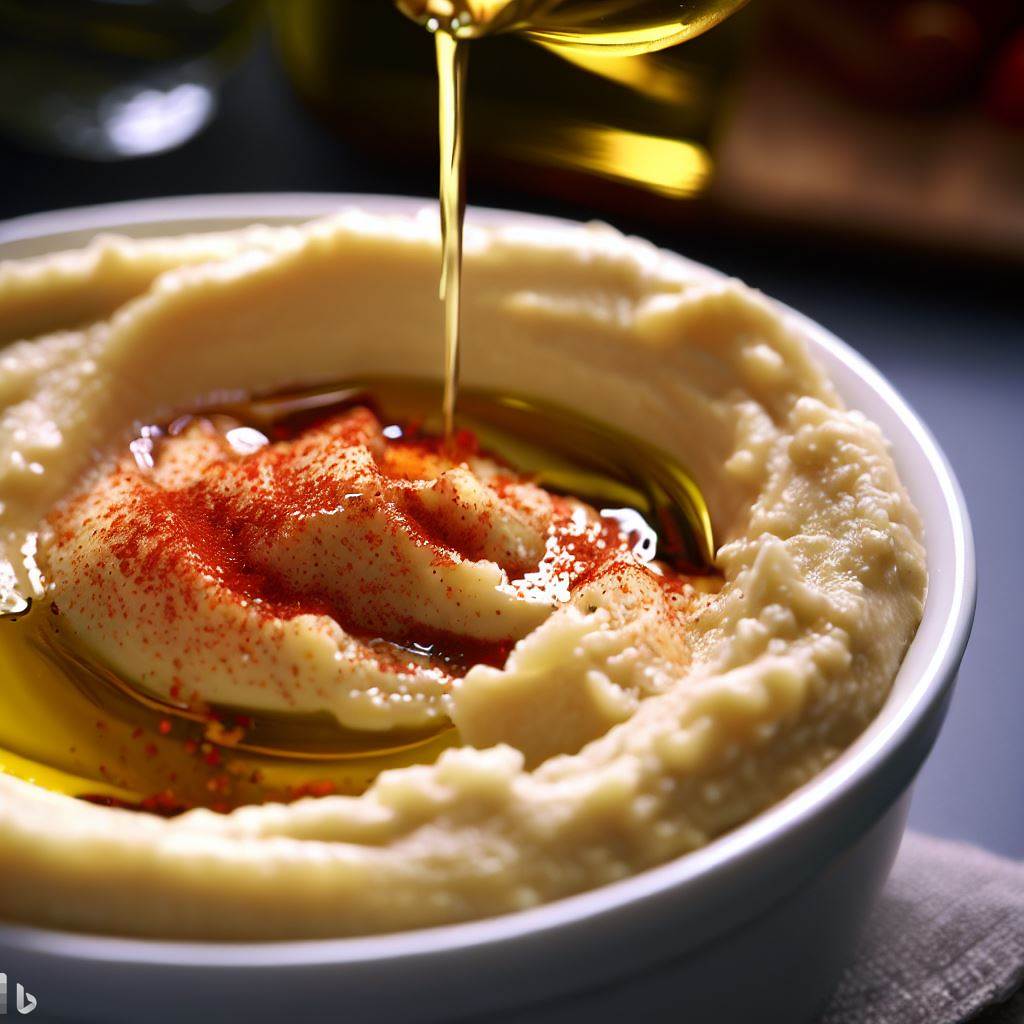
Taste the hummus and adjust the seasoning by adding more salt or lemon juice if needed. Transfer the hummus to a bowl. Finish with a little olive oil on top and sprinkle with hot paprika and salt for added flavor and presentation.
Refrigerate any leftovers. When serving again, add tahini and/or water to freshen up.
(Disclosure: We may make a commission from any links to this site.)
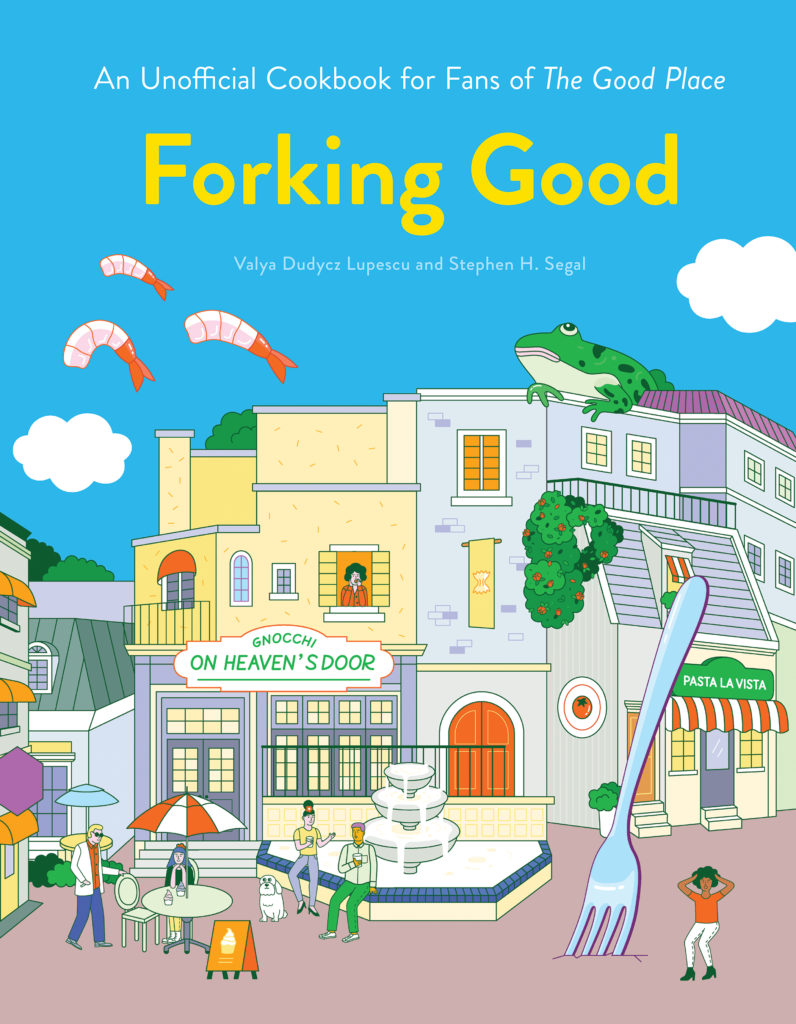
Have you seen the new cookbook, Forking Good: An Unofficial Cookbook for Fans of The Good Place by Valya Dudycz Lupescu and Stephen H. Segal? Like the show, Forking Good combines food humor with moral philosophy for a delightfully unexpected cooking experience.
Valya Dudycz Lupescu and Stephen H. Segal are the coauthors of Geek Parenting and the cofounders of the Wyrd Words storytelling laboratory. They live in Chicago in an Art Deco building that dates to the days of pulp magazines and Prohibition. Their weird family enjoys fan conventions, well-considered color palettes, and lots of music.
Valya is the author of the novel The Silence of Trees. She earned her MFA in Writing from the School of the Art Institute of Chicago. Her poetry and prose have appeared in The Year’s Best Dark Fantasy & Horror 2019, Kenyon Review, Culture, Gargoyle Magazine, Strange Horizons, and Chicago Reader.
Stephen is a journalist who has covered artists, scientists, musicians, and makers for Philadelphia Weekly and WQED Pittsburgh. As the chief editor at Legacy.com and, formerly, Weird Tales magazine, he has encouraged writers of both fiction and nonfiction to dig deep for unexpected truths. He grew up at the Jersey Shore.
~What is your favorite food to cook?
Valya: Vegetables—the variety, color, texture, and taste of them in different combinations depending on the season and my mood. I find them so satisfying to all the senses, especially roasted/sautéed and well-seasoned! I tend to go on kicks for a few months, exploring the different things one can do with them. For a while it was brussels sprouts, then asparagus, then red cabbage, and it’s been cauliflower since the summer. Oven-roasted cauliflower with different types of spices is one of our current family favorites.
~What do you always have in your fridge at home?
Stephen: More than actually fits! Two kinds of milk and three mustards and four salad dressings and five raw vegetables and six juice boxes and honestly more maple syrups than you would think anyone would have….
~What do you cook at home?
Valya: We make a lot of curries, stir fries, and pasta. Each of those has so much room for creative improvisation (and spices!)
~What marked characteristic do you love in a person with whom you are sharing a meal?
Valya: Curiosity. I enjoy sharing a meal with someone who is curious, from their openness to savor new flavor experiences to their willingness to answer and ask provocative questions in conversation.
~What marked characteristic do you find unappealing in a person with whom you are sharing a meal?
Stephen: At meals, I’m happy either to chat or eat together quietly — but if we’re talking at the table, one thing that always riles me up is when someone asks me questions and then keeps interrupting me before I can finish answering. Hey, if you’re gonna ask, listen!
~Tupperware, Rubbermaid, or Pyrex?
Valya: Pyrex, hands down. I prefer the non-porous surface of glass for storing food and for dishwasher cleaning.
~Beer, wine, or cocktail?
Stephen: Cocktail — something complicated yet cohesive, a layered flavor profile that goes on expanding from the scent right on through the aftertaste.
~Your favorite cookbook author?
Valya: I have many cookbooks that I love, but one of my favorite cookbook authors is a dear friend and fellow writer, Mary Anne Mohanraj. Mary Anne is a fantastic cook and writer who has been sharing her recipes on Patreon for years. Her most recent cookbook, A Feasts of Serendib: Recipes from Sri Lanka, is available on her website: http://serendibkitchen.com
~Your favorite kitchen tool?
Stephen: Three-way tie: the Vitamix (it has ten speeds!), the apple corer (it’s so geometric!), and the pizza cutter (it rolls so satisfyingly!)
Valya: My Wüsthof paring knife and my cast iron skillet.
~Your favorite ingredient?
Stephen: Soft cheese. Chevre, mascarpone, soft manchego, whatever. It has a happy place in breakfasts, lunches, snacks, dinners, and desserts.
~Your least favorite ingredient?
Valya: Cilantro. I’m one of those “cilantro tastes like soap” people.
~Least favorite thing to do in a kitchen?
Stephen: The third load of dishes in the same day.
~Favorite types of cuisine to cook?
Valya: I love to cook Ukrainian cuisine. I don’t do it often, usually on holidays and special occasions, but the hearty, comfort foods like pierogis (which are called varenyky in Ukrainian), borsch, Ukrainian breads and cakes, all connect me with my heritage and my ancestors.
Stephen: Hm. To cook? Mediterranean. Flipping falafels is fun.
~Beef, chicken, pork, or tofu?
Stephen: Humanely farmed chicken.
~Favorite vegetable?
Valya: Onions. I use onions in most of my dishes, especially caramelized. It’s such a perfect flavor, alone or layered with other flavors.
Stephen: More beets, please.
~Chef you most admire?
Valya: The chef that had the greatest impact on me growing up was Julia Child. I loved watching her cook on PBS; there was so much joy in it. Hers was the kind of passion I try to apply to all my meals. I also deeply admire Grant Achatz for his incredible perseverance and his fearless creativity. Eating at Alinea was an unforgettable and inspirational experience.
~Food you like the most to eat?
Stephen: At a meal: Indian cuisine — it’s such a perfectly satisfying blend of sweet, salty, savory, and spicy. As a snack: frozen dark chocolate-covered banana slices.
~What is your favorite non-food thing to do?
Valya: Our apartment is full of books. We are definitely a family of readers and music-lovers.
~Who do you most admire in food?
Valya: Melissa Clark. A dear friend and fellow foodie turned me onto Melissa’s videos, and I did a deep dive into her work. I love the way she writes about food, it’s such a pleasure watching her cook, and her “Weeknight Kitchen” podcast is one of my favorite things to listen to on my way home from work.
~Where is your favorite place to eat?
Valya: Honestly, I love to eat at home—ours and other peoples. I appreciate the intimacy and personality. Outside of home dining, we really love our neighborhood Ethiopian restaurant, Ras Dashen. Also high on our list is Band of Bohemia, such wonderful food and cocktails. w
Stephen: As an East Coaster relocated to Chicago, I thank the heavens for Jimmy’s Pizza Cafe, which is the place to get real New York pizza in town.
~How many tattoos? And if so, how many are of food?
Stephen: None.
Valya: Two. None of food, though.
Stephen: Yet.
I Kant Believe It’s Not Buttermilk Pancakes
Excerpted from Forking Good: An Unofficial Cookbook for Fans of The Good Place by Valya Dudycz Lupescu and Stephen H. Segal. Reprinted with permission from Quirk Books.
“In this realm, IHOP stands for Interdimensional Hole of Pancakes. You don’t really eat these pancakes. It’s more like they eat you.”—Michael, Season 2, Episode 10, “Rhonda, Diana, Jake, and Trent”
When Chidi agrees to teach Eleanor about ethics, he turns to Immanuel Kant’s The Groundwork of the Metaphysics of Morals. In it, Kant creates a basis for defining what behaviors are ethically acceptable (and, further, what behaviors are ethically required). Kant believed that ethical action was guided by the so-called categorical imperative of rules that produce ethical behavior if they are followed. It was his opinion that immorality is the result of a person holding others to a different standard of behavior than they do for themselves.
In Season 2, Episode 10, Chidi struggles against the obvious need to lie to maintain the Soul Squad’s aliases when they find themselves in the Bad Place. He tells Eleanor that according to Kant, lying is always wrong. He tells her, “Principles aren’t principles when you pick and choose when you’re gonna follow them!” Eleanor declares herself a moral particularist, invoking the philosopher Jonathan Dancy to make the argument that, “You have to choose your actions based on the particular situation.” Eleanor wins that round, and the conflicted Chidi tries to blend in.
The limitations of Kant’s categorical imperative don’t seem to apply in the absurdity of the afterlife. Kant may have argued that the contradiction of standards was immoral, but what happens when you have a completely different set of rules to follow, because you’re literally in hell? Or when you find yourself at . . .
THE INTERDIMENSIONAL HOLE OF PANCAKES
In Season 3, the Soul Squad arrives in the Neutral Zone between Good and Bad, at the Interdimensional Hole of Pancakes—the crossroads of all dimensions, where the pancakes contain interdimensional portals and want to eat you as much as you want to eat them. The Judge augments reality to make this place appear as a regular IHOP, but dangers still exist. As Michael warns the humans, “If you eat anything in this IHOP, you will literally explode.” Chidi missteps and falls into a portal, shrinks, and tumbles through time and space. Before he’s retrieved, he gets a glimpse of the Time Knife, which he describes as “a trillion different realities folding onto each other like thin sheets of metal, forming a single blade.”
For the indecisive deontological philosopher who spent his life in perpetual conflict for being unable to make the simplest of decisions, what does it mean to see so many dimensional possibilities at once? We’re not sure; he seems to snap back into their dimension fairly easily. Fortunately, the glimpse of the fractalesque reality did not launch him into the existential crisis that Jeremy Bearimy did.
So how does this influence our pancake recipe?
Some version of it has been part of the human diet for thousands of years, so it’s fitting that the crossroads of all dimensions is a symbolic house of pancakes. The earliest written reference to a pancake is the tagenia from ancient Greece, mentioned in the writing of the fifth century B.C.E. poets Cratinus and Magnes, and made with flour, olive oil, honey, and milk.
There are versions of pan cakes all over the world: Ethiopian injera and Indonesian serabi, French crêpes and German Pfannkuchen, Chinese bing and Indian cheela— some sweet, some savory, all grain based. In America, the earliest pancakes were likely made with cornmeal or buckwheat and called flapjacks or johnnycakes. Buttermilk pancakes, which are perhaps the most popular iteration in the United States, are believed to have come from Scotland, where they are called drop scones and made with a leavening agent that produces a taller cake than the typical crêpe-like British pancake.
Our vegan version drops the buttermilk and eggs but still captures the delicious fluff and flavor. And they won’t try to eat you.
I Kant Believe It’s Not Buttermilk Pancakes
MAKES: 25–30 silver dollar pancakes
Vegan
1 cup all-purpose flour
2 tbsp baking powder
1/2 tsp kosher salt
2 tbsp coconut oil, melted and cooled slightly (use refined for a neutral flavor or unrefined if you want a stronger coconut taste)
1 cup vanilla almond milk
1/4 cup maple syrup
Vegetable oil or coconut oil to grease the griddle/pan
Powdered sugar and fresh fruit, for topping
• Preheat the oven to 200 degrees Fahrenheit. Line a baking sheet with parchment paper. Set aside.
• In a small bowl, combine flour, baking powder, and salt. In a large bowl, combine melted coconut oil, milk, and syrup.
• Add dry ingredients to the wet, stirring until just incorporated. Don’t overbeat the batter or the pancakes will be tough.
• Allow batter to sit for 5 minutes while you heat a griddle or a cast-iron skillet on medium-low heat. The pan is ready when a drop of water sizzles upon contact.
• Lightly grease the griddle with vegetable oil or coconut oil.
• Using a large spoon, ladle small portions, about a heaping tablespoon, of batter onto the griddle. (You want the pancakes to be bite-sized.)
• When bubbles form in the batter, use a spatula to flip pancake and cook for another minute or two. Transfer cooked pancakes to the prepared baking sheet and warm in the oven while you cook the remaining batter.
• Sprinkle with powdered sugar and top with the fruit of your choice.
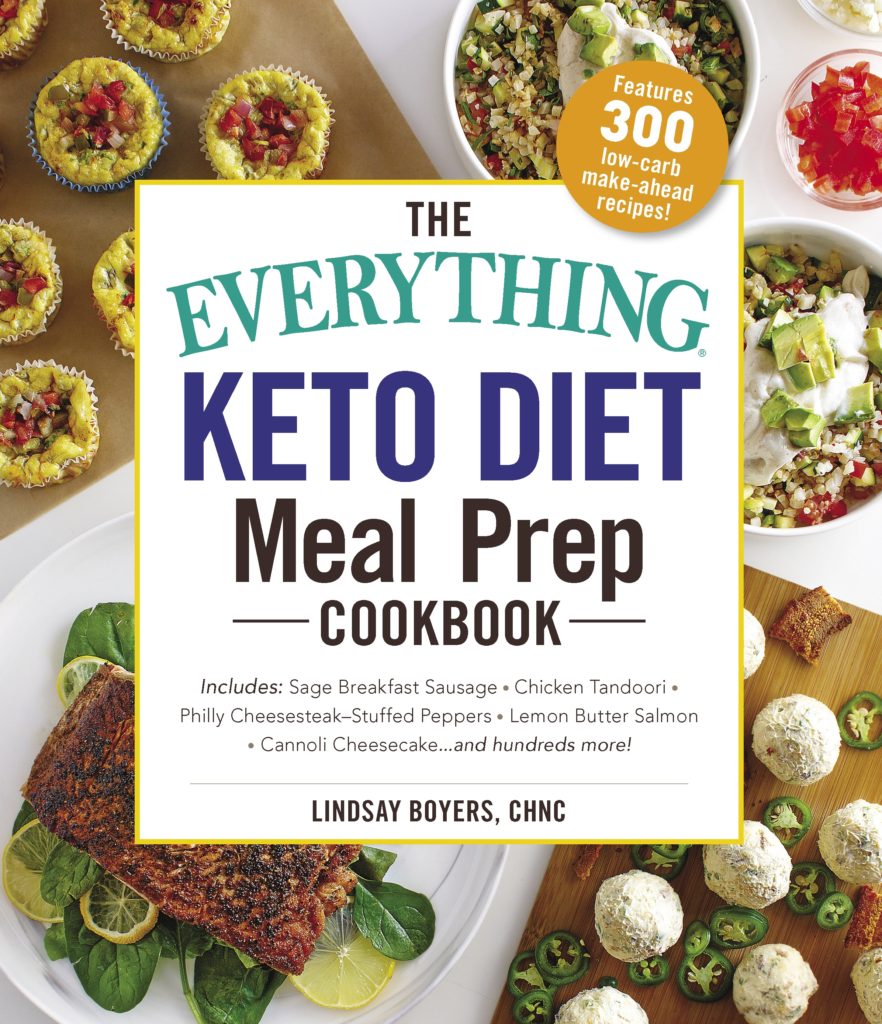
With nine books and thousands of articles published across the internet, Lindsay Boyers, CHNC, is a seasoned author. Lindsay’s latest publication, The Everything Keto Diet Meal Prep Cookbook, is a new foray, as she breeches the world of published recipes. The cookbook highlights Lindsay’s stance on health and nutrition, positing a low-carb, ketogenic lifestyle needn’t be complicated, intimidating, or expensive. Indeed, Lindsay’s cookbook demonstrates a ketogenic way of life can be enjoyable and satisfying. Further, readers can make many of these dishes with standard pantry items.
The Everything Keto Meal Prep Cookbook starts out introducing ketogenic basics and food prep, before moving onto recipes. The recipes are detailed, easy to follow, and, true to Lindsay’s promise, uncomplicated! From comforting classics (hello, Chicken Cordon Bleu!), to summer favorites (Key Lime Bars), and delicious twists (Thai Peanut Mason Jar Salad), Lindsay has all cravings covered. All food lovers will enjoy these cleverly crafted, easy, and delightful recipes regardless of carb orientation.
Lindsay Boyers, CHNC is a nutrition consultant with extensive experience in a wide range of dietary therapies including the ketogenic diet. She also specializes in elimination diets, gut health, and identifying food sensitivities in her clients. Lindsay’s articles on nutrition and health have been published on various health and wellness sites, including Healthline.com, Livestrong.com, and JillianMichaels.com. She lives in Shrewsbury, Massachusetts.
Food People Questionnaire (with a nod to Proust):
What is your favorite food to cook at home? Philly Cheesesteak Stuffed Peppers! It’s always a hit and I love using my pressure cooker whenever I get the chance.
What do you always have in your fridge at home? Tessemae’s Habanero Ranch Dressing!
What marked characteristic do you love in a person with whom you are sharing a meal? Open-mindedness! I love when someone is willing to try something new.
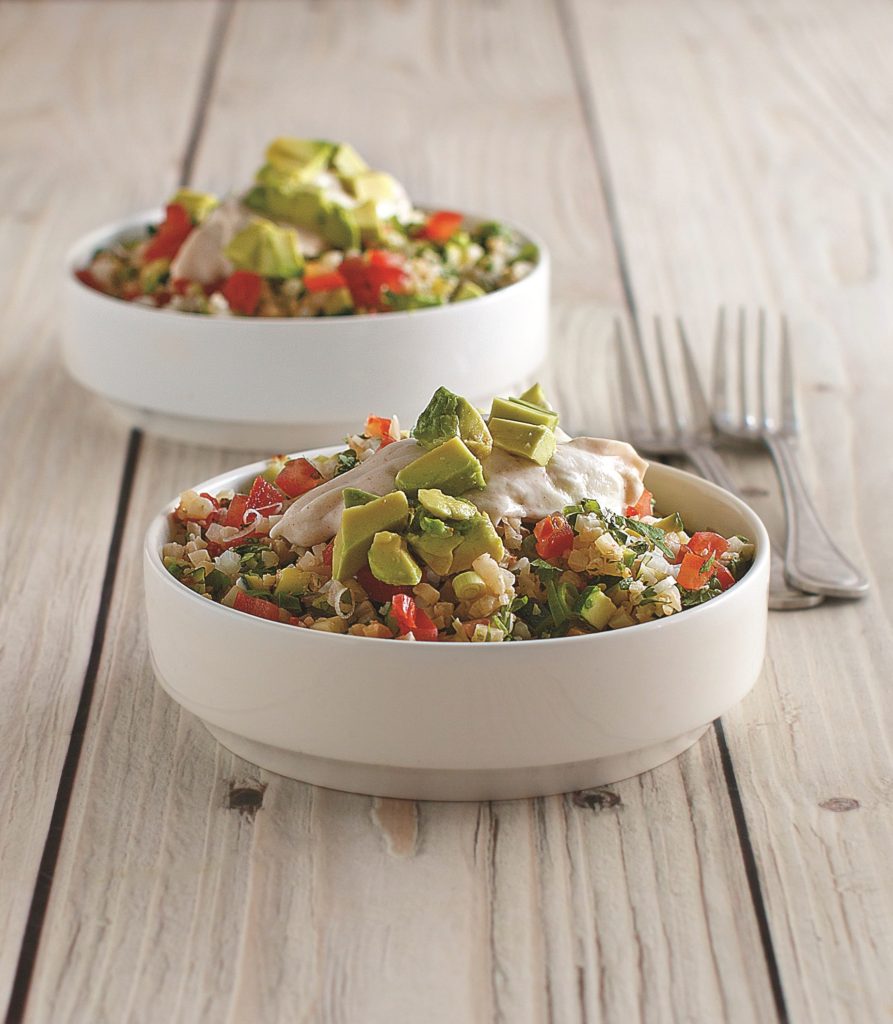
Greek Buddha Bowl
What marked characteristic do you find unappealing in a person with whom you are sharing a meal? Close-mindedness! It doesn’t bother me if someone doesn’t like something, but it does bother me when someone says they don’t like something before even trying it!
Beer, wine, or cocktail? Beer in the summer, wine in the winter.
Your favorite cookbook author? Danielle Walker of Against All Grain.
Your favorite kitchen tool? It’s a tie between my Instant Pot and my French press.
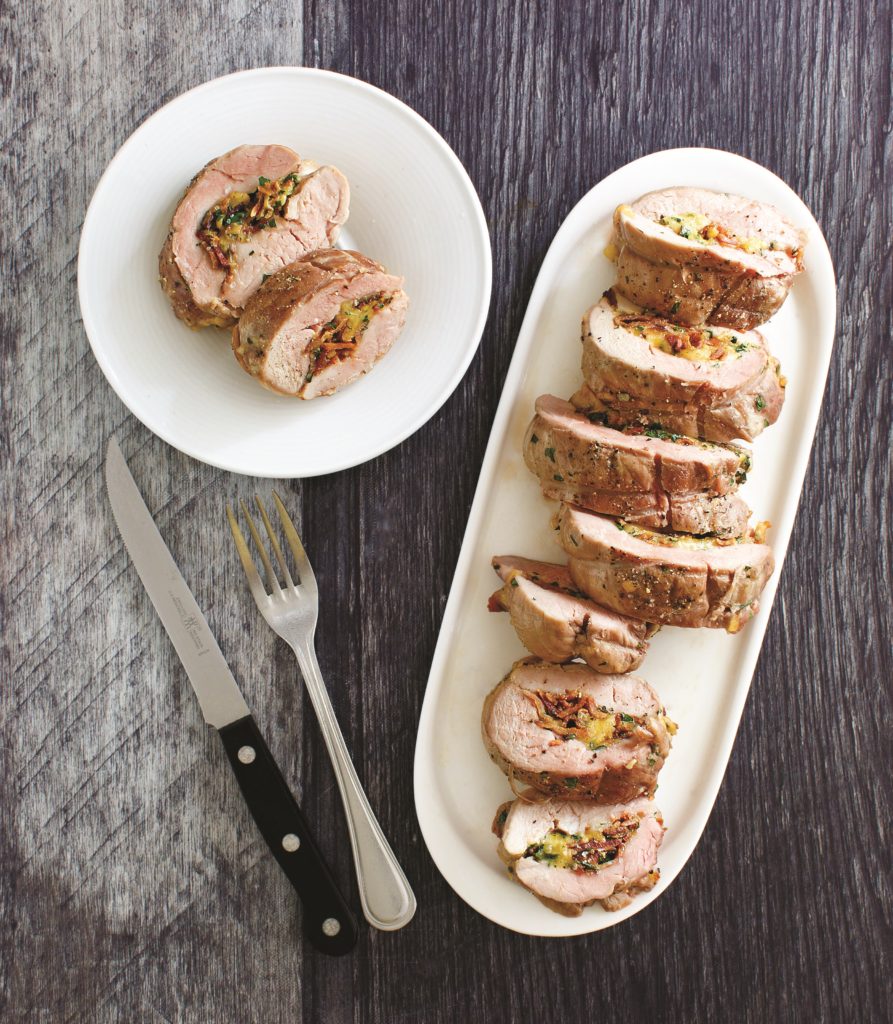
Gouda and Bacon Stuffed Pork Tenderloin
Favorite types of cuisine to cook? Italian and Mexican (even though I’m Portuguese).
Beef, chicken, pork, or tofu? Beef if it’s ground, chicken if it’s not.
Favorite vegetable? Broccoli.
Chef you most admire? I’m a big fan of Alton Brown.
Food you like the most to eat? Avocados with Everything Bagel Seasoning sprinkled on top!
Food you dislike the most? Cottage cheese, for sure.
What is your favorite non-food thing to do? Does reading count? I’ve always been in introvert, and my favorite thing in the world is reading in a hammock with a blanket.
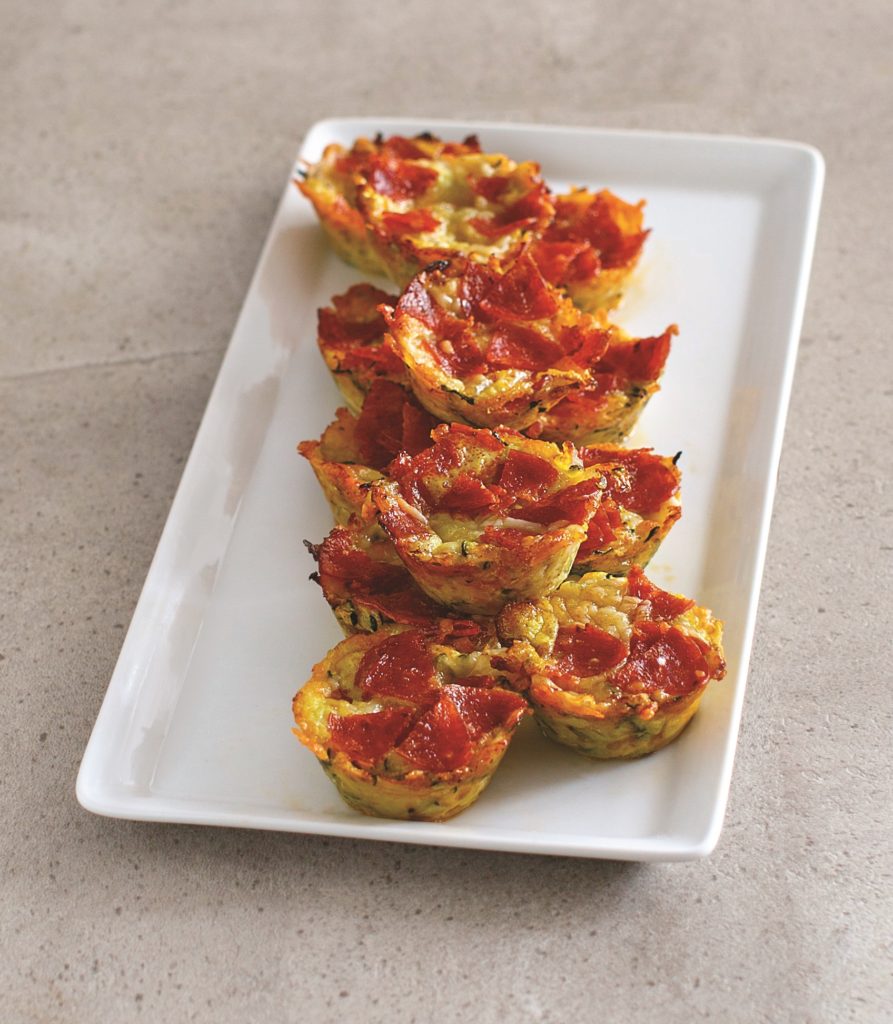
Zucchini Pizza Bites
Who do you most admire in food? There are a lot of people, but I’d probably have to choose Dr. Mark Hyman.
Where is your favorite place to eat? My house! I much prefer cooking to going out to eat. That way I can control the ingredients and make it exactly to my liking.
What is your favorite restaurant? There’s a sushi restaurant that’s local to me called Yama Zakura, and it is OUT OF THIS WORLD.
Do you have any tattoos? And if so, how many are of food? I do! I have two. None of them are of food. I was 18 and 19 when I got them, so they’re not the best looking things.
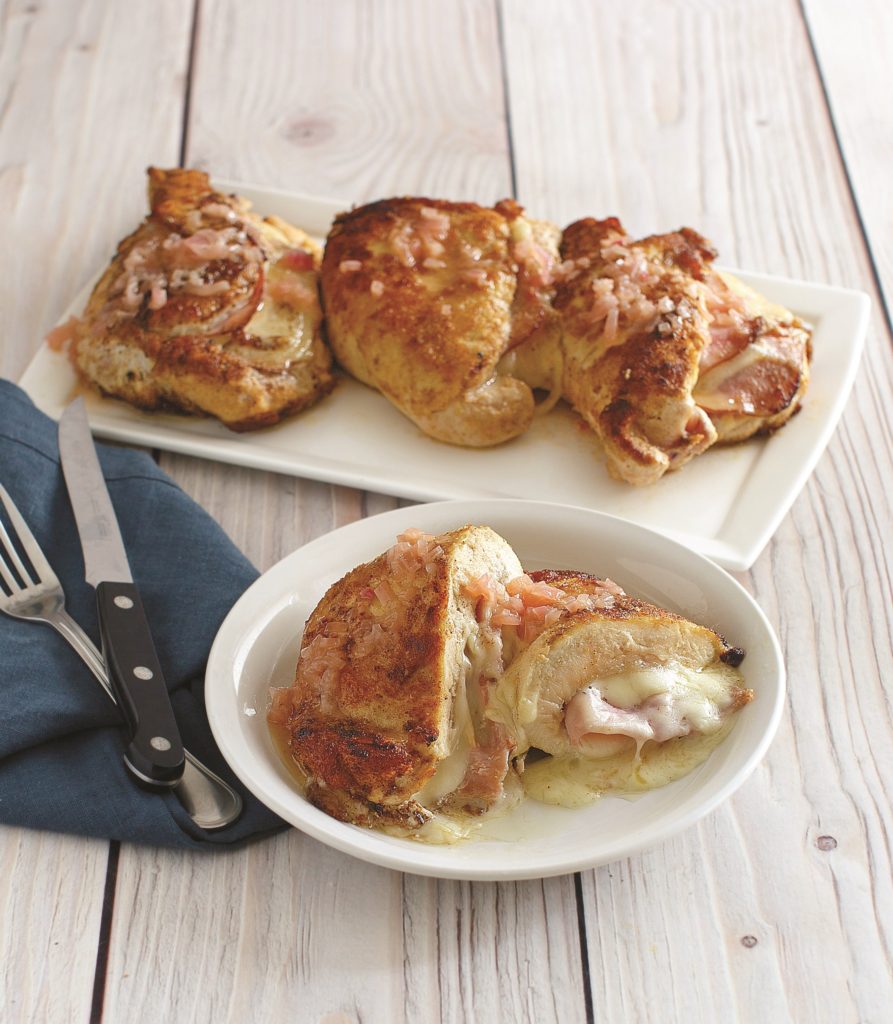
Recipe: Chicken Cordon Bleu with Creamy Lemon Butter Sauce
If you want a richer flavor, you can use chicken thighs instead of chicken breasts. This will also double the fat content of each serving, as chicken thighs are much higher in fat.
Note: Save Money with Thighs! Chicken thighs don’t get as much love as chicken breasts, but they’re an excellent source of both protein and fat. When cooked, the fat renders from the chicken thigh into the sauce in which it’s being cooked and gives it a richer flavor than chicken breasts. Plus, chicken thighs tend to be cheaper and go on sale more often, especially the bone-in, skin-on varieties. You can use chicken thighs in any recipes that call for chicken breasts. If the recipe calls for skinless, you can save money by buying it with the skin on and then removing before cooking.
INGREDIENTS | SERVES 6
6 (4-ounce) boneless, skinless chicken breasts
6 slices Swiss cheese
6 slices no-sugar-added deli ham
3 tablespoons Paleo flour
1 teaspoon paprika
1 cup plus 2 tablespoons grass-fed butter, divided
1⁄2 cup keto-friendly white wine
2 shallots, minced
1⁄2 cup heavy cream
3 tablespoons lemon juice
Pound chicken with a meat mallet to 1⁄2″ thickness. Place one slice of cheese and ham on each breast and fold chicken over, securing with a toothpick.
Combine Paleo flour with paprika in a medium bowl. Dip each chicken breast in flour mixture and set aside.
Heat 2 tablespoons butter in a large skillet over medium heat. Add chicken breasts and cook 5 minutes on each side or until chicken is cooked through.
While chicken is cooking, combine wine and shallots in a small saucepan. Bring to a boil and reduce until 2 tablespoons of liquid remain.
Reduce heat to low and whisk in remaining butter, stirring constantly until butter is incorporated. Remove from heat and whisk in cream and lemon juice.
Pour sauce over chicken and cook 1 more minute. Remove from heat.
Transfer one chicken breast and equal amounts of sauce to each of six separate airtight containers. Store in the refrigerator until ready to eat, up to one week.
PER SERVING Calories: 686 | Fat: 55 g | Protein: 39 g | Sodium: 441 mg | Fiber: 2.5 g | Carbohydrates: 6.5 g | Sugar: 1.5 g | Net
Carbohydrates: 4 g
Keto Kalamazoo has a wanderlust for travel and culinary adventures. In 2017, she ate her way across 29 countries and is itching to set off again! To date, her favorite destination is Budapest, Hungary, where she ate enough sour cherry soup to fill the Danube. A former secret diner, KK tries to stay active by promoting food and culture within her local community. She’s also a professor–but that’s not as fun and exotic as food adventures.
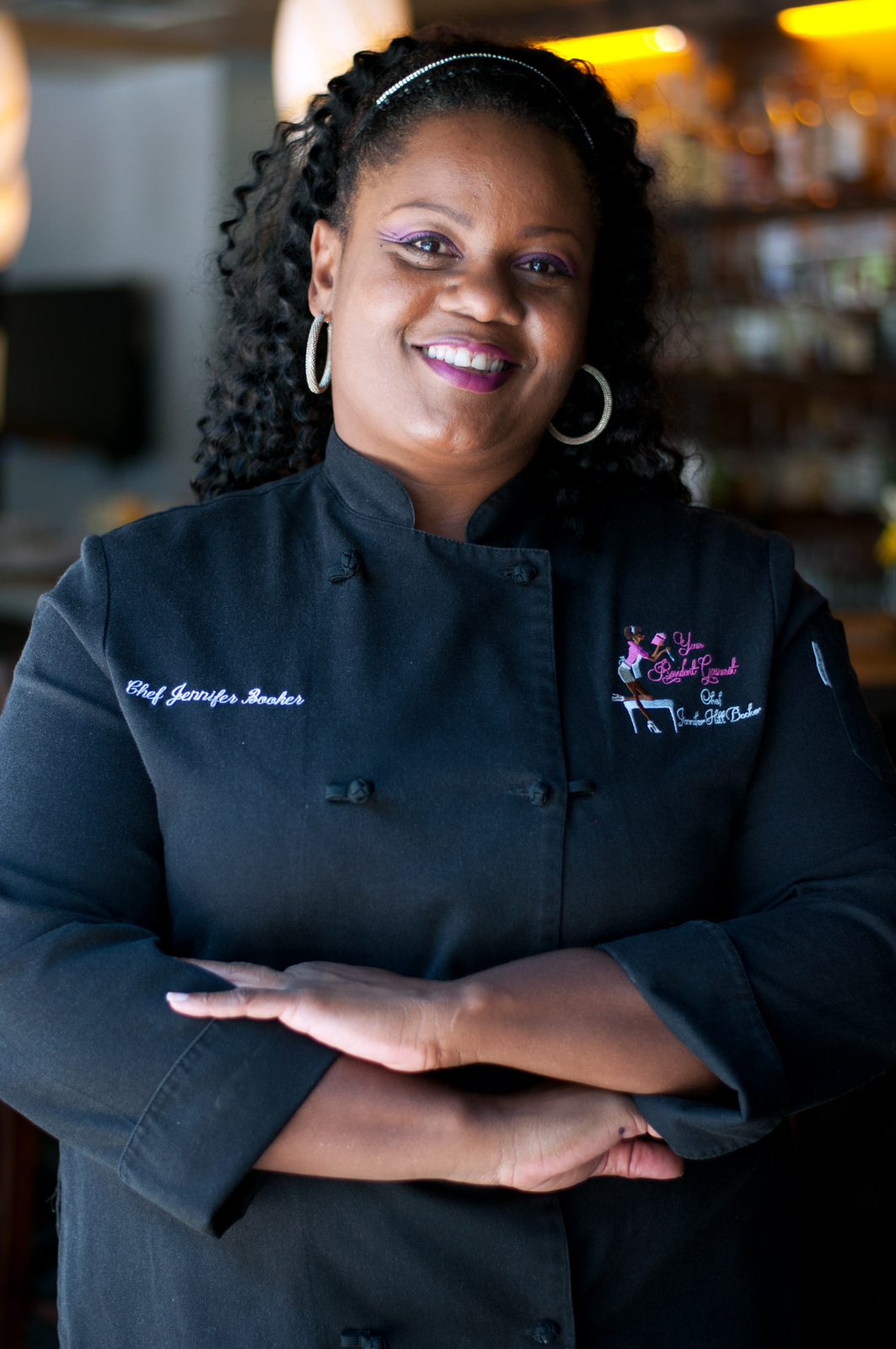
Chef Jennifer Hill Booker’s culinary path has not always been a linear one. She earned her Bachelor’s Degree from the University of Tulsa before graduating first in her class, eighteen months later, with an Associate of Occupational Science from Oklahoma State Institute of Technology. Extensive travel while married to an United States Army Officer pushed Jennifer to blaze a trail that fit her unique situation-a female African American chef, living abroad – as a result, Your Resident Gourmet was born.
During her time living in Germany, Jennifer honed her culinary talents by providing cooking classes for both military and German families. She was also able to fulfill a lifelong dream of attending Le Cordon Bleu College of Culinary Arts in Paris, where she once again graduated top of her class.
Twenty years later Jennifer finds herself once again blazing culinary trails as she wears many culinary hats as chef, cookbook author of Field Peas to Foie Gras and Dinner Deja Vu, reality TV personality, culinary educator, and business owner.
She is a Georgia Grown Executive Chef for the GA Department of Agriculture, the Culinary Explorer for the Georgia Department of Tourism and Travel, is the founder of Southern Divas of the New South™ Dinner Series, and currently sits on the James Beard Foundation Food Waste Advisory Council.
Weaving her love of traditional Southern cuisine with her belief in incorporating healthy, seasonal foods and her classic French training, Chef Jennifer created a unique style of cooking that she termed Modern Southern Healthy Cuisine with a French Accent. Chef Jennifer shares this brand of cooking through her cooking segment ‘Chef Jenn to the Rescue’, on CBS46’s Atlanta Plugged In, with original recipes in such publications as Garden & Gun and Essence Magazine, as well as her Food Network debut as a finalist on Cutthroat Kitchen.
Chef Questionnaire (with a nod to Proust):
How long have you been cooking?
Professionally for 20+ years. As a novice, I’ve been cooking since around 7-when I got my first Holly Hobby Oven.
What is your favorite food to cook?
I love to mesh Southern and French ingredients and cooking techniques together to get what I call Modern Healthy Southern Cuisine with a French Accent. It’s not Creole or what’s typically found in New Orleans-I think it’s more Mississippi, Tennessee, Alabama style Southern with classical French mixed in. So more fresh seasonal produce, farm raised meat and poultry, and lots and lots of layered flavors. I don’t use much roux, hot spices, or heavy sauces in my food. It’s my foundation and what I use approach everything I approach-like black eyed pea hummus or a cassoulet with smoked ham hocks and salt pork.
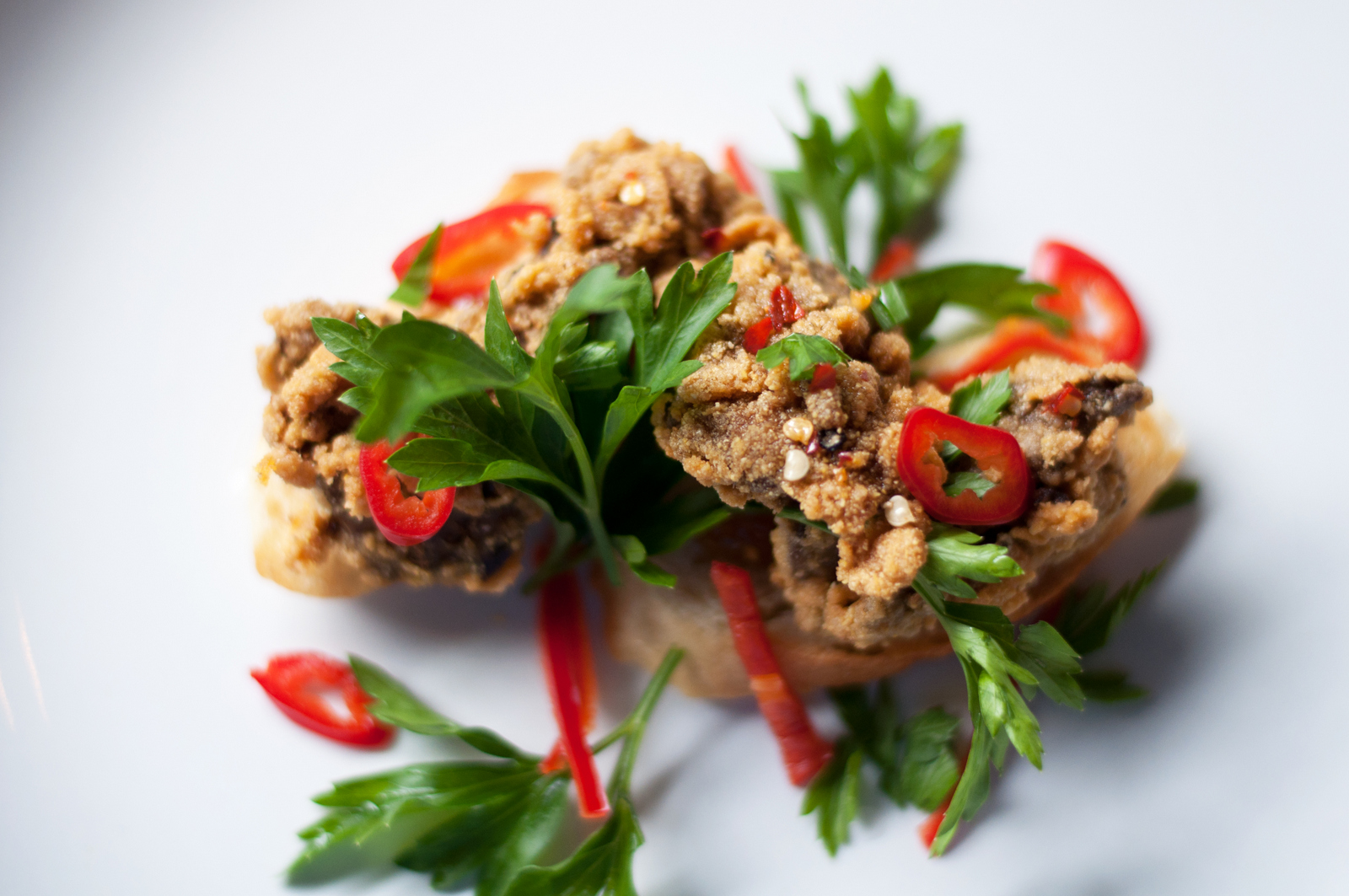
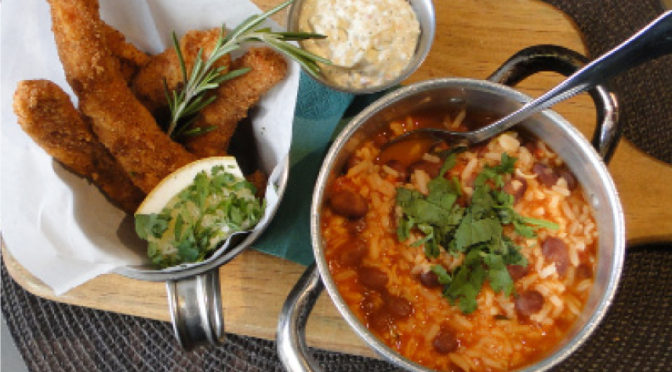
Fried Chicken Livers
What do you always have in your fridge at home?
Eggs, cream, butter, some type of cheese, capers, olives, and bacon. I can make almost everything from those ingredients.
What do you cook at home?
I’m a Southerner at heart. Nothing makes me happier than cooking a pot of beans with a ham hock or ham bone thrown in. I also love greens-either cooked or served as a salad.
What marked characteristic do you love in a customer?
Customers that are adventurous eaters and LOVE food! They are a joy to cook for.
What marked characteristic do you find unappealing in a customer?
Those who give you the wash list of their dietary ‘restrictions’. You’re a grown up, you know what you can and cannot eat.
Tupperware, Rubbermaid, or Pyrex?
Oh my gosh-this is a good one! I grew up on Tupperware but when I got my own place, I couldn’t afford it! Now I use a mix of Rubbermaid and Lexan – which is commercial kitchen storage brand that ends up in my home kitchen. I do like the glass Pyrex casserole dishes with the snap on lids-how clever is that!?
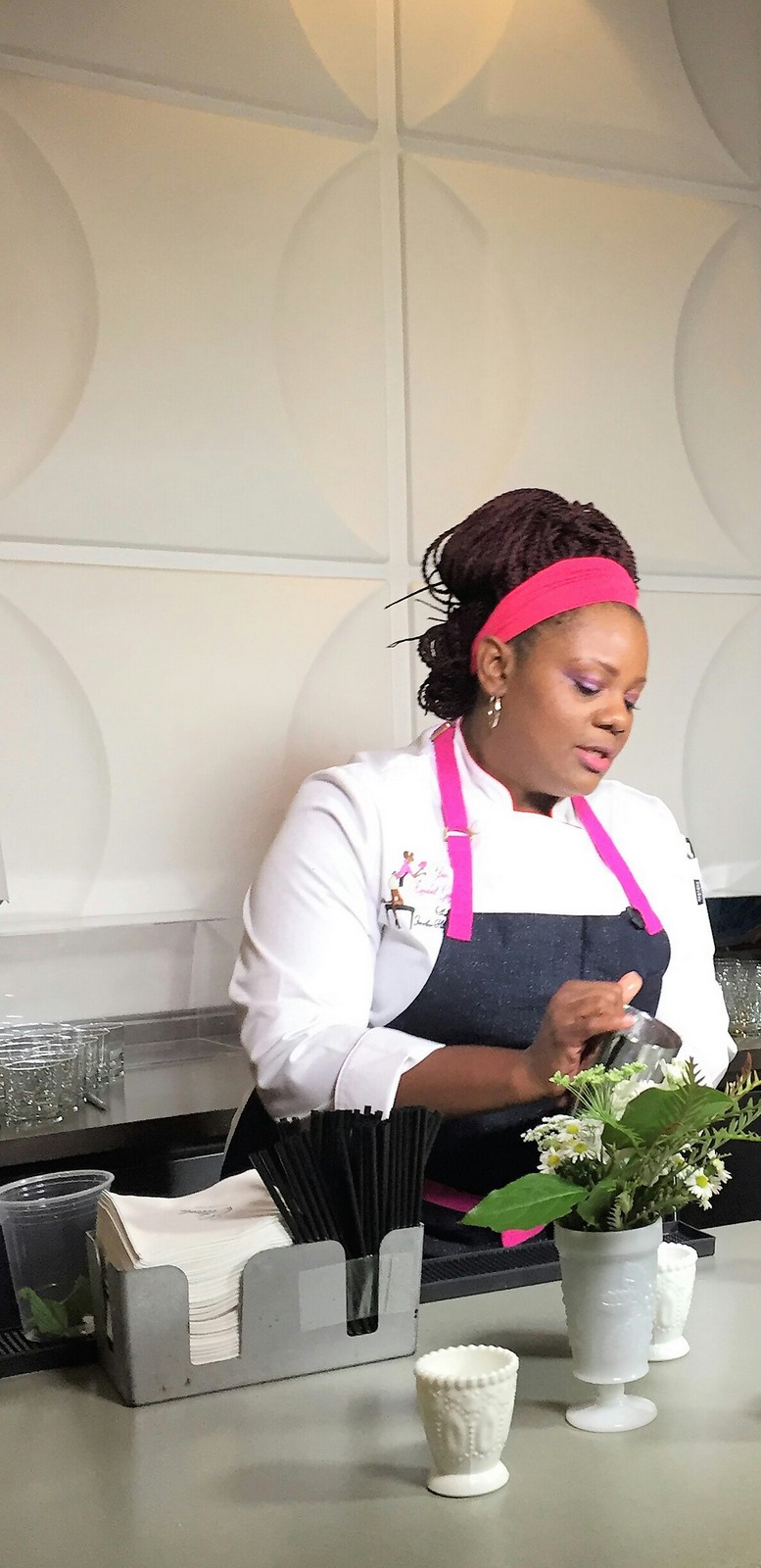
Making cocktails
Beer, wine, or cocktail?
Cocktails in polite company-but I really prefer my booze on the rocks. It tastes pure and without any pesky calories from mixers.
Your favorite cookbook author?
I like recipes that work-and Ina Garten’s always do. For inspiration, I have to have lots of bright juicy pictures in the cookbooks I read- and the Culinaria cookbook series are beautiful. But my all time favorite cookbook? Julia Child. She explains her recipes, no matter how arduous, and soldiers through.
Your favorite kitchen tool?
Hands down a rubber spatula. You can stir, fold, mix, sauté, and scrape! Scraping the bowl, pot, or pan clean is near and dear to my heart because it prevents waste, you get that last bite that can make or break a portion, and it Saves Money. Why wash food down the drain when you can scrape it out and eat it?!
Your favorite ingredient?
Garlic. I Love Garlic. It adds aroma and enhances the flavor to a dish-and can be strong and pungent or soft and sweet.
Your least favorite ingredient?
I don’t have a least favorite, but I am totally over Kale.
Least favorite thing to do in a kitchen?
Peel shrimp and clean the oven. I still have scars on my fingers for the thousands of pounds of shrimp I’ve peeled over my culinary career. I just hate taking the time to clean the oven! It takes smoke and a small fire in the oven to compel me to finally clean it.
Favorite types of cuisine to cook?
My all time go to favorites are Southern, Classical French, and Mediterranean (which for me is just a way to cook everything that has tomatoes, olive oil, and garlic in it). I also get excited by what’s in season or a style of cooking. I went through a period where I grilled everything-fruit, pizza, bones for stock!
Beef, chicken, pork, or tofu?
This is a hard one. I’m going to go with pork. You can coax so many flavors and textures from pork that it never gets boring.
Favorite vegetable?
If I had to eat one vegetable for the rest of my life . . . I guess it would be brussels sprouts. They taste like broccoli and cabbage and are so versatile I’d never get bored.
Chef you most admire?
I have a chef crush on Anthony Bourdain-mainly because of his bad boy imagine and he knows his stuff! A dear friend of mine, Chef Joe Randall, has my unwavering admiration. He’s been cooking as an Executive Chef for 40 years. He’s run kitchens (both North and South), written cookbooks, owned a cooking school, mentored young chefs, and currently runs the African American Chefs Hall of Fame in Savannah, Georgia, and unapologetically promotes Southern cuisine. None of which are easy-especially for a proud Black man in America.
Food you like the most to eat?
I’m all about the savory!
I love big flavors that range from my Mother’s turkey & dressing to roasted tomatoes and garlic with fresh basil and shaved parm or a muffuletta from Central Grocery in New Orleans that I smuggle home and bake in a cast iron skillet with another skillet pressing it down. Now I’m hungry!
Food you dislike the most?
Cauliflower-how can it be a vegetable when it’s white?? It’s almost like broccoli’s twin sister, while broccoli is popular and has personality, cauliflower is bland and boring and hoping people will like her.
How many tattoos? And if so, how many are of food?
I have 2 tattoos. One is food and it’s also my Zodiac sign . . . I’ll let you figure that one out.
A poet, journalist, author, and gourmet extraordinaire. Ronnie Hess grew up in New York City, attended the Lycée Français de New York and Julia Richman High School, and graduated from Hunter College, the City University of New York. She earned a master’s degree in history from the University of Wisconsin-Madison.
Hess began a career in broadcast journalism at Wisconsin Public Radio. In the 1980s, she was a reporter/producer for CBS News in Paris, spending nearly four years in France reporting on political, social, and cultural issues. After returning to the Midwest, she worked for Minnesota Public Radio and Chicago Public Radio and was a freelance writer/producer for the “American Justice” series that aired on A&E. Returning to UW-Madison, she became director of communications in the Division of International Studies, and taught middle school English in France during a sabbatical year.
Ronnie Hess and husband (Ron Rosner) in Lisbon
Hess has contributed to many publications – national, regional and local – including Saveur, The Christian Science Monitor, and The Milwaukee JournalSentinel. She was restaurant critic for several years for Madison Magazine and was a freelance arts critic for The Capital Times.
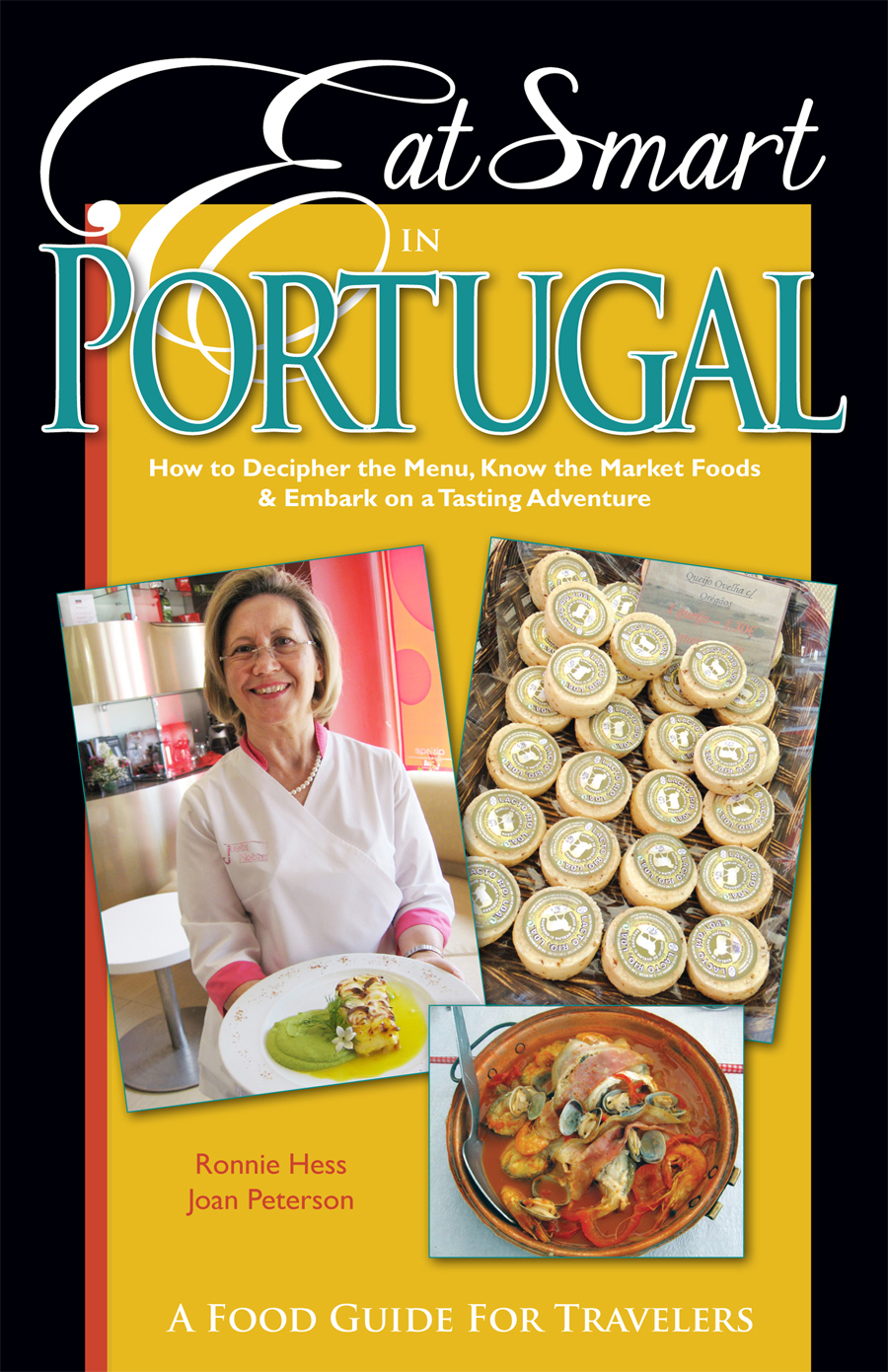
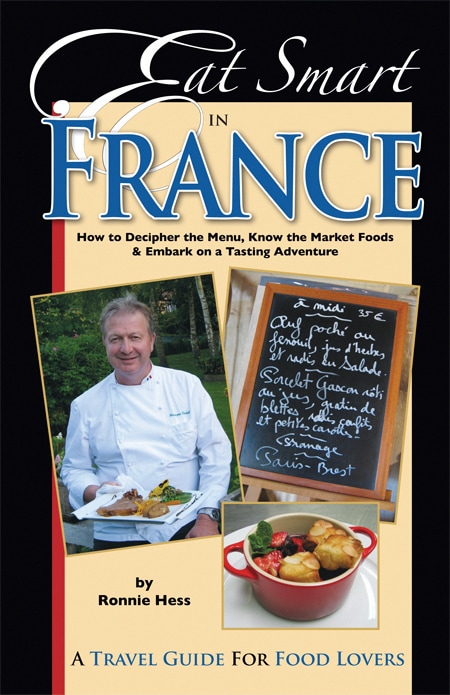
Ronnie has penned two books in a series with one of our favorite publishers, Ginkgo Press – Eat Smart in France, and Eat Smart in Portugal (click through to read my interviews with her!). Eat Smart Guides are genius, teaching about history, culture, menus, language, and more for a country – and include recipes. They tell you how to decipher the menu, know the market foods, and embark on a Tasting Adventure. I love them, for the broad introduction to a culture through its cuisine, as well as the travel (and eating) inspiration contained therein. Highly recommended.
What is your favorite food to cook at home?
Well, apart from salads, I have a few favorites: risotto, pasta and pesto, vegetable frittatas.
What do you always have in your fridge at home?
Yogurt. And granola in the cupboard. I make my own.
What marked characteristic do you love in a person with whom you are sharing a meal?
Lively conversation.
What marked characteristic do you find unappealing in a person with whom you are sharing a meal?
Bad manners. And not speaking.
Beer, wine, or cocktail?
Wine.
Your favorite cookbook author?
Jacques Pépin.
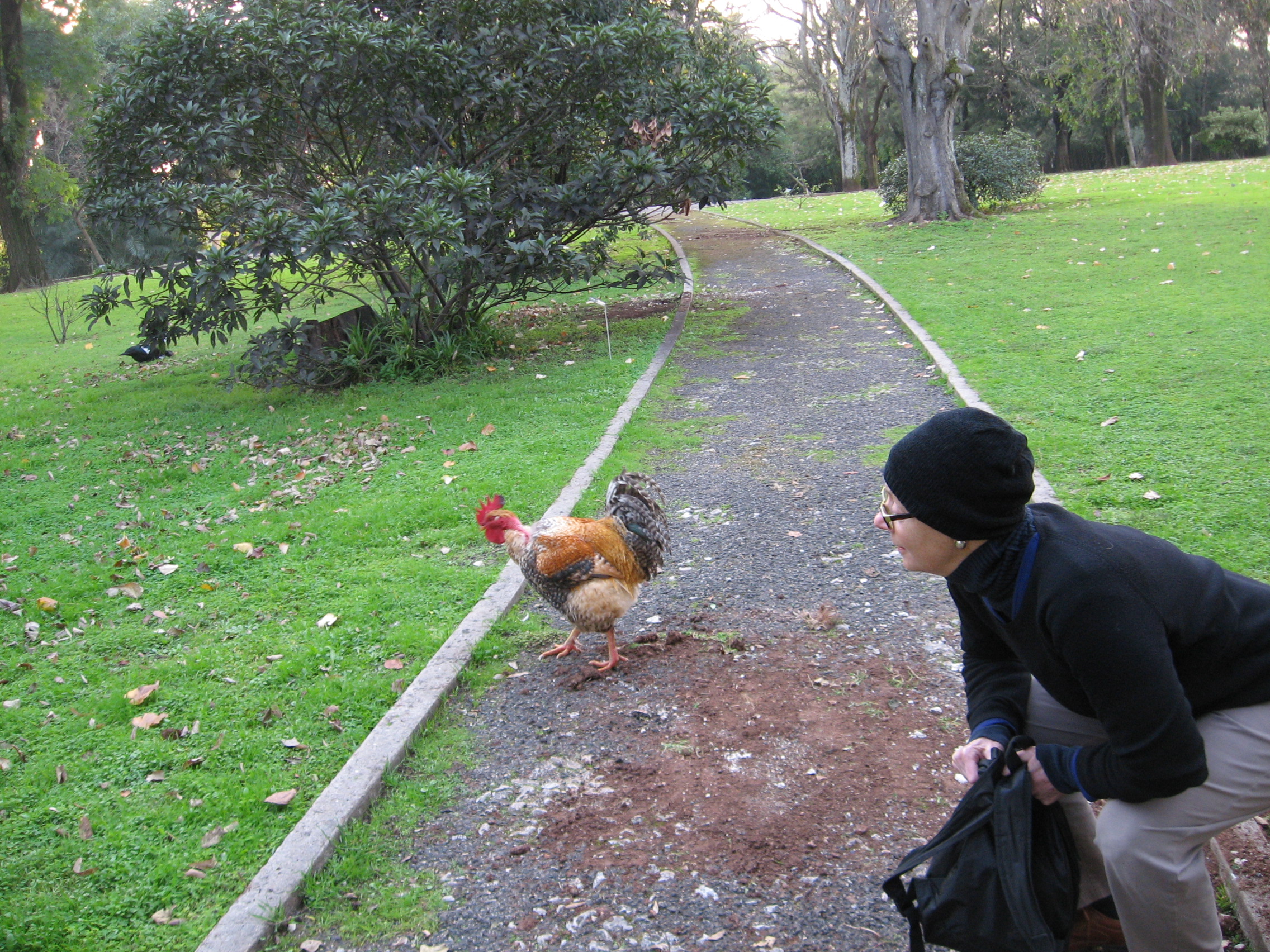
In Belem’s Jardim Botanico Tropical
Your favorite kitchen tool?
Tongs.
Favorite types of cuisine to cook?
Mediterranean.
Beef, chicken, pork, or tofu?
None of the above. It’s fish.
Favorite vegetable?
Lettuce.
Chef you most admire?
Generally, it’s not one but all. They keep long hours, are always on their feet, working in stressful and often uncomfortable conditions.
Food you like the most to eat?
Chocolate.
Chocolate cake for lunch in a restaurant in Provence
Food you dislike the most?
I like everything. Well, I’d have a hard time eating certain insects.
What is your favorite non-food thing to do?
Water aerobics.
Who do you most admire in food?
The people who grow my food, bring it to market.
Where is your favorite place to eat?
Increasingly it’s my kitchen. Restaurants are too noisy and I can’t always count on the food.
What is your favorite restaurant?
Typically, a neighborhood restaurant, specializing in Mediterranean or an ethnic cuisine I would never cook. I love Indian food.
Do you have any tattoos? And if so, how many are of food?
Nope.
In northeastern Portugal in January, snowed in for several days in the village of Montesinho
Recipe: Vegetable Frittata
(Serves about 4 people)
This is based on Mark Bittman’s recipe that was featured in the New York Times. You can vary the ingredients, depending on what vegetables you’ve got, so it’s never the same. My instructions are below but here are Mark’s.
You’ll need about 6 cups of sliced or diced vegetables. These can be raw or cooked but obviously if they’re raw, you’ll want first to add those to a large oven-safe sauté pan.
Heat about 2 tablespoons of olive oil, add the vegetables and cook covered until almost done. (I start with onions and garlic and then add vegetables that need the most time, such as carrots, before adding green pepper or zucchini.)
Season with salt, freshly-ground pepper and any other herbs (fresh or dried).
Break 4-6 eggs in a small bowl, beat, and add to the frittata.
Cook until the eggs are set.
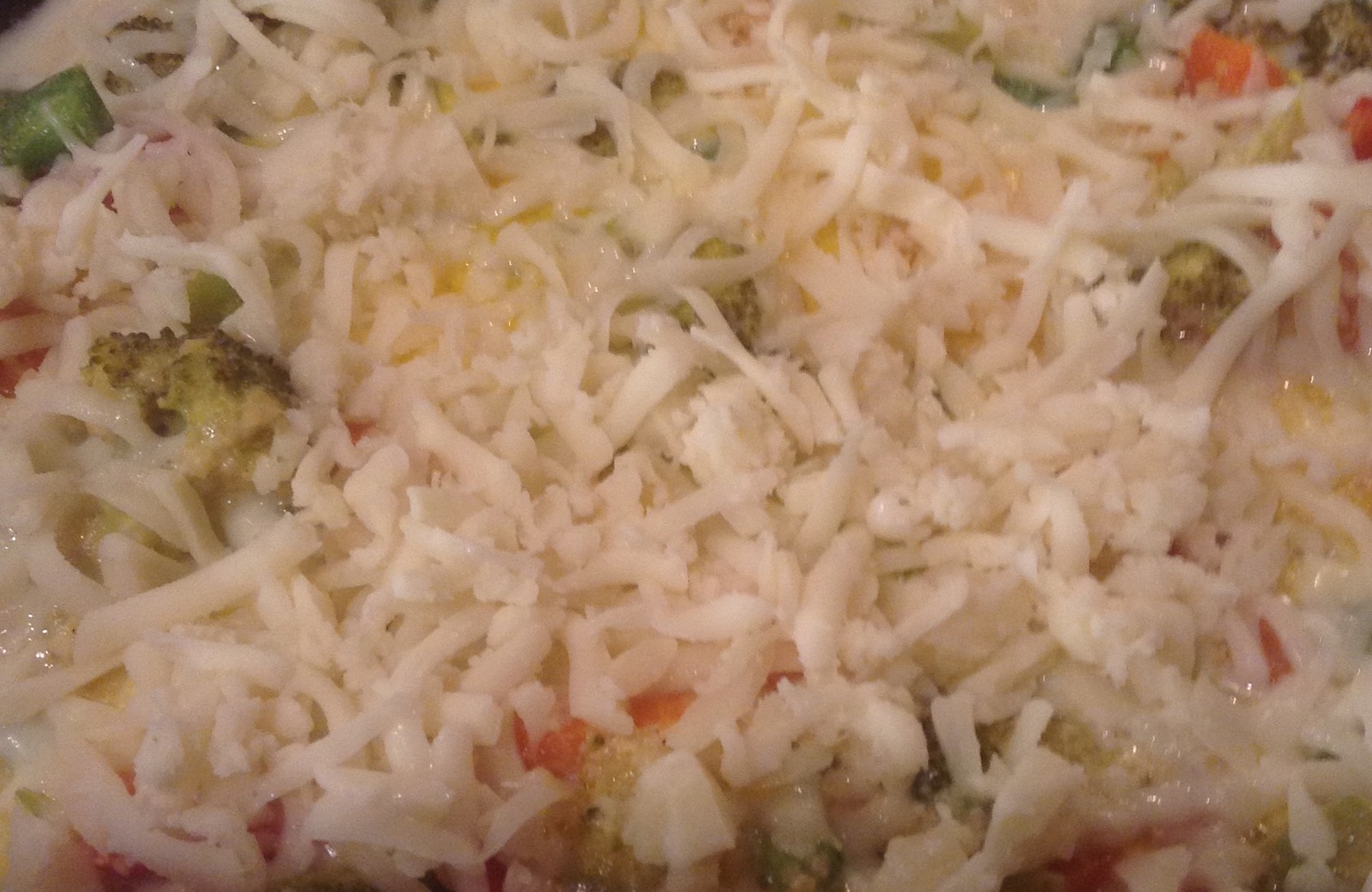
midway through cooking, with mozzarella cheese on top of the partially cooked frittata
At this point I usually add feta cheese and some grated parmesan cheese and finish off the dish under the broiler.
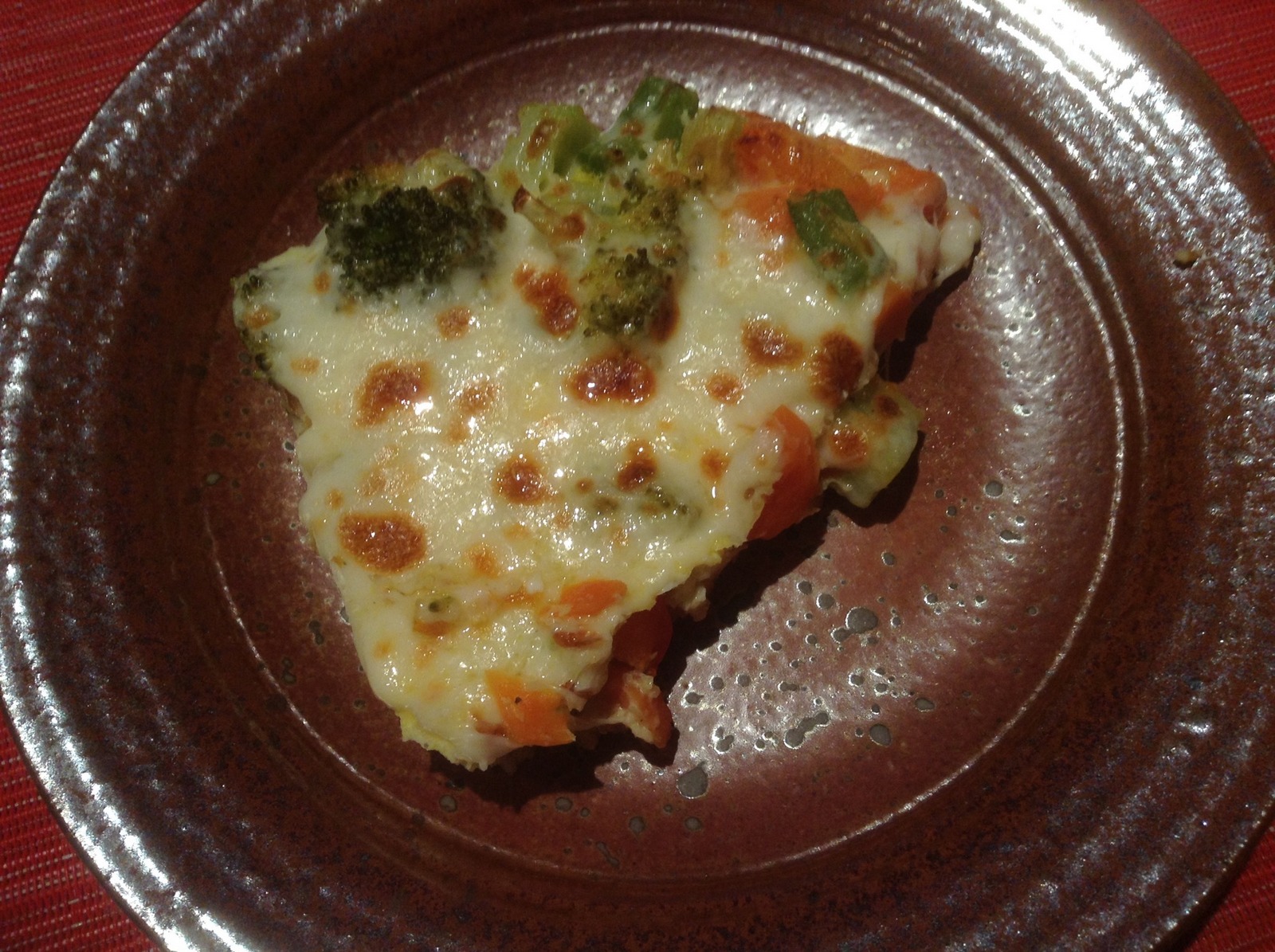
After grilling the cheese under the broiler. In this version I used carrots, broccoli, green and red peppers.
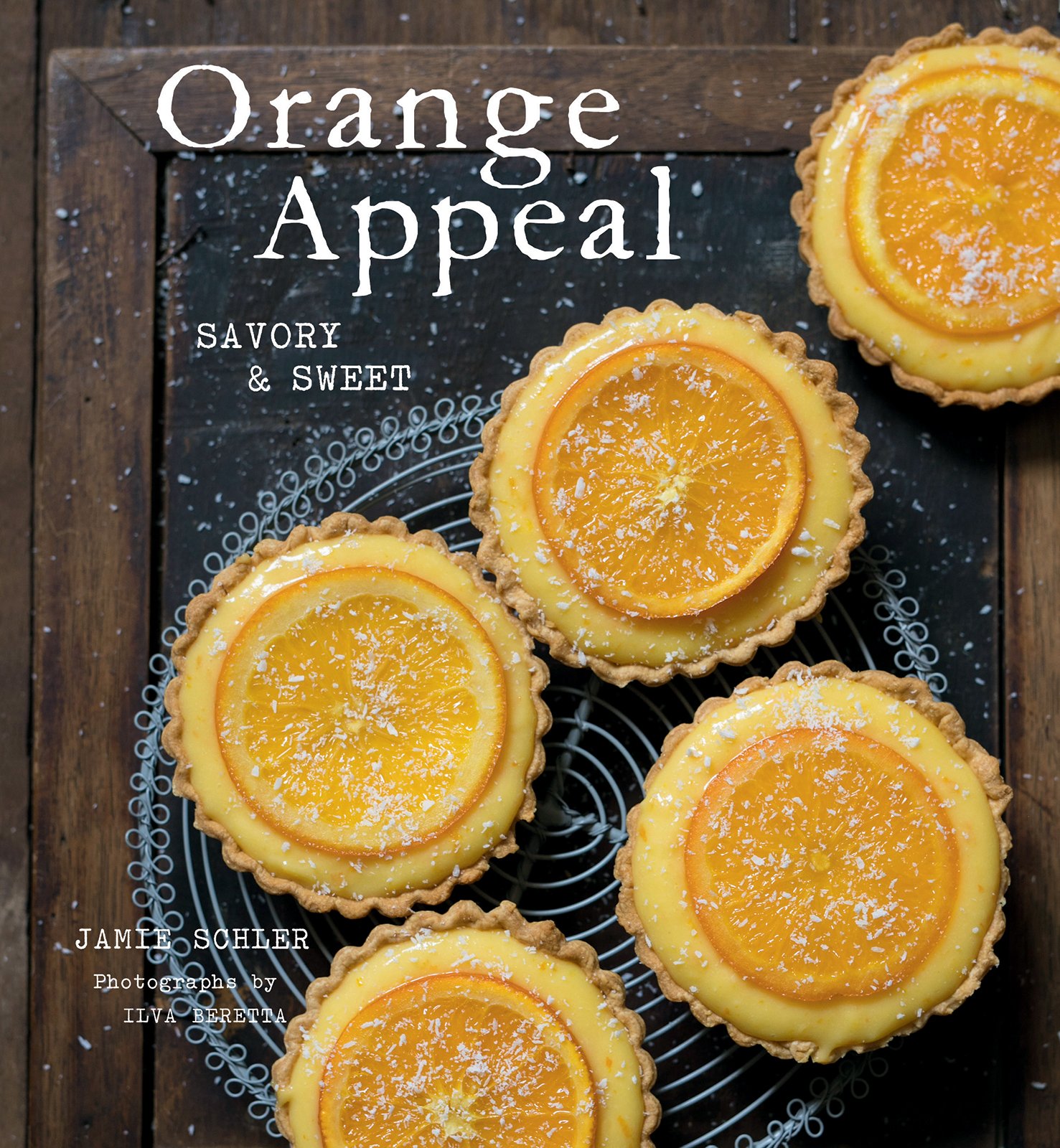
Jamie Schler writes stories inspired by food, culture, travel, and the real people she meets in real life, every day and she’s an advocate for authentic traditional French home cooking. Jamie has worked in the world of art in Philadelphia and New York, as a milliner in Milan, Italy, and gastronomic tourism in Paris. She grew up on Florida’s Space Coast but now lives in Chinon, France, where she owns and runs the Hôtel Diderot with her husband, and where she makes a whopping 1500 pounds of jam a year. An IACP award-winning writer, her work has appeared in The Washington Post, The Art of Eating, Fine Cooking, France Magazine, Modern Farmer, Leite’s Culinaria, and The Kitchn, among other publications. She blogs at Life’s a Feast, and she just wrote her first cookbook, Orange Appeal, featuring her favorite fruit, the orange.
Orange Appeal highlights one of my favorite fruits…but the one I always forget how incredible it is until I’m eating it – the orange. Schler is incredibly creative with oranges, and brings them into everyday life with ease.
I asked Schler about including oranges into our cooking and eating repertoires. She noted, “A day without orange juice is like a day without sunshine” was more than just a familiar television jingle, it was our mantra, emblematic of the culture of my childhood and youth. I grew up on the Indian River in Florida, famed for its citrus and one of the world’s largest producers of oranges. My first cookbook, Orange Appeal, is, in some sort, an homage to my favorite fruit, the fruit I became addicted to growing up in Florida, a central element of our food culture. But a transformation happened during the creation, development, and testing of the recipes for Orange Appeal – I stopped thinking of the orange as simply a fruit and began thinking of it as an astonishing and versatile staple ingredient. My recipe testers and I were just astonished at how the orange in one of its many forms (fruit, juice, zest, peel, marmalade, orange blossom water, liqueur) transformed the flavor profile of every single dish we made in such unexpected ways!”
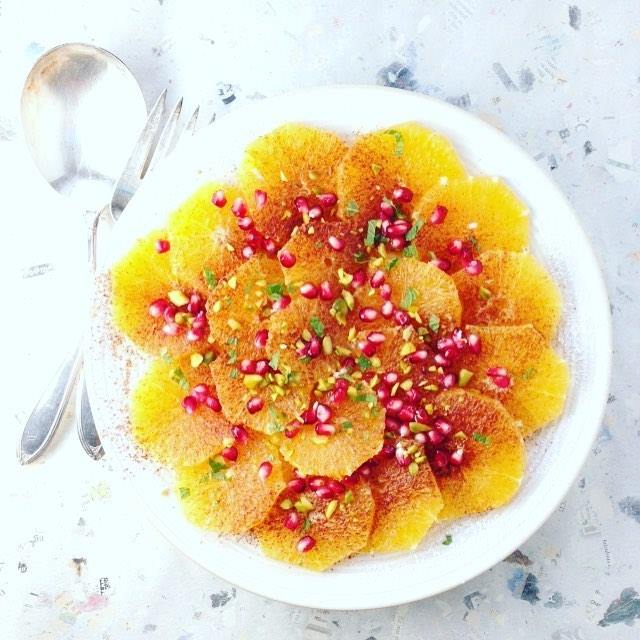
Moroccan Orange Slices in Orange Blossom Water
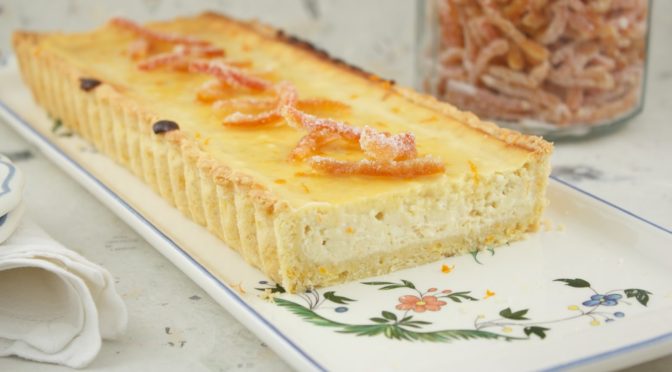
It’s hard to stop reading Orange Appeal. When I queried Schler about her favorite recipes in the book, she said, “My favorite dishes from the book? That’s tough to answer, there are so many! Maybe the Sweet and Spicy Caramelized Onion, Raisin, and Orange Compote; the Blood Orange Hummus Vinaigrette; Mediterranean Lamb Meatballs and the Curried Cod in Coconut Milk, Lime, and Orange. For sweets, the Moroccan Spiced Orange Slices in Orange Blossom Water, and the Oranges in Spiced Wine Syrup; the Orange, Ricotta, and Chèvre Tart, and the Orange-Cranberry Spiced Granola with Almonds. Is that too many?”
Food People Questionnaire (with a nod to Proust):
What is your favorite food to cook at home?
Cake! Always cake! There have even been times when my family has arrived home after a long day of work and school and my answer to their “What did you make for dinner?” is “Cake!”
What do you always have in your fridge at home?
Yogurt, milk, mustard and salad dressing, butter, olives and pickles, a jar of cherry jam. Packets of butter and a few out of date packets of phyllo.
What marked characteristic do you love in a person with whom you are sharing a meal?
There are 2 necessary characteristics I love in a person with whom I share a meal: real interest in and knowledge about food and a great sense of humor!
What marked characteristic do you find unappealing in a person with whom you are sharing a meal?
I get little pleasure out of dining with a glutton, someone who swallows down food without savoring or appreciating it.
Beer, wine, or cocktail?
Wine, of course! I have never liked beer and rarely think of a cocktail, maybe because I have lived the last 30 years in France and Italy, both wine countries!
Your favorite cookbook author?
Anna Thomas and Françoise Bernard
Your favorite kitchen tool?
A great knife and my Better Zester zester! I love a good whisk, too!
Favorite types of cuisine to cook?
French and Moroccan – and I have several recipes from these cuisines in my cookbook!
Beef, chicken, pork, or tofu?
Lamb! Always lamb!
Favorite vegetable?
Oh, hard question! Garden-fresh tomatoes in summer and zucchini all year round! Although I love Belgian endives and cauliflower, too. And eggplants. Is that too much to love?
Chef you most admire?
Antonin Carême
Food you like the most to eat?
Trick question?
Food you dislike the most?
Liver and offal. Ugh. I’m not particularly crazy about sorrel, either, much to my husband’s chagrin. And don’t ask me to eat overripe bananas or mealy apples.
What is your favorite non-food thing to do?
Read. And write.
Hôtel Diderot in Chinon, France
Who do you most admire in food?
I admire people who break barriers. There are several men on my list, from Antonin Carême, to Graham Kerr to Paul Prudhomme, but let’s concentrate (mostly) on the women. I admire the first women chefs who, against norms and misogyny, worked their way to head great kitchens in France, from women such as La Mère Brazier to Rougui Dia, Anne-Sophie Pic, and Hélène Darroze. I admire women like Anna Thomas, Rose Levy Beranbaum, Mollie Katzen, Madhur Jaffrey, Françoise Bernard, the intrepid and groundbreaking cookbook authors who inspired me, just out of college and just married, to cook and bake fearlessly and adventurously and, in extension, to begin to eat better, too.
I’ve always admired TV chefs like Graham Kerr and Julia Child, Nigella Lawson and Jamie Oliver who brought the raw passion and casual simplicity to millions and inspired us to cook and to love cooking (even if and especially when we messed up) and sharing food with others.
I admire chefs like Virginia Willis, Kathleen Flinn, Zoë François, Sandra Gutierrez, Nancie McDermott who reach out and teach others to live better and eat better by cooking real food, local food, ethnic or regional food, those loud voices who, with grace, passion, generosity, and humor, continue to instruct and share and inspire and push forward to carry on their mission.
Where is your favorite place to eat?
Living in Europe for more than 30 years, I head straight to the nearest – and best – diner whenever I visit the States. I love a great American diner! I’ve eaten in many Michelin-starred restaurants and bouchons in Lyon and have had such sublime and truly memorable meals, but my favorite place to eat is at home when my husband (or now my son) cooks.
What is your favorite restaurant?
I’ve had some amazing and incredible meals in France, Italy, and the States. It’s hard to commit to a favorite, although I could draw up a list.
Do you have any tattoos? And if so, how many are of food?
Tattoos? No, none. They are against my religion. But I’d gladly wear food-inspired jewelry!
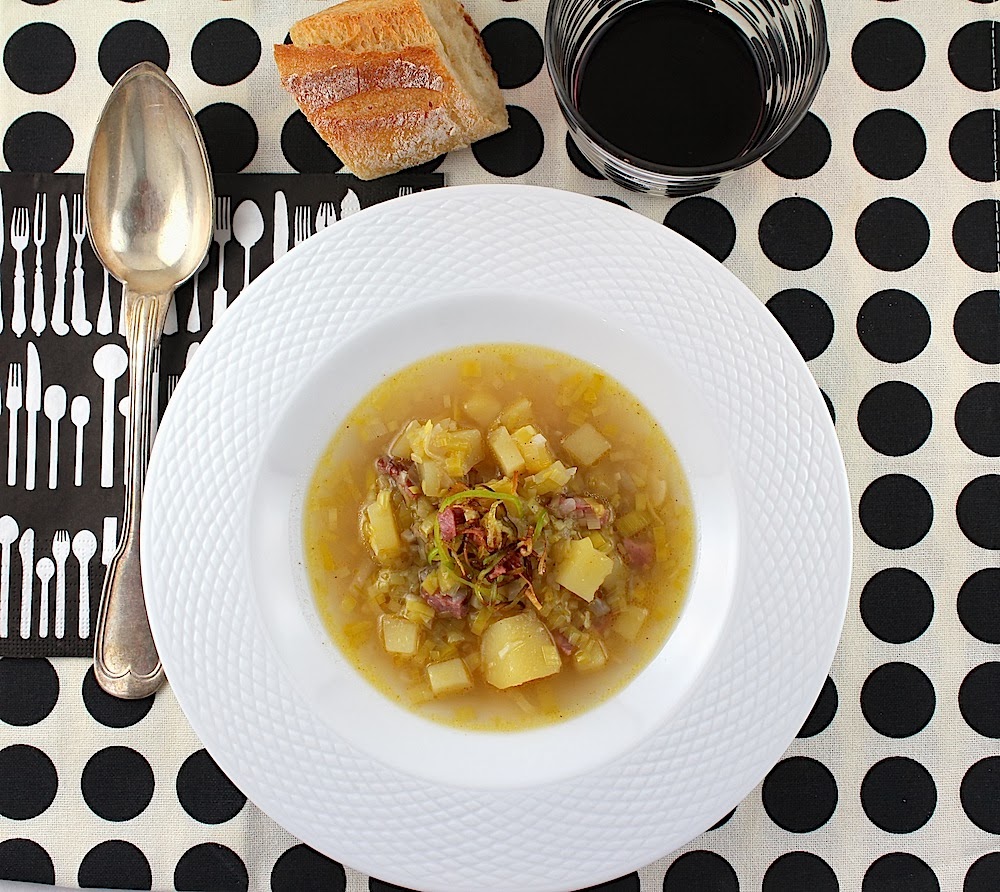
Leek and Potato Soup Recipe
My French husband is constantly busting those myths about French cuisine that I, as an American, have ingrained into my mind, that French home cooking is fussy, complicated and complex, and expensive. This Leek and Potato Soup proves the point: while utterly elegant and flavorful, it is simple and quick to make and absolutely thrifty. Leek and Potato Soup for Two is at once warming, comforting, and sophisticated.
3 medium leeks, whites only + 1 extra small leek for topping
1 small red onion
2 cloves garlic
2 medium potatoes (about 10 ounces / 300 g)
Olive oil and butter or margarine
50 g smoked lardons or bacon in small cubes
1 small cube vegetable bouillon (or 1/2 large cube) or enough homemade to cover vegetables (soup for 2 bowls)
Olive oil or equal parts olive oil & margarine
Salt and pepper
Prepare the vegetables by chopping the white parts of 3 leeks, the onion and 1 clove garlic.
Peel the potatoes and cut into small cubes. Simply crush the second clove of garlic, leaving in one piece.
Add 2 or 3 tablespoons of olive oil or half oil, half butter into a soup pot.
Heat and add the onion and garlic and cook, stirring, for a minute or two; add the chopped leeks and bacon and a couple grindings of pepper, stir and cook “until it smells good” as the French cook told me… just a couple of minutes until the onion is transparent.
Add the potatoes and just cover with water, adding the bouillon cube, or bouillon.
Bring to the boil, lower the heat and allow to simmer gently for 15 – 20 minutes just until the potatoes are tender.
Taste, add salt and pepper to taste.
Remove the soup from the heat, cover and allow to sit until dinner time (we make this about half an hour or so before dinner).
When ready to serve, heat a tablespoon of olive oil in a clean skillet or pot; add a tablespoon or two each of cubes of bacon or lardons and very thinly sliced white leek; cook, stirring, until crisp.
Reheat the soup and serve topped with the crisp lardons or crumbled bacon and leek strips.
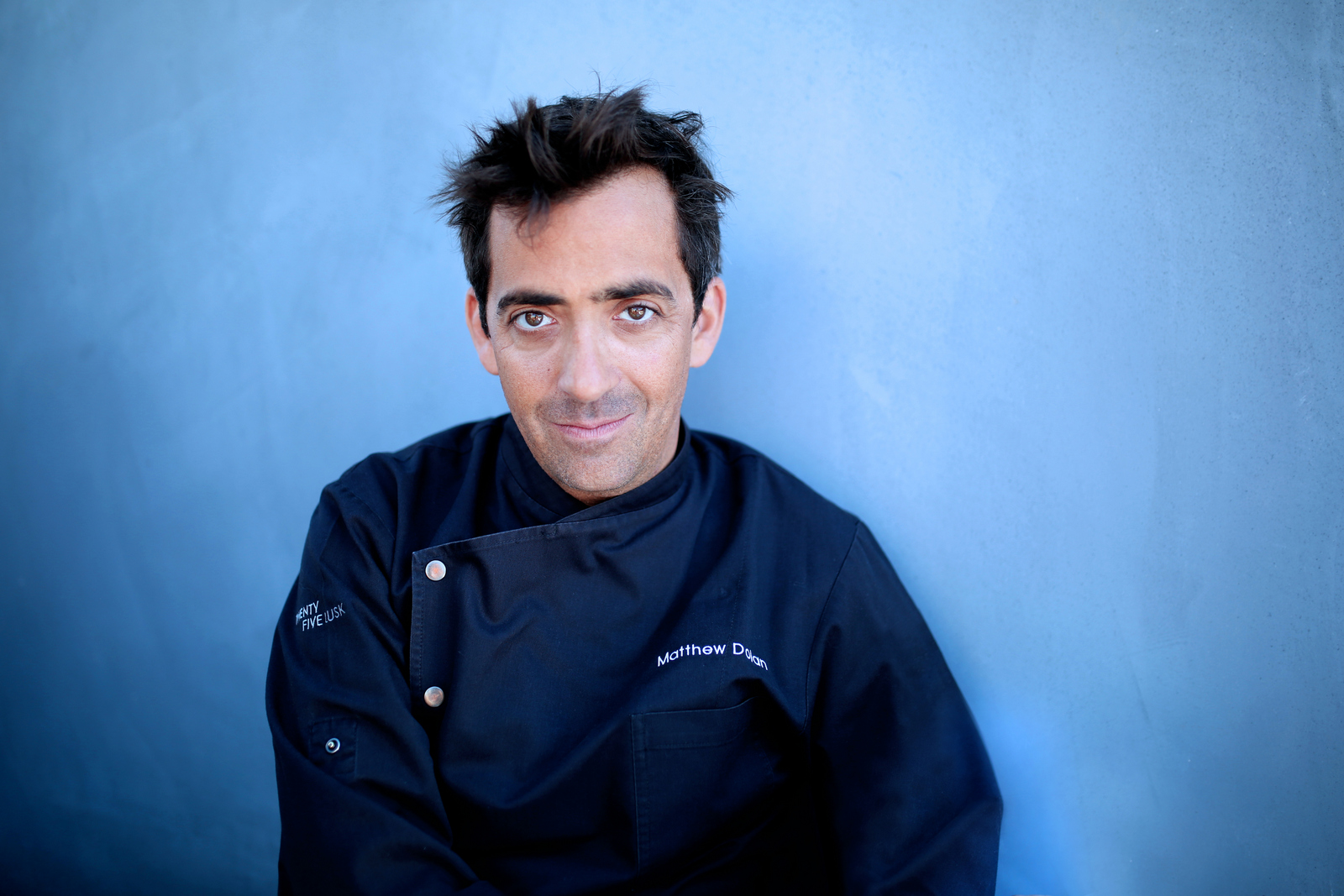
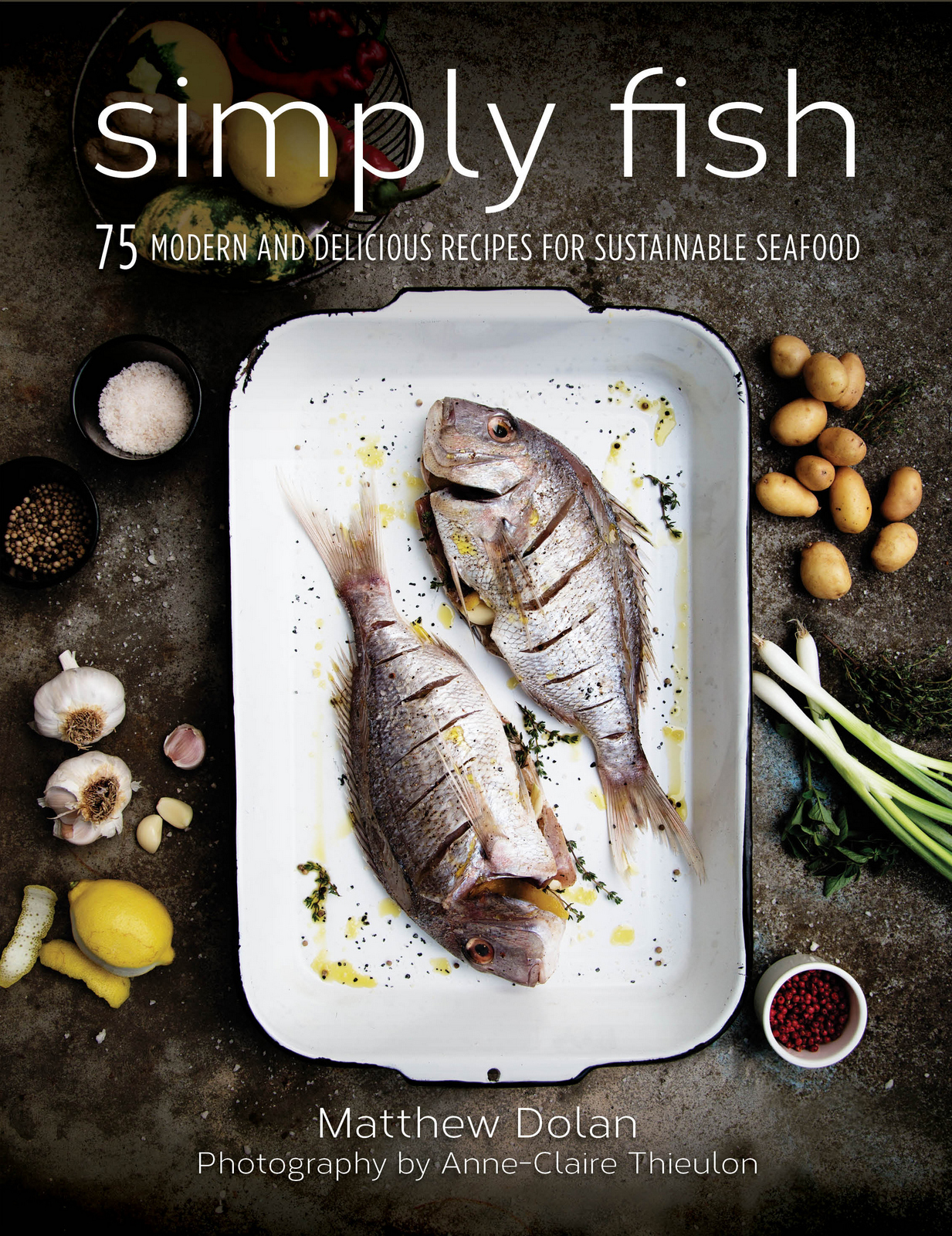
Matthew Dolan is an established chef and restaurant owner who trained at The Culinary Institute of America in New York. His restaurant, Twenty Five Lusk, was named Esquire magazine’s Best New Restaurant and Open Table Diners Choice Top Hot Spot Restaurants in the United States since its opening in 2010.
Dolan notes, “I am an American, aware of my Celtic roots, and I blame these roots for the passion that I carry forth in all things, especially my love of cooking and creating dynamic experiences through food. Cooking for others is a joy rewarded by seeing the enjoyment of others. Passion and care are the fundamentals of excellent food, and I am passionate about fish.”
Chef Dolan has a new venture out, one that is accessible to food lovers around the world. His new cookbook, Simply Fish, is a treasure.
“Simply Fish is your definitive guide to preparing seafood that is sustainable, healthy, and delicious. Matthew Dolan’s recipes are accessible and brilliant, and his stories are engaging. The bounty of the sea is here, in a book you’ll treasure.” — Drew Nieporent, restaurateur, Tribeca Grill, Nobu, Bâtard
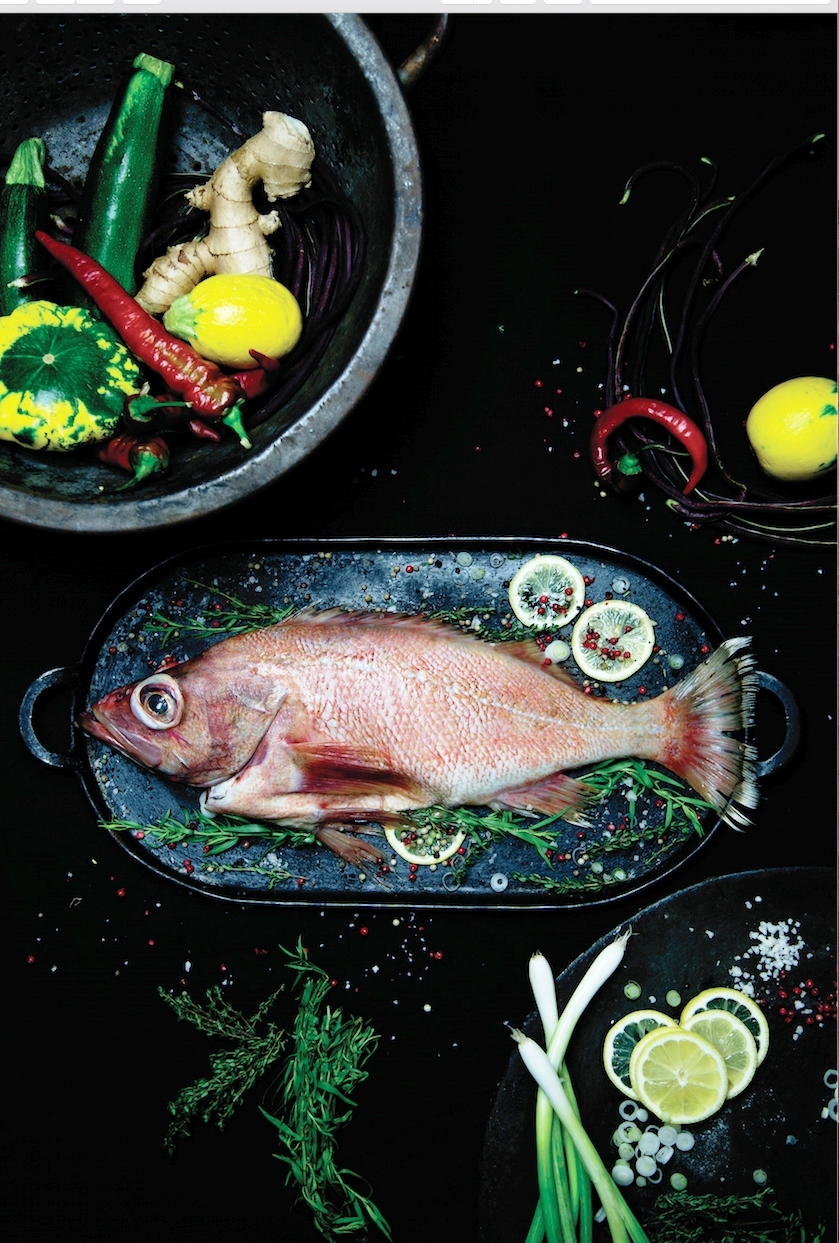
Simply Fish explores many recipes, techniques, and secrets to delivering a restaurant-quality experience in your own home, simply through cooking fish. You’ll learn about fish, sustainability, and enjoying cooking with seafood, and get inspired by the beautiful, delicious, seasonal recipes (including no-fish desserts!). I especially love the section of each recipe entitled ‘what to tell the fish guy’ – because I think many people are stumped by fish right from the point when you need to purchase it. Genius!
Chef Dolan has also included a few stories of travel, fish, and eating that showcase his humor, quick wit, and thoughtfulness. About a sauna, swimming in the frozen sea, and the meal afterward, Dolan said, “One by one, these crazy Finns leapt in and swam about as if it was noon and they were at Club Med somewhere in the Caribbean. What else was I to do except take the plunge—literally. What a contrast as I felt my heart implode and an unexpected feeling of warmth. I thought I was dying. Then this passed and it was time to get out. Thanks to a little insane moment of ice swimming, we were ravenous and alive. At the center of the table was a beautiful arctic char, roasted whole and awaiting its place in our bellies. Dill and butter-poached potatoes, smoked whitefish, pickled herring, roasted beets, butter lettuces, caviars, and mind-blowing sour breads encircled this magnificently roasted cold-water fish. There were marinated cucumbers known as grandma’s cucumbers, sausages, wine, and beer. The inherent simplicity and care with how this feast came together would later redefine my cooking.”
Chef Questionnaire (with a nod to Proust):
What is your favorite food to cook at home?
Risotto, seasonally driven, usually with mushrooms.
What do you always have in your fridge at home?
Beer and ham. Simple staples.
Caviar+Lobster
What marked characteristic do you love in a person with whom you are sharing a meal?
Excitement for the experience, the food, and the effort that surrounds it.
What marked characteristic do you find unappealing in a person with whom you are sharing a meal?
Inferior table manners. I am worried that we are losing sight of the importance of table manners. I still believe that good manners shows that we respect each other, as well as the time we have committed to one another. And speaking with food in your mouth is silly and awful…it would be nice if we stood when others join the table, but I realize this is asking too much.
Beer, wine, or cocktail?
Beer mostly, softer and gentler wines always, but I am not a tough guy who can handle heavier brown spirits, so if it’s cocktails, we are talking Dark and Stormy or a very fresh margarita – no salt nor triple sec.
Your favorite cookbook author?
Michel Roux
Your favorite kitchen tool?
Tasting spoon. The difference between good and great is determined by this tool.
Favorite types of cuisine to cook?
Tough question. I’m an Irish-American with a classical French background. I employ the French and Italian, borrow from the Chinese at times, but the favorite path is driven by sustainable seafood and making the most of ethical choices that are market driven.
Beef, chicken, pork, or tofu?
Pork.
Favorite vegetable?
Asparagus
Chef you most admire?
Pierre Gagnaire
Food you like the most to eat?
Szechuan Dumplings
Food you dislike the most?
Kidneys. Can’t do it.
What is your favorite non-food thing to do?
Sky dive – only been once, but need to go again quickly
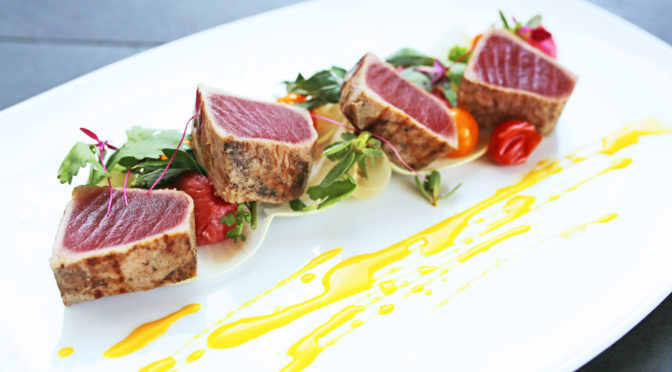
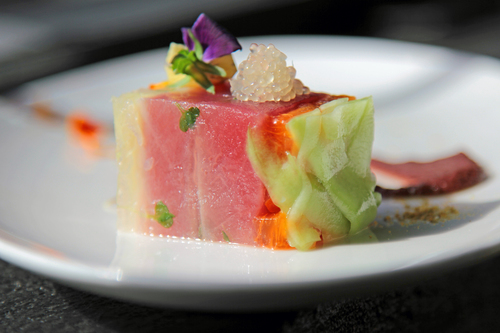
tuna cucumber persimmon terrine
Who do you most admire in food?
Anybody that agrees that food has the ability to take people away from their lives, their issues, and create a moment of joy. There are loads of us doing this, but those that care about the individual receiving the food first, I admire you. And we waste too much food in the USA. So if you are controlling your portion size and making efforts to reduce food waste, I admire you even more.
Where is your favorite place to eat?
There is a Korean inspired place here in San Francisco, Namu Gaji, and it has become a regular thing. They do a really good job.
What is your favorite restaurant?
I have to say, Farm Shop in Brentwood (LA), California is a very amazing and consistent place. That said, Liho Liho Yacht Club in San Francisco is a stunner, as well.
Do you have any tattoos? And if so, how many are of food?
I only have accidental tattoos, or scars from burns if you will, after twenty-eight years in the kitchen. I think that they are a lot cooler and less of a time commitment. Not opposed, maybe one day?
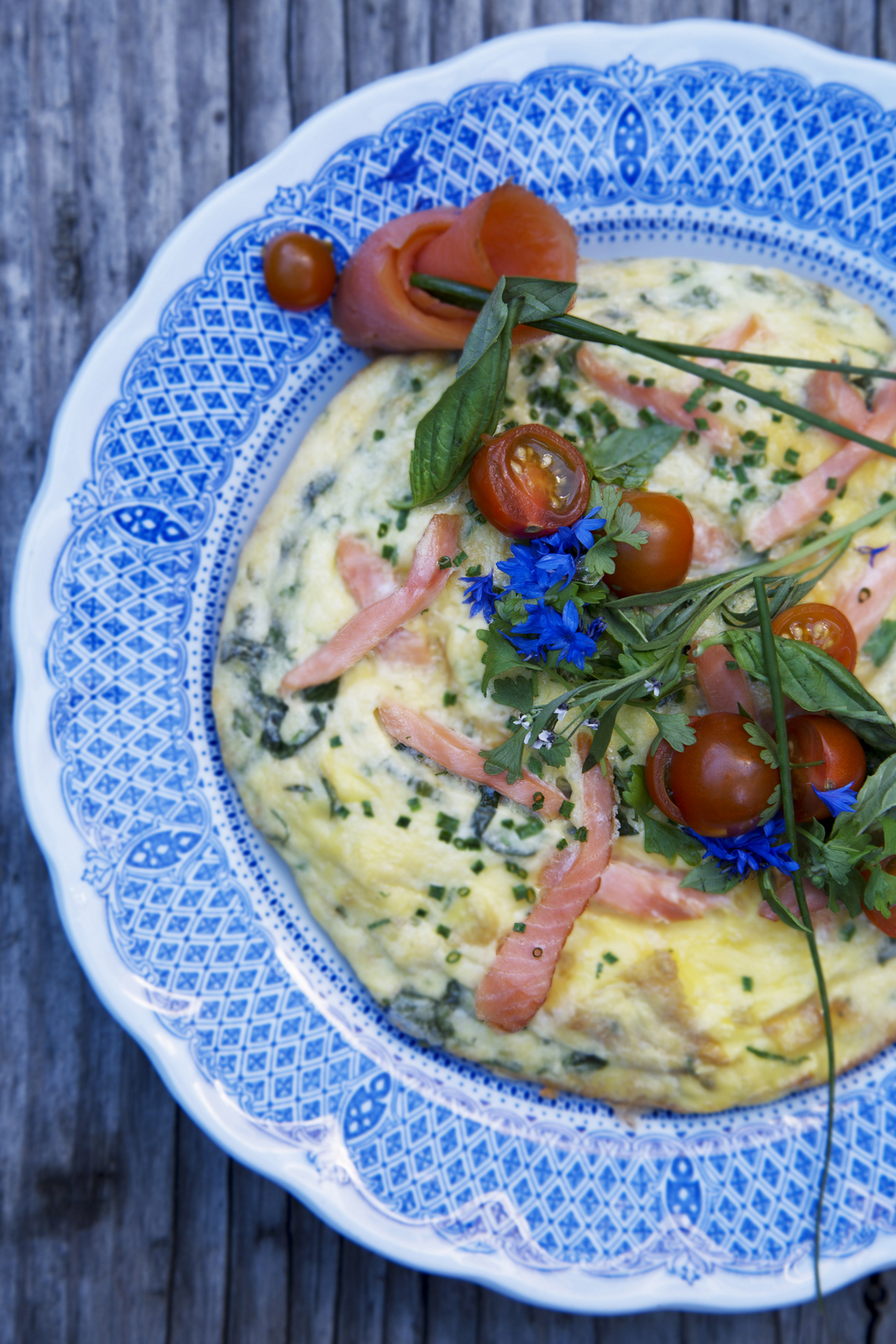
Recipe: smoked salmon and farm egg frittata with basil, lemon, chives, and tomato
serves 4
what I cook at home, actually this is also from the book
10 free-range or organic eggs (if farm-direct, the flavor’s even better)
½ cup sour cream
Juice of 1 lemon
Zest of 1 lemon
2 teaspoons salt
1 teaspoon pepper
1 cup grated sharp cheddar cheese
½ pound Pacific or sockeye smoked salmon, sliced into thin strips
1 cup basil leaves, destemmed, torn
2 Tablespoons (½ bunch) fresh chives, diced
1 cup cherry tomatoes, halved lengthwise (reserve ½ cup for garnish)
2 Tablespoons cooking oil
1 Tablespoon unsalted butter
what to drink
Blanc de blanc champagne
Txakolina Rosé from Spain
Your favorite daytime drinking beer
Bloody Mary
what to tell the fish guy
You probably don’t need the fish guy for this one. There is usually a refrigerated case close to the fish counter that will have what you are looking for. But, if the fish guy has some smoked fish options that are not pre-packaged, you can ask where the fish is from and when it was smoked. Normally, fish will be brined or cured before smoking. If you go the prepackaged route, check the sell by date; the fresher the better.
method
Preheat your oven to 400°F. In a mixing bowl, whisk together the eggs, sour cream, lemon juice, lemon zest, salt, pepper, and cheddar cheese. Using a wooden spoon or spatula, fold in the sliced smoked salmon, basil, chives, and ½ cup tomatoes. Heat a cast-iron skillet or nonstick pan over high heat and add the oil and butter. Once the butter has melted and the combination begins to slightly smoke, add the contents of the mixing bowl. Using a wooden spoon, stir everything in the pan in an effort to evenly distribute the garnish throughout the egg mixture. Cook for 3 minutes and place in the oven. Cook for 15 to 20 minutes or until the eggs are fully cooked. Remove from the oven and allow the frittata to cool for 2 to 3 minutes. Turn the frittata over onto a cutting board and serve.
plating
I usually cut this into pie-shaped slices. Add ½ cup of the sliced cherry tomatoes on the side to serve.
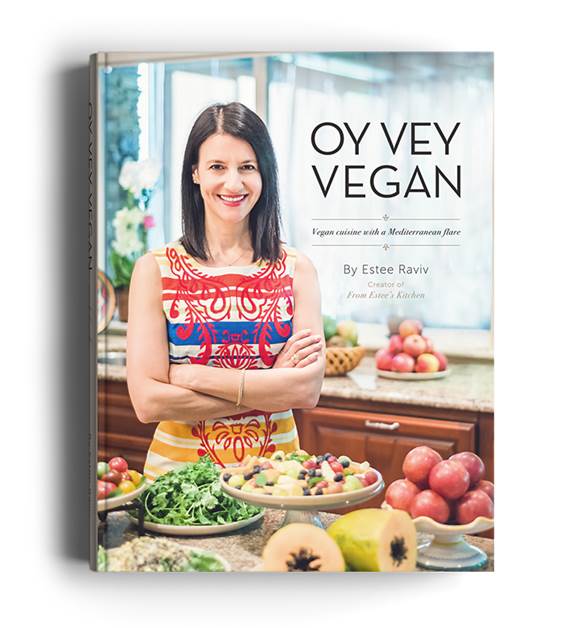
The first thing I noticed, when talking with Oy Vey Vegan Cookbook author Estee Raviv, was her passion for her work. Now in food, you will find passionate people (we all love to eat). Raviv is an artist. Cooking is an outlet for her creativity – and that anyone can relax – and cook – in the kitchen. Cooking is Art!
Raviv’s foray into Vegan cooking and eating came about because of her digestive issues. After being raised in Israel, where cheese and dairy are plentiful and delicious, she experimented with elimination diets – and found that eating vegan changed her life. That change is why she started writing her blog, as well as her new cookbook, Oy Vey Vegan. She was so happy that she felt so good, and wanted to share this with the world.
Raviv noted that, like all of us when faced with changing our way of eating, she found it difficult to change her state of mind, and said, “What am I going to do now?” How could she change her routine – and ways of thinking? Well, we can all learn from her – she created her own menu for every day, and found alternatives that are healthy and not trying to be something else. Raviv avoids processed food – she noted that “you can be vegan and eat junk, so coming to veganism as a healthy aspect of a plant-based diet is helpful. Vegan eating is very healthy for us and, of course, it can prevent all types of cancers and other chronic diseases.” Her own menus sound delicious, starting with oatmeal for breakfast (which she loves), and then whatever healthy snacks she chooses for the day – lots of fruits, vegetables, legumes, and very creative salads that contain plant-based protein. Eating vegan is a whole new world that is fascinating and creative, and she thrived in it.
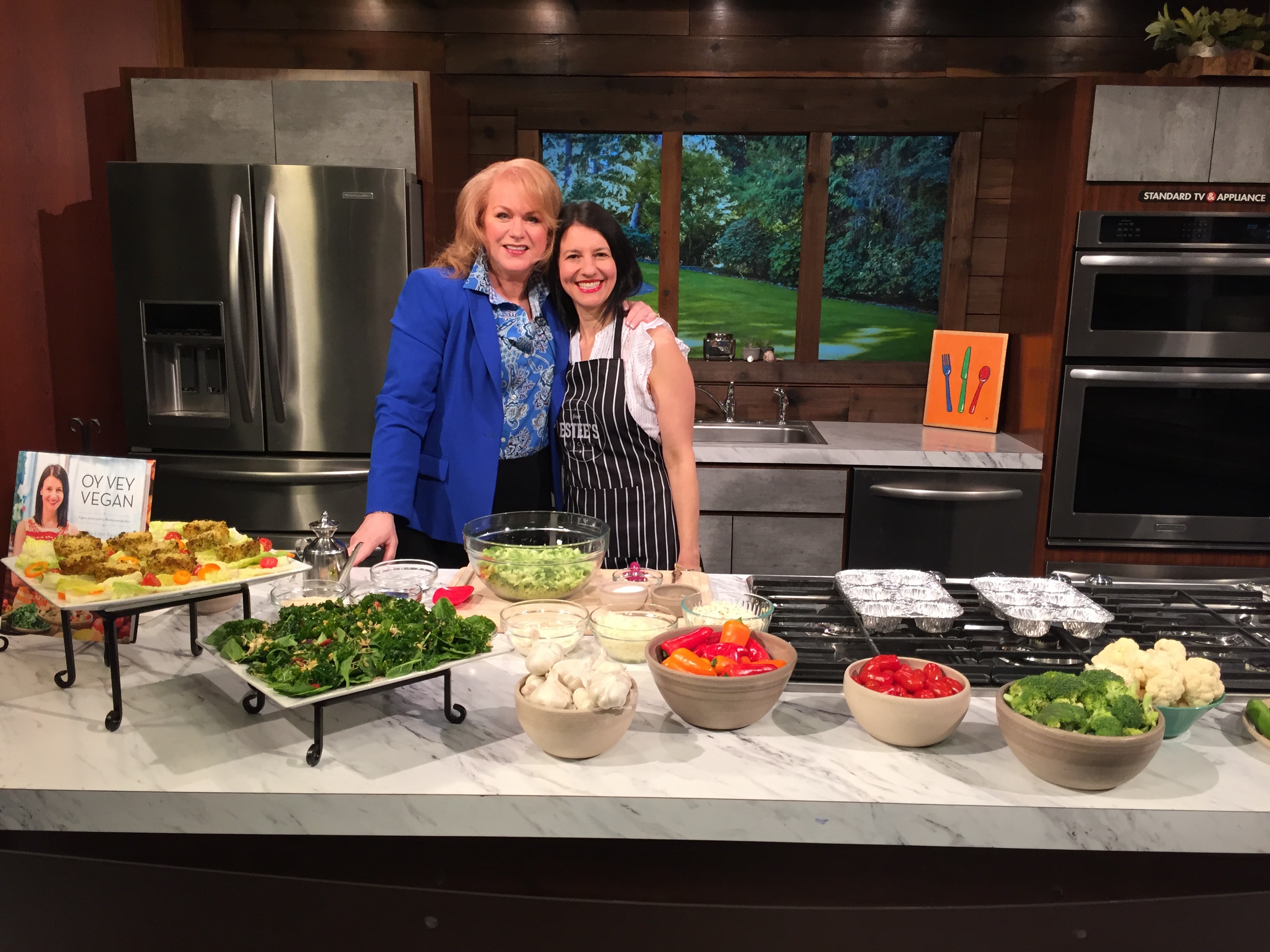
cooking segment on TV
Appearing on a regular basis with a cooking segment on tv in Oregon and Washington, and teaching cooking classes with From Estee’s Kitchen, Raviv is happy to share the things that she is cooking for her family every day.
My book in store
Her cookbook, Oy Vey Vegan, includes recipes that she uses every single day. It’s an excellent tool for people that want to eat vegan and don’t know how, as it includes simple and accessible global recipes using fresh ingredients. Most recipe ingredients are in the fridge or pantry all the time, and there are also traditional Jewish dishes with a vegan spin. Examples include vegan pate, which is a staple in every Jewish holiday meal, and matzo ball soup, which she recreated into a vegan version (without eggs) and says, “it tastes better than the traditional dish.”
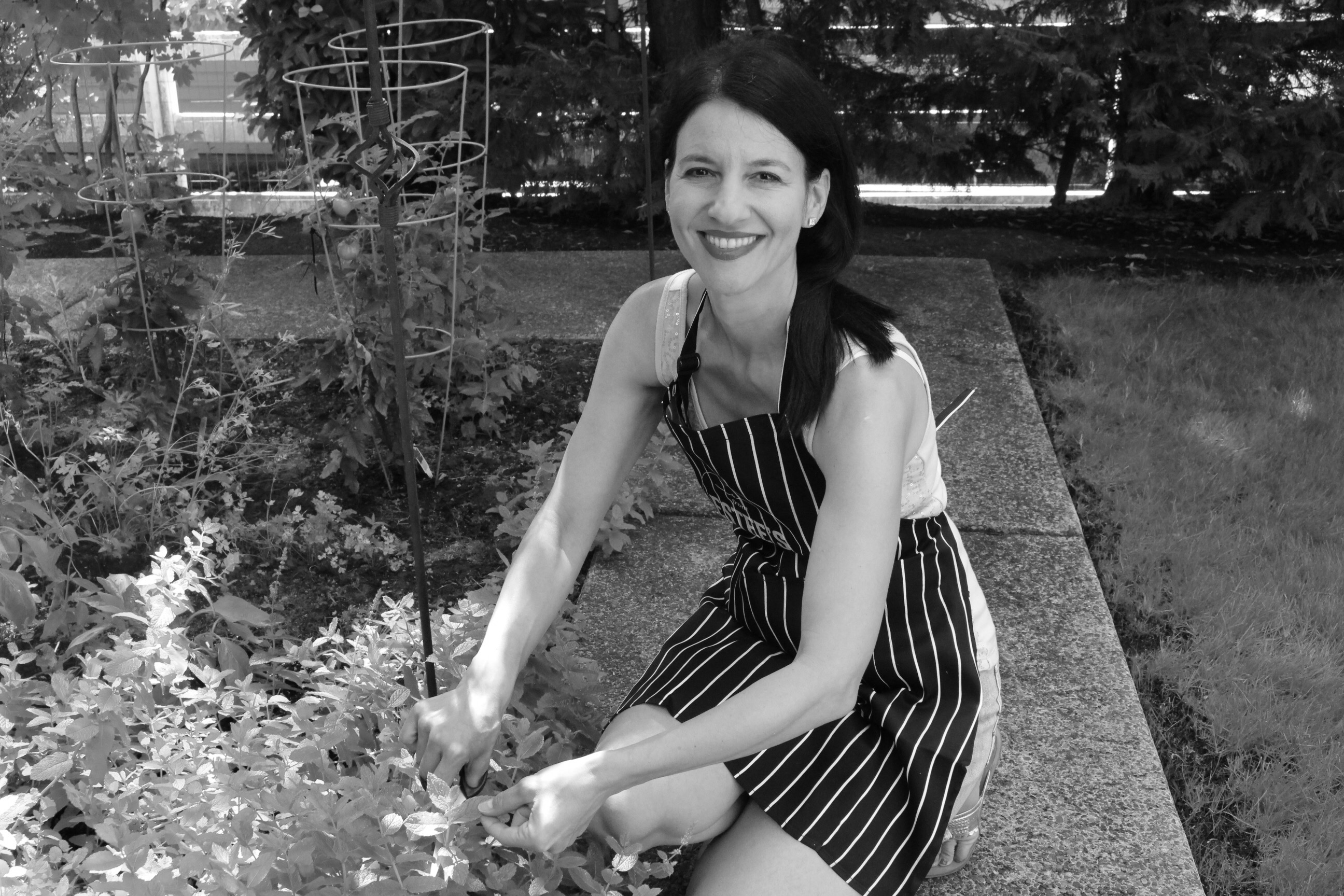
My herb garden
Raviv was most passionate about the joy of eating, remarking that “most if not all of the recipes in Oy Vey Vegan are guilt-free – you can eat and feel good about yourself, and don’t worry about quantities. If you put good things in your body, food is medicine, food is good – as long as you eat the right things, you can eat without guilt.”
As a takeaway from her cookbook, tv segments, cooking classes, and blog (i.e., her life’s work!), Raviv hopes that she can help people with health issues, by teaching about using food as preventive medicine. If you eat right, you can prevent so many diseases. Raviv said, “Act now – don’t wait to be sick, but start now – and change your opinion or stigma about veganism…there’s so much more to eat than seeds and lettuce. If you eat a balanced vegan meal that contains protein, you won’t be hungry, and will be super-satisfied. And if I can change other people’s lives, I’ll be very very happy.”
She loves to eat, is passionate about food, and can eat as much as she wants. Delicious food as preventive medicine? Sounds good to me.
Book signing event at New Seasons Market
Food People Questionnaire (with a nod to Proust):
What is your favorite food to cook?
Eggplant, salads, tempeh, quiches. I love to cook mostly everything! I love to cook, period:)
What do you always have in your fridge at home?
Fruits, vegetables, tempeh and Almond milk.
What do you cook at home?
Everything vegan, mainly recipes from my book and new recipes that I develop. Today, for example, I made a sprouted lentil salad with orange slices and sunflower seeds, homemade hummus and stuffed eggplants.
What marked characteristic do you love in a person with whom you are sharing a meal?
First, I love people that love to eat. People that appreciate good healthy food, and people that are passionate about food in general.
What marked characteristic do you find unappealing in a person with whom you are sharing a meal? People that are not open to try new food. People that think that vegan food is not satisfying food or not good food.
Tupperware, Rubbermaid, or Pyrex?
Pyrex for sure.
Beer, wine, or cocktail?
Wine
Your favorite cookbook author? Crossroads cookbook author Tal Ronnen
Cooking at my outdoor kitchen
Your favorite kitchen tool?
Food processor
Your favorite ingredient?
Love avocado, every day! Year round!
Your least favorite ingredient?
Margarine – does not exist in my kitchen
Least favorite thing to do in a kitchen?
Clean up
Favorite types of cuisine to cook?
Hard to choose because I love so many but Probably Mediterranean
Beef, chicken, pork, or tofu?
Tofu
Favorite vegetable?
Eggplant
Chef you most admire?
Giada de Laurentis
Teaching a cooking class
Food you like the most to eat?
Kale salad with crunchy tempeh on top…and avocado, of course
Food you dislike the most?
Bok choy
What is your favorite non-food thing to do?
Travel with my family / barre class / hikes with my husband /
Who do you most admire in food?
My mom – she is an amazing and creative cook
Where is your favorite place to eat?
If to be honest, at home but I do like to eat out in an Ethiopian cuisine, or at Jory restaurant at the Allison inn and spa (Oregon wine country)
How many tattoos? And if so, how many are of food?
None, not my thing
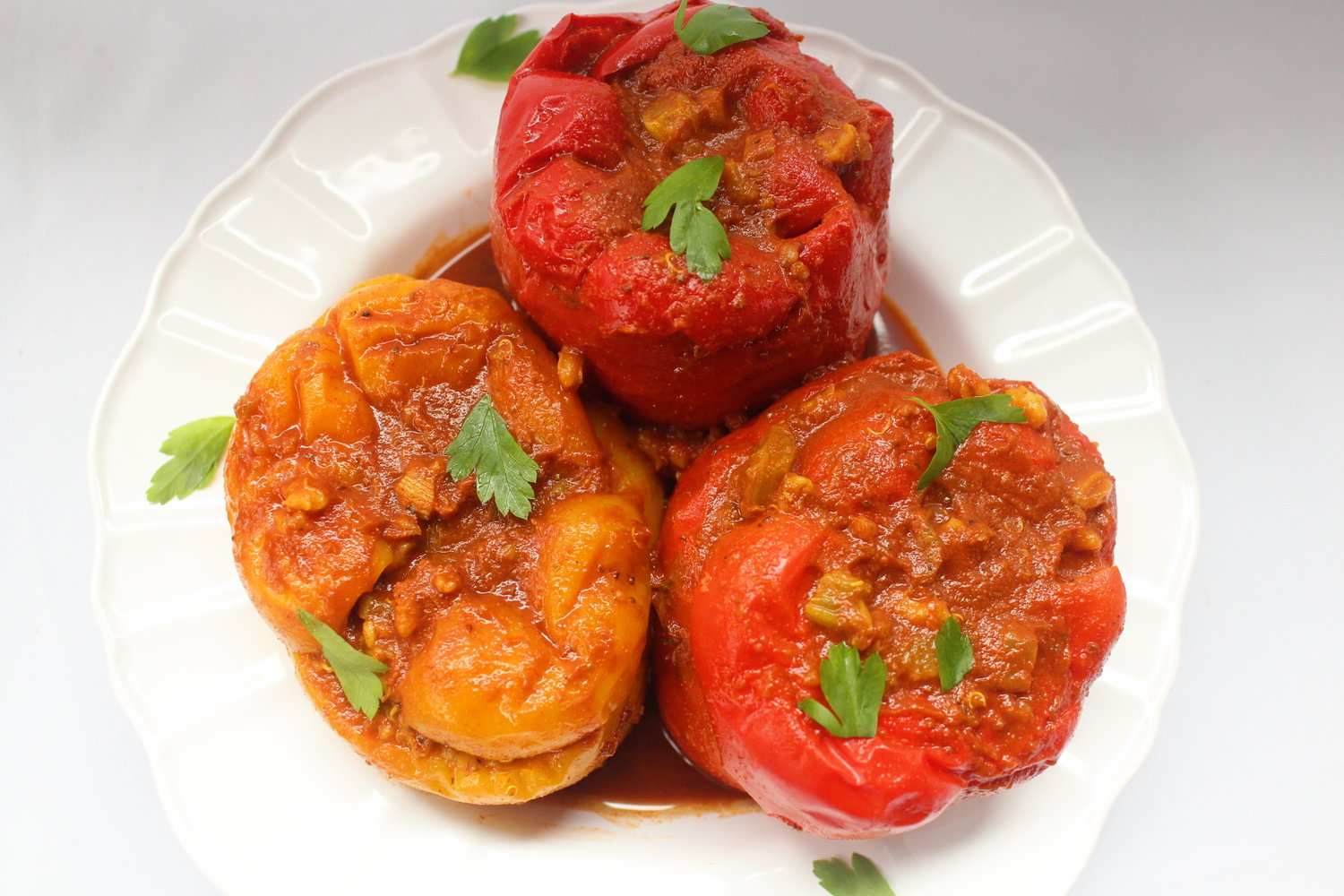
Recipe: Vegan Stuffed Peppers
Growing up, my mom used to make stuffed peppers all the time. And I loved it! Of course, she used meat and rice in her recipe. I recreated it vegan-style and it turned out so flavorful! No meat is necessary to create an amazing stuffed peppers dish.
Ingredients:
6 colorful bell peppers
Filling:
1 teaspoon olive oil
4 cup celery stalks, chopped
4 green onions – chopped
1/2 teaspoon turmeric
1/2 teaspoon sweet paprika
1/2 teaspoon onion powder
1/2 cup pearl barley or brown rice
1/4 cup quinoa
1 1/2 cups boiling water
1 tablespoon fresh cilantro or parsley, chopped
salt
pepper
Sauce:
1 1/2 cup boiling water
1 tablespoon tomato paste
1 teaspoon no chicken base
1 teaspoon sweet paprika
1 teaspoon agave
Salt
Pepper
Directions:
For the filling:
In a sauce pan on medium heat add olive oil, celery, green onions, salt and pepper. Saute for a couple of minutes.
Add the spices: turmeric, paprika and onion powder, Saute for a couple more minutes, then add the pearl barley, quinoa, boiling water. Lower the heat and let simmer until all the water have evaporated. Add parsley or cilantro, mix and Set aside.
For the sauce:
Add all the ingredients in a sauce pan and bring to a boil.
For the peppers:
Cut the top part of the peppers and keep it to cover the peppers after you fill them. (You can remove the green core.)
Scoop out the seeds.
Place the peppers in a wide pan; try to fit the peppers tightly.
Fill the peppers with the filling mixture and cover them with the top part of the pepper.
Pour the sauce over the peppers and let simmer for an hour, or until the peppers are soft.
Every 10-15 minutes, take a spoon and pour some sauce on the peppers, to keep them moist and flavorful.
Be creative and you can always use the filling in any other veggie you like. This specific filling is super light because it has a large content of the celery, and a lesser amount of carbs.
Nicole Gulotta is a writer, editor, and tea enthusiast. She’s the author of Eat This Poem: A Literary Feast of Recipes Inspired by Poetry (Roost Books, 2017), and pens a blog by the same name. I first discovered Nicole’s website years ago, when looking for travel guides that encompassed both bookstores and great food. What gems Eat This Poem’s literary city guides are – written by those in the know, so it’s a local’s guide to goodness, when you travel. Nicole’s website is fill of musings on cooking – and life, and is one that I turn to again and again.
Imagine my elation when I saw Nicole’s new book being created, published, and released (next week!). I caught up with Nicole in sunny California, while snowbound in Michigan, and asked her about writing a combination of food and poetry. She noted that while she had been writing the blog for several years, and had felt rooted in the combination of food and poetry, she was approached by an editor about starting the book – and it felt like the right project at the right time. And while the gestation process for Eat This Poem: A Literary Feast of Recipes Inspired by Poetry was long, she had been writing of these topics for years, had found her footing with it, and was excited to do something more substantial with it – for which I am grateful.
When I delved into her history, I learned that while poetry arrived early in her life, food came much later – and so it wasn’t a natural fit to pair the two. But Nicole noted that when you can step away from your life experiences and look at them, it enables those insightful moments to happen.
The Eat This Poem cookbook features more than 75 new recipes paired alongside verse from 25 of America’s most beloved poets. Forage mushrooms with Mary Oliver, then wander into your kitchen to stir creamy truffle risotto. Study the skin of a pear with Billy Collins while you bake a warm vanilla-pear crumble. And honor the devoted work of farmers with Wendell Berry while snacking on popcorn dusted with rosemary and drizzled with brown butter.
You know me – when I asked what she hoped readers take away from the book, Nicole said, “The idea of being still in a kitchen, and having food and poetry be an opportunity to do something that takes care of yourself and the people around you as well. Our lives are so rushed and busy and we have all these things to do…and I want people to feel like they can indulge in poetry and food and ENJOY that, even if only for a brief moment.”
And, when I asked about poetry, Nicole (a life-long poetry lover) remarked, “Poetry is so great because it really keeps you rooted in the moment/present, and if you read a poem it might take a short time (or longer), but it is a special, be-present time. You can do this and inspire your day!”
Indeed – food and poetry are the perfect combination for stillness, thoughtfulness, and a good life.
Food People Questionnaire (with a nod to Proust):
What is your favorite food to cook?
Something Italian, like bolognese that simmers for hours
What do you always have in your fridge at home?
Homemade almond milk, Dijon mustard, a wedge of Parmesan, and eggs from the farmers’ market
What do you cook at home?
I keep things simple, especially Monday through Friday, like quick bean tacos, lentil curry, and pasta with whatever fresh vegetables are in season.
What marked characteristic do you love in a person with whom you are sharing a meal?
A good appetite
What marked characteristic do you find unappealing in a person with whom you are sharing a meal?
Chewing with your mouth open
Tupperware, Rubbermaid, or Pyrex?
Pyrex
Beer, wine, or cocktail?
Wine
Your favorite cookbook author?
Nigel Slater’s writing is so welcoming and poetic
Your favorite kitchen tool?
My Japanese chef’s knife
Your favorite ingredient?
Garlic. It’s the beginning of everything.
Your least favorite ingredient?
Dried fennel
Least favorite thing to do in a kitchen?
Empty the dishwasher
Favorite types of cuisine to cook?
Italian, Indian, and Mexican. But these days, anything I can get on the table in under 30 minutes.
Beef, chicken, pork, or tofu?
Beef, medium rare, with a touch of flaky salt on top
Favorite vegetable?
I know they’re technically a fruit, but tomatoes have my heart every summer. I also love roasted cauliflower.
Chef you most admire?
Suzanne Goin
Food you like the most to eat?
Always pasta, preferably spaghetti with a slice of garlic bread alongside
Food you dislike the most?
A poorly dressed salad
What is your favorite non-food thing to do?
Spend time with my son
Who do you most admire in food?
Anyone who helps support local farmers, treats animals and the environment with respect, and values seasonal cooking
Where is your favorite place to eat?
My kitchen table, or Bestia, in downtown Los Angeles
How many tattoos? And if so, how many are of food?
Zero.
Recipe: Energizing Orange Smoothie
In a high speed blender, add 2 cups freshly squeezed orange juice, 1 chopped carrot, 1 banana, 1 cup frozen mango, 1 small piece of peeled ginger (1-inch), ½ teaspoon ground turmeric, and 1 cup ice.
Process until smooth, and garnish with chia seeds, if desired.
When we visited Ireland, I fell in love with the food. Not only that famous brown bread, and the smooth, creamy butter, but the seafood chowder that we ordered at almost every meal, and the hearty breakfasts, and the Guinness stew, and the seafood, and…well, you get the picture. But most of all, what I admired and happily ate was the creativity and local ingredients that went into each meal.
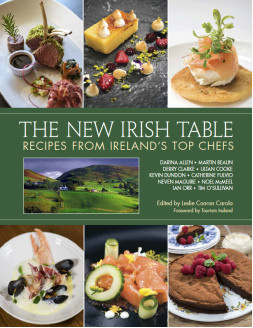
Imagine my joy at finding a cookbook, The New Irish Table: Recipes from Ireland’s Top Chefs, that celebrates new Irish food, by chefs that are leading the charge for creativity in Ireland’s artisanal food movement. They come from all four of Ireland’s provinces (including Northern Ireland), and each shares a menu of recipes.
I learned more about Ireland, and its food, than I imagined gleaning from a book – and am inspired to not only cook these delicious recipes, but to head to Ireland and visit their restaurants.
Luckily for us, I was able to chat with editor Leslie Conron Carola, who is the owner and director of Arena Books Associates, LLC, has produced many illustrated books, including Ireland: A Luminous Beauty; Spectacular Ireland, and Ireland’s Treasure’s with Peter Harbison. The New Irish Table: Recipes from Ireland’s Top Chefs is published by Charlesbridge.
Food People Questions (with a nod to Proust):
What is your favorite food to cook at home?
Hmm-that depends on the season for particulars, but it’s always fresh, fresh, fresh and as-local-as-possible. Lots of fresh vegetables and fruit and again as-local-as-possible meat and fish (with exceptions, of course. I love Chilean sea bass, and salmon, and shrimp!).
Quickly sautéed and/or roasted fish or chicken with lightly steamed or grilled fresh vegetables, and/or a lightly-dressed salad. Fresh herbs and lemon and a bit of butter doesn’t hurt!
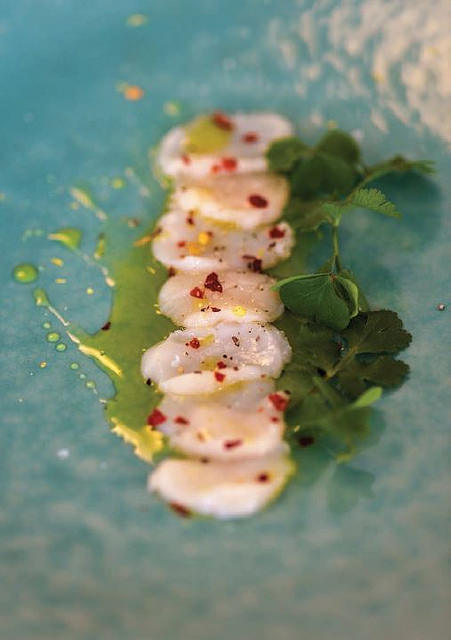
Carpaccio of Scallops with Chilli, Lemon, and Wood Sorrel Recipe by Chef Darina Allen of Ballymaloe Cookery School in Shannagary, Co. Cork.
What do you always have in your fridge at home?
Chicken broth–homemade when possible; fresh vegetables and cheese, yogurt. A piece of chocolate.
What marked characteristic do you love in a person with whom you are sharing a meal?
Conversation- sharing ideas and the pleasure of eating a well-prepared meal, a meal engaging our senses. It doesn’t have to be a complex meal.
What marked characteristic do you find unappealing in a person with whom you are sharing a meal?
No conversation and very quick eating without much enjoyment.
Beer, wine, or cocktail?
Wine
Your favorite cookbook author?
Alice Waters
Your favorite kitchen tool?
Vitamix and sharp knives
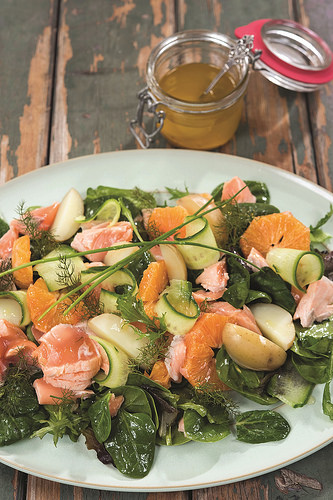
Orange, Spinach, and Salmon Salad Recipe by Chef Catherine Fulvio of Ballyknocken House and Cookery School in Glenealy, Ashford, Co. Wicklow.
Favorite types of cuisine to cook?
Natural, seasonal, fresh. And Italian and French, and, of course, what the Irish chefs are preparing!
Beef, chicken, pork, or tofu?
Chicken and pork.
Favorite vegetable?
Oof, this is difficult, I love many: spinach, broccoli, butternut squash, brussels sprouts, fresh tomatoes and salad vegetables.
Chef you most admire?
Alice Waters. And all these Irish chefs: Darina Allen, Derry Clarke, Kevin Dundon, Martin Bealin, Ian Orr, Ultan Cooke, Noel McMeel, etc.
Food you like the most to eat?
Again, that depends on the season, but hearty soups, stews, and wonderful Italian food are lovely complements to wintry days. And lighter weather suggests lightly prepared fresh vegetables and meat or fish. With fresh berries or other fruit to top it off.
Food you dislike the most?
Heavy meat organs.
What is your favorite non-food thing to do?
Concerts, operas, museums and galleries, and reading
Potato, Prawn, and Lime Soup Recipe by Chef Kevin Dundon of Dunbrody House in Arthurstown, Co. Wexford.
Who do you most admire in food?
In the U.S.: Alice Waters and the late MFK Fisher. In Ireland: Darina Allen, Derry Clarke, Kevin Dundon, Ian Orr, and all the Irish chefs in The New Irish Table.
Where is your favorite place to eat?
A comfortable home dining room or terrace, or a quiet restaurant.
What is your favorite restaurant?
U.S.: Chez Panisse in Berkeley, CA; Gramercy Tavern, Le Bernardin, Balthazar (for needed steak frites), and Eataly is a lot of fun in NYC. Lots of choices.
Do you have any tattoos? And if so, how many are of food?
Not a one!
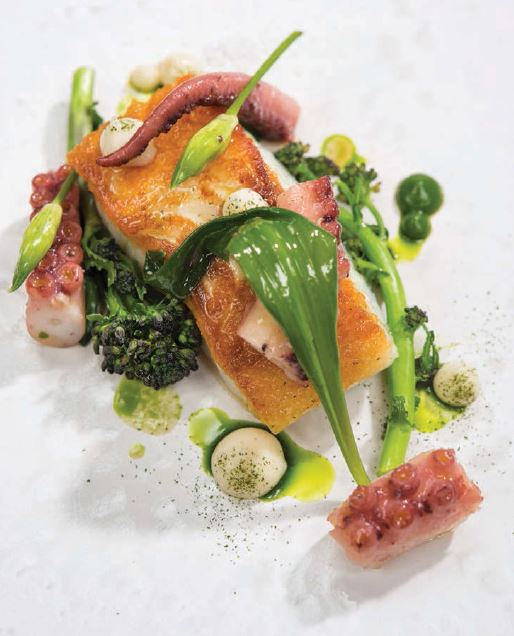
Recipe: Cod, Octopus, Purple Broccoli, Broccoli Puree, and Horseradish Mayonnaise
Recipe by Chef Derry Clarke of l’Ecrivain, Co. Dublin
FOR THE OCTOPUS
2 qts/2 L court bouillon
1 octopus (2 lb/1 kg)
FOR THE BROCCOLI PUREE
2 medium size heads of broccoli, shaved and cleaned
FOR THE HORSERADISH MAYONNAISE
1 egg yolk
1 tsp mustard
1 lemon
2/3 cup/150 ml vegetable oil plus more to sauté the cod
2 tbsp/40 g horseradish, grated
FOR THE COD
4 cod fillets
FOR THE PURPLE BROCCOLI
¼ lb/100 g purple sprouting broccoli
In a deep pot, add the court bouillon and the octopus and simmer for 1 ½ hours until tender. Remove and chill. Portion octopus into 1 ½ in /4 cm pieces.
Place the egg yolk into a small bowl and add the mustard and a squeeze of lemon juice. Slowly whisk in the vegetable oil until thick. Season with salt and pepper to taste, and add the grated horseradish.
Bring a pot of water to boil and add a little salt. Cut and blanch the 2 heads of broccoli in the salted water for 2 minutes. Remove and squeeze out the excess water with a kitchen cloth or towel. Discard the water. Place the broccoli in a food processor and blend until smooth. Season and chill to keep a bright green color.
Season the fish fillets with salt and pepper.
Heat a pan with a little oil on a high heat, and place the cod skin side down and turn heat to low. Cook for about 4 minutes until the skin is crispy and golden. Turn the fish over, add butter and lemon juice, and cook for 1 minute.
Bring a pot of water to boil and cook the purple broccoli for 1 ½ minutes until tender. Season.
Heat broccoli puree in a pot until warm.
Heat a little butter in a pan and toss the octopus pieces in the butter until warm. Season with salt and pepper, and add a teaspoon of chopped parsley or dill.
To serve, place a few spoons of broccoli puree and some purple broccoli on a plate and arrange a cod fillet on top. Garnish with the octopus and horseradish mayonnaise.
Serves 4 – The End. Go Eat. –
Manage Consent
To provide the best experiences, we use technologies like cookies to store and/or access device information. Consenting to these technologies will allow us to process data such as browsing behavior or unique IDs on this site. Not consenting or withdrawing consent, may adversely affect certain features and functions.
Functional
Always active
The technical storage or access is strictly necessary for the legitimate purpose of enabling the use of a specific service explicitly requested by the subscriber or user, or for the sole purpose of carrying out the transmission of a communication over an electronic communications network.
Preferences
The technical storage or access is necessary for the legitimate purpose of storing preferences that are not requested by the subscriber or user.
Statistics
The technical storage or access that is used exclusively for statistical purposes.The technical storage or access that is used exclusively for anonymous statistical purposes. Without a subpoena, voluntary compliance on the part of your Internet Service Provider, or additional records from a third party, information stored or retrieved for this purpose alone cannot usually be used to identify you.
Marketing
The technical storage or access is required to create user profiles to send advertising, or to track the user on a website or across several websites for similar marketing purposes.